
What Is a CR Mill in CNC Machining?
A CR mill in CNC machining is usually a creep feed milling machine. It cuts deep in one slow pass instead of many shallow ones. This page explains the mechanism, the cutting window, and the part shapes where it pays off.
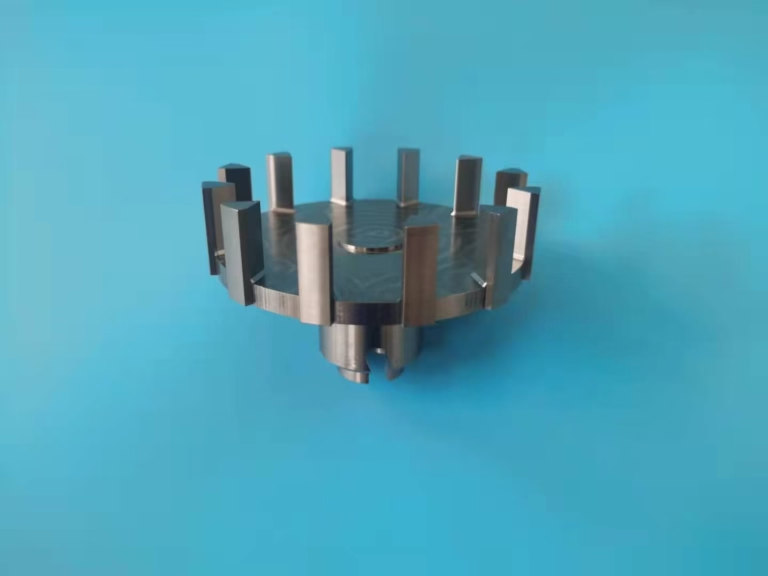
What a CR mill in CNC machining actually is
The short answer: a CR mill in CNC machining is a creep feed milling machine. The name comes from the feed rate, not the tool. The table creeps forward at 1–100 mm/min while the cutter takes a depth of cut up to 20 mm or more in a single pass. Conventional milling does the opposite: fast feed, shallow cuts, many passes.
That single deep pass changes the whole force picture. In conventional milling, the cutter enters and exits the material thousands of times per minute, and each impact loads the edge. In creep feed milling, the tool stays buried in the cut. Contact is continuous, so the load is steady rather than cyclic. The surface that comes off is smoother because the edge is not hammering the workpiece.
The trade is speed for stability. Feed rates are low, sometimes under 10 mm/min on hard alloys, so cycle time per part looks bad on paper. But the part often comes off the machine closer to final size. That removes a roughing operation and sometimes a stress-relief step. The machine hour rate is higher; the total process chain can be shorter.
One naming warning. Some shops use CR mill to mean a corner rounding end mill, a tool with a radius ground on the corner. That is a cutting tool, not a machine. This page covers the creep feed process, because that is what changes how a precision part is planned.
- 1Slow feed, deep cut1–100 mm/min table feed with axial depth up to 20 mm+ in one pass.
- 2Continuous engagementThe edge stays in the material, so impact loading drops.
- 3Tool, not machineCorner rounding end mills are also called CR mills. Context decides.
How the creep feed cut works
Three things have to line up: a stiff machine, a rigid toolholder, and a wheel or cutter that can clear the chips it makes. Creep feed milling is normally done on a machine with high static stiffness and a spindle that holds torque at low speed. On a light benchtop mill, the same parameters will chatter or stall.
The cutter is usually a form wheel or a multi-flute end mill with a large corner radius. Because the whole axial depth is engaged, the chip has to escape along the flute without packing. Chip evacuation is the usual limit on how deep a single pass can go. Coolant delivery matters more here than in conventional milling, and high-pressure through-spindle coolant is common.
Heat goes into the chip, not the part, when the parameters are right. That is why creep feed surfaces often measure Ra 0.8–1.6 μm straight off the machine, with finer finishes reachable in a finishing pass. If heat starts soaking into the workpiece instead, the symptom is a blue or straw-colored surface and a part that moves after unclamping.
Dressing and tool wear are part of the cycle. A form wheel loses its profile as it wears, so the shop has to dress it on a schedule and check the first part against the drawing. For end mill work, flank wear on the corner radius shows up as a size drift on the wall. Measure the first article, then decide the re-tool interval.
- 1Machine firstHigh static stiffness and low-speed torque are non-negotiable.
- 2Chip clearanceDeep axial engagement means chips must exit fast or the cut fails.
- 3Heat pathChips carry the heat. A blue surface means the part absorbed it.
When creep feed milling is the wrong choice
Creep feed milling is not a general-purpose replacement for conventional milling. On a 6061 aluminium bracket with thin walls, the low feed rate just adds cycle time. Aluminium cuts fast and cool with standard high-speed toolpaths, so there is little to gain.
It also struggles with parts that need very little stock removed. If the total depth of cut is 1.5 mm, a single 1.5 mm creep feed pass has no advantage over two conventional 0.8 mm passes. The process pays back when the depth is large, when the material is hard, or when the geometry is a deep slot or a thin rib that would deflect under side load.
Fixturing has to be considered early. A deep single pass pushes the part hard in one direction. A weak vise or a marginal clamp will let the part move, and the size will be wrong even if the machine is rigid. Shops often build a dedicated fixture or use a vacuum plate for thin parts.
Finally, not every shop runs the process. It needs the right spindle, the right coolant system, and operators who know how to read a creep feed cut. Sending a creep feed job to a shop without that setup usually ends in chatter marks and a scrapped first article.
- 1Thin aluminium wallsConventional high-speed paths are faster and just as accurate.
- 2Shallow stock removalUnder about 2 mm total depth, there is no clear gain.
- 3Weak workholdingOne deep pass pushes the part in a single direction.
Part shapes that suit a CR mill in CNC machining
Deep slots are the classic case. A slot 15 mm wide and 25 mm deep in 17-4PH is slow to rough with conventional step-downs, and the tool deflects at the bottom. A creep feed pass takes the depth in one go and holds the wall straight.
Thin ribs and fins are the second case. Because the axial load is aligned with the tool axis, side deflection on the rib is lower than with a long, small-diameter end mill engaging the side. Aerospace and heat-exchanger work use this a lot.
Hard and work-hardening alloys are the third. Titanium TC4 (Ti-6Al-4V), Inconel, and 440C stainless all punish a cutter that impacts the surface repeatedly. Continuous engagement keeps the edge in cut and reduces the work-hardened layer that makes the next pass harder than the last.
Form features are the fourth. A profiled wheel can cut a radius, a dovetail, or a fir-tree root in one pass rather than tracing it with a ball nose. That is where creep feed grinding and creep feed milling overlap, and where the process saves the most time on a production run.
- 1Deep slotsOne deep pass keeps the wall straight and the floor flat.
- 2Thin ribsAxial load beats side load when the feature is flexible.
- 3Hard alloysContinuous contact limits the work-hardened layer.
Process planning and tolerance control
The first planning question is how much stock to leave for finishing. On a creep feed pass, leave 0.2–0.5 mm on the walls and floor, then finish with a conventional or high-speed path. That gives the finishing tool a clean, uniform cut and holds the ±0.005 mm tolerance on critical features.
The second question is clamping sequence. Because the part is pushed in one direction, plan the fixture so the reaction is taken by a hard stop, not by friction alone. For thin plates, a vacuum chuck or a low-melt fixture spreads the load and avoids distortion.
The third question is inspection. Creep feed parts can move after unclamping if residual stress was high in the blank. Check the first article after a cool-down, not straight off the machine. On tight features, that means a CMM report on the drawing datums.
At GreatLight, creep feed-style deep cuts run on 3-axis and 4-axis mills and on the 16 simultaneous 5-axis centers, with 127 high-precision CNC machines across three wholly-owned plants. Maximum processing size is 4,000 mm, and the large travel is 4,000 × 400 × 150 mm. We run first-article inspection and 100% inspection before shipment.
- 1Leave stock0.2–0.5 mm on walls and floor for the finishing pass.
- 2Hard stopsTake the cut reaction on a stop, not on friction.
- 3Check after coolingMeasure the first article once the part has settled.
Creep feed milling vs conventional milling
Compare the cutting window before you commit a process.
| Factor | Creep feed (CR mill) | Conventional milling |
|---|---|---|
| Table feed | 1–100 mm/min | 500–5,000 mm/min |
| Axial depth per pass | Up to 20 mm+ | 0.2–2 mm typical |
| Radial engagement | Low, often full width | High, side cutting |
| Edge contact | Continuous | Repeated impact |
| Surface off the machine | Ra 0.8–1.6 μm | Ra 1.6–3.2 μm |
| Best material fit | Titanium, Inconel, hard steel | Aluminium, mild steel, plastics |
| Main limit | Chip evacuation, fixture stiffness | Tool deflection, cycle count |
The rule we use on the shop floor
If the slot is deep, the rib is thin, or the alloy is hard, plan the roughing as a creep feed pass and finish with a light cut. If the part is aluminium with shallow pockets, stay with conventional high-speed milling. There is no prize for using the harder process where it does not pay.
Questions engineers ask about CR mills
Can a CR mill cut both metal and plastic?
Yes, but the case for creep feed is weak on most plastics. ABS, POM, and PEEK cut fast with conventional toolpaths and do not work-harden. The process earns its place on titanium, Inconel, hardened steel, and some stainless grades where impact loading shortens tool life.
If a plastic part has a very deep, narrow slot, a slow deep pass can still help with chip clearance. It is a geometry decision, not a material rule.
What tolerance can creep feed milling hold?
On a rigid machine with a good fixture, creep feed roughing sets up a finishing pass that holds ±0.005 mm on critical features. The roughing pass itself is not the tolerance step; it is the preparation for it.
Parts with high residual stress can move after unclamping. Measure after the part has cooled and settled, not straight off the table.
Does creep feed milling make lead times longer?
Per part, the cut is slower. Across the whole process, it can be faster because it removes a roughing operation, reduces tool changes, and cuts hand finishing on deep features. On a 10,000-part run, that usually wins.
On a one-off prototype with shallow features, it usually loses. We quote the process that fits the geometry, not the one with the better name.
Do you review the design before cutting?
Yes. Quotation and a free DFM analysis come back within 12 hours. We flag features that would be cheaper to mill conventionally, corner radii that are too small for the tool, and walls that will deflect under a deep pass.
Production can start within 24 hours once the design and fixture plan are agreed.
What quality checks apply to these parts?
Raw material check, in-process monitoring, and final inspection. We inspect 100% of parts before shipment and can supply reports on request.
The plants hold ISO 9001:2015, IATF 16949:2016, ISO 13485:2016, and ISO 27001:2022. Uploads are kept confidential, and an NDA is available on request.
Can you run large production volumes?
There is no minimum order quantity. We run from one prototype to 10,000+ part runs across 127 high-precision CNC machines, including 16 simultaneous 5-axis centers.
Parts typically ship in 3–5 days after production starts, and the historical late-delivery probability is below 2%.
Send us the deep slots and the hard alloys
Upload a STEP file and we will tell you whether a creep feed pass saves time on your part, or whether conventional milling is the better call.
12-hour quoteFree DFM analysis100% inspectionNo minimum order
More machining notes
We publish setup notes, tooling trials and inspection data from the factory floor.











