
What Is CNC Machine Mean?
A CNC machine reads a program and moves a cutting tool along a path you defined in CAD. This page explains the mechanism, the tolerance limits, and when CNC is the right call for a part. Written for design engineers and buyers who need a straight answer.
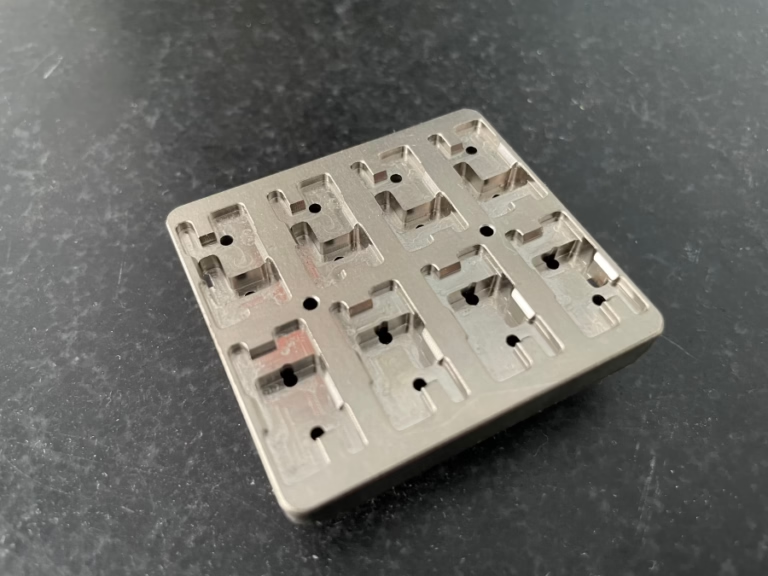
What is CNC machine mean in plain terms
CNC stands for Computer Numerical Control. A CNC machine is a cutting tool guided by a computer instead of a handwheel. The operator loads a program, the controller reads it line by line, and motors drive the spindle and axes to follow that path. That is the whole idea.
Before CNC, a machinist turned dials and watched a DRO. Skill lived in the operator's hands. Now most of that skill lives in the program and the setup. The operator still matters, but the repeatable geometry comes from code.
The computer does not think about the part. It executes coordinates, feed rates, and spindle speeds. If the program says X 120.000 Y -45.500, the axis goes there. When the same program runs 500 times, the tool path is identical every cycle.
That repeatability is the real product. A manual lathe can hit ±0.025 mm on a good day with a skilled hand. A CNC machine holds ±0.005 mm across a full run, shift after shift, without the operator chasing the dimension.
- 1CNC = Computer Numerical ControlA machine tool driven by a stored program, not by handwheels.
- 2G-code is the instruction setCoordinates, feed rates, tool changes, and spindle commands in text form.
- 3Repeatability is the pointIdentical tool paths every cycle, which is what makes volume work possible.
How the control loop actually works
The controller sends pulses to servo or stepper motors. Each pulse moves a ballscrew a known distance. An encoder on the motor reports back, and the controller corrects any gap between commanded and actual position. This closed loop runs thousands of times per second.
A typical 3-axis vertical mill has X, Y, and Z travels. A 4-axis machine adds a rotary table, often Ø400 mm, so the part can index without a re-fixture. A 5-axis machine tilts the spindle or the table on two rotary axes at once, which lets the tool reach undercuts in one setup.
Spindle speed and feed rate are chosen together. Aluminum 6061 cuts clean at 3,000-8,000 rpm with carbide. Stainless 316 work-hardens if you dwell, so you keep the feed up and the tool engaged. Titanium Ti-6Al-4V runs slower and hotter, and the coolant has to reach the cut.
The physics is simple. A sharp edge shears metal. Heat leaves with the chip. If the chip is too thin, the edge rubs instead of cuts, and the tool wears fast. That single rule explains most surface finish problems on a CNC.
- 1Closed-loop positioningEncoder feedback corrects the axis hundreds of times per second.
- 2Rotary axes change the setup count4-axis indexes the part; 5-axis reaches undercuts in one fixturing.
- 3Chip load drives tool lifeToo light a chip rubs the edge and shortens tool life.
Where CNC stops being the right answer
CNC is subtractive. The tool removes material, so internal channels with no opening cannot be cut. A closed cavity inside a block is impossible on a mill. You either split the part, change the design, or pick another process.
Very deep pockets are another boundary. A pocket 10× deeper than the tool diameter needs a long, thin cutter that deflects. You lose tolerance and finish. On our 3-axis machines the travel is 750 × 1,150 × 550 mm, so a 400 mm deep bore in a 4,000 mm part is a different job than a pocket in a 100 mm bracket.
Hard materials above 45 HRC cut slowly. Tool steel at 60 HRC is usually ground, not milled, after heat treat. We machine 4140 and 4340 in the annealed state and leave grinding stock for the hard finish.
Volume matters too. If you need 50,000 identical plastic parts, injection molding beats CNC on unit cost. CNC wins from one prototype to 10,000+ part runs, where the geometry is complex and the quantity does not justify a tool.
- 1No closed internal cavitiesA mill needs tool access; split the part or change the process.
- 2Deep pockets lose accuracyAspect ratio above 10:1 means tool deflection and poor finish.
- 3Hardened steel is ground, not milledLeave grinding stock and finish after heat treat.
- 4High volume favors moldingCNC is strongest from one prototype to 10,000+ part runs.
From CAD file to finished part
It starts with a 3D model in STEP or IGES. The CAM programmer picks tools, sets stock, and generates tool paths. The post-processor turns those paths into G-code for the specific machine controller. A wrong post means the machine moves somewhere you did not intend.
Setup comes next. The operator clamps the stock, probes the datum, and loads the tools. A tool offset error of 0.05 mm shows up directly on the part. This is why first-article inspection matters more than any spec sheet.
Cutting runs in passes. Roughing removes bulk with a large cutter. Finishing takes the last 0.2-0.5 mm with a smaller tool to hit the tolerance and finish. On our machines that means ±0.005 mm and Ra 0.8-1.6 μm as a standard finish, down to Ra 0.2-0.8 μm when the drawing calls for it.
Then inspection. We check raw material, monitor in process, and inspect 100% before shipment. Reports go out on request. If a dimension is out, the part does not ship.
- 1STEP or IGES in, G-code outThe post-processor must match the machine controller.
- 2Setup error shows on the partA 0.05 mm tool offset error is a 0.05 mm part error.
- 3Rough, then finishLeave 0.2-0.5 mm for the finishing pass.
What CNC can and cannot cut well
Aluminum is the easy one. 6061, 7075, and 2024 cut fast and hold tight tolerance. 7075 is stronger but less weldable. 6061-T6 is the default for brackets and housings.
Stainless 303 machines freely; 304 and 316 work-harden and need steady feed. 17-4PH (SUS630) is common in medical and aerospace parts and can be heat treated after machining to reach high strength.
Steel grades 1018 and 1045 are straightforward. 4130, 4140, and 4340 are alloy steels for higher load, often heat treated after machining. Titanium Ti-6Al-4V and Inconel are machinable but slow, and the tool cost is real.
Plastics like POM, PEEK, and PC cut cleanly but move with temperature. A tight-tolerance plastic part needs a temperature-controlled shop and a finishing pass that accounts for thermal growth. Carbon fiber needs diamond tooling and dust control.
- 1Aluminum: fast and accurate6061-T6, 7075, 2024 are the workhorses.
- 2Stainless: keep the feed up303 is free-cutting; 304 and 316 work-harden if you dwell.
- 3Titanium and Inconel: slow and costlyMachinable, but heat and tool wear drive cycle time.
- 4Plastics: watch thermal growthPOM, PEEK, and PC need stable temperature for tight tolerance.
CNC vs manual vs molding: which fits your part
Pick the process by geometry, quantity, and tolerance, not by habit.
| Factor | CNC Machining | Manual Machining | Injection Molding |
|---|---|---|---|
| Best quantity | 1 to 10,000+ parts | 1 to 50 parts | 50,000+ parts |
| Typical tolerance | ±0.005 mm | ±0.025 mm | ±0.05 mm or looser |
| Complex 3D geometry | Yes, 5-axis in one setup | Limited by hand control | Needs a mold and draft |
| Setup cost | Low, program and fixture | Low, mostly labor | High, tooling cost |
| Unit cost at volume | Stays flat | Rises with labor | Drops sharply |
| Change a feature | Edit the program | Re-machine by hand | Cut a new mold |
| Surface finish | Ra 0.8-1.6 μm standard | Ra 1.6-3.2 μm typical | Ra 0.8-1.6 μm from tool |
When to choose CNC
If your part has complex 3D geometry, tight tolerance, or a quantity between one and 10,000, choose CNC. If you need 50,000 simple plastic parts, choose molding. If it is a one-off repair in the field, a manual lathe may be faster.
Common questions about CNC
Does CNC mean the machine is automatic?
Partly. The tool path is automatic, but setup, loading, and inspection still need an operator. A CNC machine will run the same program all day, but someone has to clamp the stock, set tool offsets, and check the first part.
Lights-out machining is possible for long runs with bar feeders and pallet changers, but most job-shop work is attended.
What tolerance can a CNC machine actually hold?
On a rigid machine with the right setup, ±0.005 mm is realistic for metal parts. Our standard is ±0.005 mm, and we inspect 100% before shipment.
Tighter than that is possible on a grinder or a jig borer. On a mill, chasing ±0.002 mm across a long run usually costs more in inspection than it saves in assembly.
Can CNC cut any shape?
No. The tool must reach the surface. Closed internal cavities, sharp internal corners smaller than the cutter radius, and deep narrow slots are all limits.
A 5-axis machine removes many of those limits by tilting the tool, but it cannot cut a cavity with no opening.
How long does a CNC part take to make?
Quotation and DFM analysis come back within 12 hours. Production can start within 24 hours, and parts ship in 3-5 days for most jobs.
Complex 5-axis work or parts needing heat treat and finishing add time. We quote the schedule with the price so there is no surprise.
Do I need a 5-axis machine for my part?
Only if the geometry needs it. A 3-axis machine handles most brackets, plates, and housings. A 5-axis machine earns its cost when the part has undercuts, deep angled faces, or features on five sides.
If your part fits in a vise and every feature faces up, 3-axis is cheaper and just as accurate.
Is my design file kept confidential?
Yes. Uploads are secure and confidential, and we sign an NDA on request. We do not share customer files or use them in marketing without written permission.
If your program has export-control markings, tell us before upload so we can route the job correctly.
Get your CNC part quoted
Send a STEP file and a drawing. We reply with a quote and a free DFM analysis within 12 hours.
12-hour quote100% inspectionNo minimum order
More from GreatLight
We publish setup notes, tooling trials and inspection data from the factory floor.











