
What Is CNC Machine Operator Salary?
A cnc machine operator salary is not one number. It moves with the work the operator actually performs: loading parts, proving programs, setting tools, holding ±0.005 mm on a mold insert. This page breaks down what shops pay for, what they refuse to pay for, and how to read a wage figure without being misled.
In this article
- 1
- 2
- 3
- 4
- 5
- 6
- 7
Key takeaways
What a CNC Machine Operator Salary Actually Pays For
A cnc machine operator salary is a wage for a set of tasks, not for a job title. One shop hires an operator to load a fixture, press cycle start and check a bore with a plug gauge. Another shop hires an operator to touch off tools, adjust offsets mid-run, and read a first article against a drawing with a ±0.005 mm tolerance. Same title on the badge. Very different money.
That gap is the first thing to understand. When people quote an hourly range for operators, they are usually quoting the lower end of the market, because button-pushing roles are more common than setup roles. The upper end belongs to people who can keep a process in control without a programmer standing next to them.
So the useful question is not what does an operator earn. It is what does this operator do, on what machine, to what tolerance, on what shift. Those four variables explain most of the spread you see in published wage data.
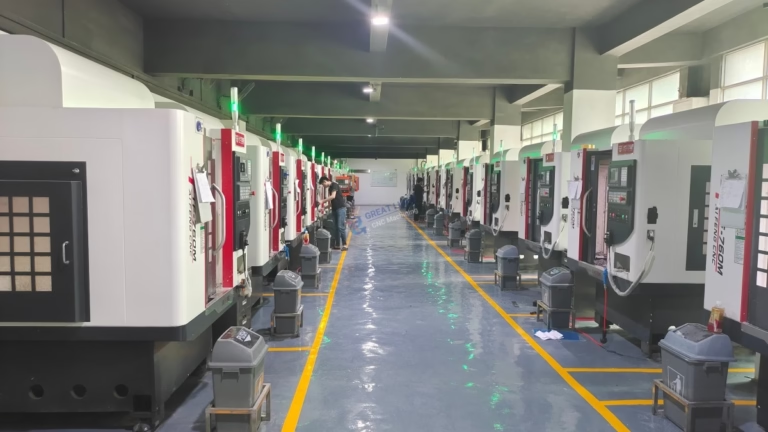
We run 127 high-precision CNC machines across three wholly-owned plants, and the pay bands on our floor are built the same way: by what the person is trusted to change without asking.
The Four Levels Behind Every Pay Band
Level one is machine tending. The operator loads raw stock, runs proven programs, watches for tool breakage and checks finished parts with go and no-go gauges. There is no offset editing. This level is paid close to general production work because the skill ceiling is low and training takes days, not months.
Level two is setup and first-article work. The operator mounts the vise or chuck, dials in the workpiece, loads tools, touches off, sets work offsets, and cuts a first article for inspection. This is where pay steps up sharply, because a bad setup scraps material and burns machine hours.
Level three is process ownership. The operator watches tool wear, adjusts offsets within limits, swaps inserts before finish drifts, and can tell a chatter problem from a worn insert by ear and chip color. This person keeps a ±0.005 mm job running across a full shift.
Level four is programming and proving. The operator writes or edits at the control, proves new parts, and selects workholding for a 5-axis or mill-turn job. This level overlaps with programming pay and is priced accordingly.
When Operator Pay Rises and When It Stops Rising
Pay rises with consequence. If a mistake costs a scrapped aluminium bracket, the wage reflects that. If a mistake costs a scrapped titanium aerospace housing after 30 hours of 5-axis time, the shop pays for the judgment that prevents it. Tolerance and material value set the ceiling of what an operator is worth.
Pay stops rising when the role stops changing. An operator who has run the same part on the same 3-axis machine for three years is not accumulating new skill. Their wage flattens, and no amount of tenure changes that. This is why long-service operators sometimes earn less than a recently trained setup hand.
Automation pushes in both directions. A bar feeder and a probe reduce the number of decisions per shift, which flattens the low end. But it also raises the cost of the remaining decisions, because one operator now supervises several machines. The person watching six spindles has to know which alarm is real.
Region and industry sit on top of all of this. Aerospace and medical work carries more documentation and tighter tolerances than general fabrication, and the wage follows the paperwork and the risk, not the machine brand.
How to Read a Published Salary Figure
Published ranges usually blend every level into one average, which makes them nearly useless for a specific hire. A range that reads 15 to 28 per hour is not a range. It is two different jobs sharing a label.
Check what the source counted. If the survey included tenders, setup hands and programmer-operators, the midpoint describes nobody. If it separated them, the numbers become usable.
Check the geography. A wage quoted for a rural shop with low living costs does not transfer to a metro area where the same operator can walk to three other shops. Neither number is wrong. They answer different questions.
Check the shift. Night and weekend work almost always carries a premium, and a figure that ignores shift mix will understate what a shop actually pays per hour worked.
Finally, check whether the figure includes benefits. Health coverage, paid training and tooling allowances can matter as much as the hourly rate, especially at the entry level where cash is tight.
How to Place an Operator on the Right Band
Works for hiring and for pay reviews.
- 1List the daily tasksWrite down every action the operator performs in a normal shift, including offset edits and gauge checks.
- 2Mark the decisionsFlag the points where the operator chooses rather than follows. Those points are what you are paying for.
- 3Measure the failure costEstimate what one mistake costs in material, machine time and delivery. High cost means high band.
- 4Check the machine classA 3-axis fixture job, a 4-axis mill and a 5-axis cell carry different setup demands.
- 5Set the toleranceWork holding ±0.005 mm needs in-run checks; a loose cosmetic part does not.
- 6Compare region and shiftApply a local market adjustment and a shift premium on top of the skill band.
Operator Levels and What Each One Owns
Use this to place a candidate or a job description before you talk numbers.
| Level | What they own | Where pay sits |
|---|---|---|
| Tender | Load, cycle start, gauge check | Baseline production rate |
| Setup | Workholding, offsets, first article | Clear step above tender |
| Process owner | Offset edits, tool wear, in-run checks | Mid to upper band |
| Programmer-operator | Control edits, proving, workholding choice | Upper band, overlaps programming |
The Short Answer
If the role is loading and gauging, price it as production work. If the role owns offsets, first articles and in-run decisions to ±0.005 mm, price it as skilled setup work and expect to pay for it.
Questions Engineers and Buyers Ask
Does a 5-axis operator earn more than a 3-axis operator?
Usually yes, because the setup is harder and the failure cost is higher. A 5-axis cell has more axes to align, more collision risk and often more expensive material in the vise.
But the machine alone does not set the wage. An operator running a 3-axis job to ±0.005 mm with in-run checks can out-earn a tender on a 5-axis machine that only loads and gauges.
Is experience or skill the bigger factor?
Skill, measured by the decisions the operator is allowed to make. Five years of loading the same fixture teaches little that a shop will pay extra for.
One year of setup work, first articles and offset control teaches a lot. Hiring managers look at the task history, not the calendar.
Why do two shops in the same city pay differently?
Industry, tolerance and part value. A medical shop documenting every step to ISO 13485 carries more overhead per operator hour than a general fabrication shop.
Shift mix also matters. A shop running three shifts pays premiums that a single-day-shift shop never sees.
Can an operator move into programming?
Yes, and it is the most common path. Setup hands who already edit offsets and read drawings are close to control-level programming.
The gap is usually CAM software and geometry, not the machine. Training on both is what unlocks the higher band.
Does automation reduce operator pay?
It reduces the number of tenders needed and raises the value of the people who remain. One operator supervising several machines has to judge which alarm is real.
That judgment is exactly the thing shops pay a premium for, so the average can rise even as headcount falls.
What should a job description include to get the band right?
Tolerance, machine class, materials, whether the operator edits offsets, and whether they cut first articles.
Add the shift pattern and the documentation standard. Those five lines separate a tender role from a setup role more clearly than any title.
Talking to a Shop About Pay? Start With the Part.
Send us your drawing and we will tell you what the job actually demands: tolerance, setup time and inspection steps.
12-hour quote100% inspectionNDA on request
More from the shop floor
We publish setup notes, tooling trials and inspection data from the factory floor.











