
What Is CNC Machine Operator Training?
CNC machine operator training is the structured path from machine tender to setup-capable machinist. It covers offsets, first-article checks, tool wear, and knowing when to stop the spindle. This page explains the skill levels, what each one can safely run, and how to judge a shop by its training depth.
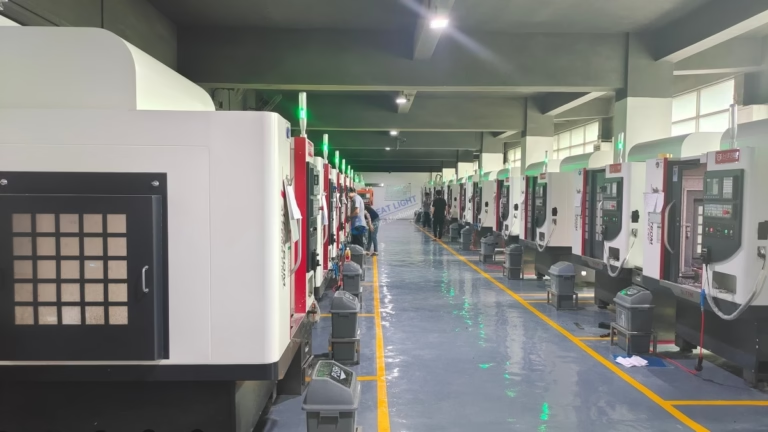
What CNC machine operator training actually covers
Most descriptions of CNC machine operator training list machine parts and G-code letters. That misses the point. On a real shop floor, the trained part is judgment. The operator decides whether a sound is normal, whether a chip color says the tool is running hot, and whether the part in the vise is still the part in the program.
Training splits into four layers that build on each other: safety and machine awareness, offsets and workholding, inspection and process control, and the ability to improve a process instead of only repeating it. An operator who runs a proven program is not the same as one who can prove a new setup.
That difference shows up in your parts. A tender loads stock and presses cycle start. A setup operator touches off tools, adjusts wear offsets, and reads a first article against the drawing. Only the second one protects a ±0.005 mm tolerance on a run of 500 parts.
So the honest answer to what is CNC machine operator training is this: it is the transfer of decisions. Everything else, the panels and the codes and the checklist, exists to support those decisions.
The five levels of CNC machine operator training
Level one is machine tender. The operator loads and unloads parts, watches coolant, swaps tools at the scheduled count, and stops the machine when something looks wrong. This level needs days, not months. It is real work, and it is also the level where most scrap is caught, because a tender who stops the spindle early saves a batch.
Level two is operator with offset authority. This person can adjust tool wear offsets, re-zero a part after a fixture change, and confirm a feature with calipers or a bore gauge. They understand that a 0.02 mm offset move changes the cut by half that amount on a diameter. This level takes weeks of supervised practice.
Level three is setup operator. They mount fixtures, indicate a vise or a rotary table, touch off tools, set work coordinates, and run the first article. On a five-axis job they also verify the post-processor output and the tool vector before the first cut. This is the level that decides whether a job runs at all.
Level four is process owner. They read the inspection report, adjust speeds and feeds for tool life, and know when chatter means the fixture, not the tool. Level five is programming and process design, where the operator writes the setup sheet the next person will follow.
Levels four and five take years. No short course produces them. That is why shops hire for level three and above, and why the training pipeline below that level is what keeps a shop staffed.
Why operator skill sets the tolerance floor
Machine accuracy and operator skill are two different budgets. A machine may position to ±0.005 mm, but the finished part depends on how the stock sat in the vise, how the tool was touched off, and whether the fixture moved under load. Thermal drift alone can push a bore 0.01 mm over a long run.
A trained operator accounts for these. They warm up the spindle before the first article, they check the first three parts instead of the first one, and they record the offset at the start of the run so drift is visible. That routine is what holds a 99.99% qualification rate on a real batch.
Untrained operation shows up as patterns, not random error. Taper in a deep bore usually means tool deflection that nobody compensated. A step at the Z transition usually means the wrong tool length. Size walking in one direction across a run usually means thermal growth nobody tracked.
None of these are fixed by buying a better machine. They are fixed by an operator who knows what to look for at the right moment. This is the engineering meaning of CNC machine operator training: it converts machine capability into delivered tolerance.
What training does not fix
Training cannot rescue a bad process. If the setup sheet has the wrong tool, or the fixture clamps on a thin wall, a skilled operator will still fight the job. The right move is to send the setup back to the process engineer, not to ask the operator to compensate forever.
It also does not replace in-process inspection on tight work. A ±0.005 mm feature on a 500-part run needs gauging at intervals, not one check at the end. Operator skill decides when to gauge; the gauge decides whether the part ships.
And it does not transfer across machine families for free. A mill-turn center with a sub-spindle and a bar feeder has a different setup logic than a three-axis vertical. The operator carries the principles, then learns the specific control and tooling.
For buyers, this means the training question is really a setup question. Ask who touches off the tools, who signs the first article, and what happens when a dimension drifts mid-run. The answers tell you more than a certificate on the wall.
Which parts suit which operator level
Match the job to the level before you promise a date.
| Operator level | Typical parts | Setup time | Risk if unmatched |
|---|---|---|---|
| Tender | Repeat runs, one fixture, loose tolerance | Minutes, program proven | Scrap hidden until final inspection |
| Offset operator | Simple milled or turned parts, ±0.05 mm | Under an hour | Size drift mid-run |
| Setup operator | New fixtures, 4-axis, first articles | Half a day | First article rejected |
| Setup + 5-axis | 5-axis contoured parts, tight datums | A day or more | Tool collision, scrap batch |
| Process owner | Long runs, tool-life sensitive alloys | Ongoing tuning | Cost creep, late delivery |
The short verdict
If the part is simple and the program is proven, a trained tender plus a strong first-article check is enough. If the part needs a new fixture, tight datums, or five-axis motion, insist on a setup-capable operator and ask for the first-article report before the run continues.
Questions engineers ask
How long does CNC machine operator training take?
Reaching tender level takes days. Reaching offset authority takes weeks of supervised practice. Becoming a reliable setup operator usually takes months, because the operator needs to see many fixture types and many failure modes before the judgment is real.
No fixed number fits every shop. The variable is how many different setups the trainee sees, not how many hours they sit in a classroom.
Can a beginner be trained on five-axis machines?
Yes, but not first. Five-axis work adds rotary datums, tool vectors, and collision risk. The usual path is three-axis setup first, then four-axis, then simultaneous five-axis with supervision.
A trainee who cannot read a first article on a three-axis part should not be alone on a five-axis job. The tolerance budget is the same, but the ways to fail are more numerous.
Does certification prove operator skill?
Certification proves the training happened. It does not prove the operator can hold ±0.005 mm on your part. The better evidence is a first-article report, an in-process gauging plan, and a shop that can explain its setup routine.
Ask what the operator does when a dimension drifts. A specific answer about offsets, tool wear, or thermal growth is worth more than a document.
What is the biggest cause of scrap on a trained line?
Wrong tool length or a stale offset after a tool change. It is boring, and it is the most common. The second is a fixture that moved because the clamp torque was guessed rather than set.
Both are setup problems, not machining problems. That is why setup discipline is the part of CNC machine operator training that buyers should care about most.
How does training affect lead time?
A setup-capable operator shortens the gap between material arrival and first article. That gap is usually the largest variable in a short-run job.
At GreatLight, quotation and free DFM analysis come back within 12 hours and production can start within 24 hours, provided the setup is ready.
Do you need an NDA before sharing drawings?
No. Uploads are secure and confidential, and an NDA is available on request if your process requires one.
Send the drawing and the tolerance callouts. The DFM feedback is more useful when the critical dimensions are marked.
Send the drawing, get a manufacturability answer
Upload your part and we will review the tolerances, the fixture plan, and the setup level it needs. Quotation and free DFM analysis within 12 hours.
12-hour quote100% inspectionNo MOQ
More from the shop floor
We publish setup notes, tooling trials and inspection data from the factory floor.











