
What Is a Pallet in CNC Machine Workholding?
A pallet in CNC machine workholding is the plate that holds the part and indexes into the machine table, so the next job can be loaded while the spindle keeps cutting. This page explains how pallets locate, what accuracy they can hold, and when they are worth the floor space.
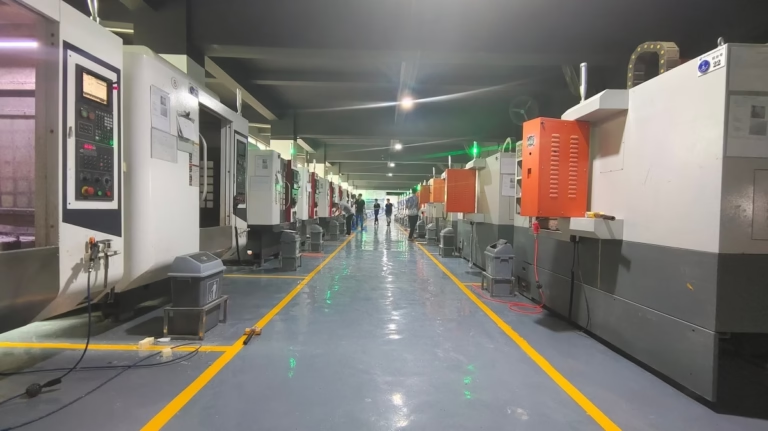
What a Pallet in CNC Machine Workholding Actually Does
A pallet is a flat, stiff plate bolted to the machine table or to a pallet changer. The workpiece, or a vise or fixture holding it, is clamped to that plate. When the pallet slides or rotates into the machine, it lands on hardened locating pins or cones that push it into the same position every time. That repeat position is the whole point.
The pallet itself does not cut anything and does not add stiffness to the part. It only carries the part and defines where the part sits in machine coordinates. If your fixture is solid and your locating faces are clean, a pallet is invisible to the toolpath. If they are not, no amount of probing will fix a part that rocks on a dirty seat.
On a horizontal machining center, the pallet usually travels on a rail or a rotary indexer. On a vertical mill, it is more often a sub-plate that an operator swaps by hand or with a lift assist. Both do the same job: they separate load time from cut time.
Terms get mixed up. A tombstone is a vertical pallet face, usually with four sides. A sub-plate is a pallet that stays bolted to the table. A zero-point plate is a pallet with hydraulic or mechanical clamps built in. When a shop says pallet, ask which one they mean before you quote a fixture.
How Pallets Hold Position to ±0.005 mm
Repeatability comes from the locating elements, not the plate. A typical setup uses two tapered pins or two ball-lock seats plus a flat rest pad. The taper pulls the pallet into the seat and removes the clearance that a straight pin would leave. Pull-stud systems do the same with a clamping cone that draws the pallet down onto three or four rest pads.
The clamp force matters as much as the geometry. Hydraulic zero-point clamps hold 5-15 kN per stud, which is enough to keep the pallet from shifting under a heavy face mill. Mechanical cam clamps hold less but need no hydraulic unit. If your part is light and your cuts are light, a mechanical system will repeat well for years.
Surface condition decides the real number. A chip under a rest pad of 0.05 mm thickness tilts the part and shows up as a taper on the finished face. This is why pallet seats get a brush and a wipe between every load, and why air blast at the seat is common on automated cells.
Temperature also moves the number. A pallet that sits near a door in winter and then goes into a warm machine will grow or shrink a few microns before it settles. On tight work we let the pallet sit in the machine area for 20-30 minutes before the first cut.
Pallet Materials and What Each One Is For
Cast iron pallets are the default for heavy work. They damp vibration, hold threads well, and do not move much when the temperature changes. The trade-off is weight: a 500 × 500 mm cast iron pallet can weigh 60-90 kg, which is fine for a rail changer and hard to lift by hand.
Steel pallets, usually 1045 or 4140, are welded or machined from plate. They take more abuse than aluminum and can be repaired by welding. We use them for parts over 300 mm where the pallet also acts as the fixture base. Stress relief after welding is not optional if you want the seat to stay flat.
Aluminum pallets, typically 6061-T6 or 7075, are light and quick to machine. They suit small parts, robot cells, and any station where an operator loads by hand. They wear faster at the locating seats, so we press in hardened steel bushings where the pins land.
For low-volume work, a simple steel sub-plate with two dowel holes and four clamp slots is often enough. It costs a fraction of a zero-point system and repeats within 0.02-0.05 mm, which is fine for many brackets and housings. Do not buy a hydraulic pallet system for ten parts a year.
When Pallets Pay Off and When They Do Not
Pallets pay off when spindle hours are the bottleneck. If a machine cuts 18 hours a day and load time is 20 minutes per cycle, you lose roughly 25% of the day to loading. Two pallets and a changer cut that loss to near zero. That is the entire business case, and it is easy to check with a stopwatch before you spend money.
They also pay off on parts that need four or five sides machined. One pallet per orientation lets you move the part through the machine instead of re-clamping it on the table. Fewer re-clamps means fewer datum errors and less scrap on complex housings.
Pallets do not pay off when the part is large and heavy. A 4,000 mm frame stays on the table. Lifting it onto a pallet adds risk and gains nothing if the machine is not the constraint. The same is true for one-off prototypes where the setup is already a few minutes.
They also do not fix a bad process. If your fixtures flex, your tooling is worn, or your probing routine is sloppy, a pallet just moves the same error to a nicer plate. Fix the fixture first, then automate the load.
Setting Up a Pallet Correctly
Start with the seat, not the part. Stone the pallet face and the machine table, then check flatness with a dial indicator. Any burr at a rest pad shows up as a tilt at the part, and a tilt of 0.01 mm over 200 mm is already 0.003 mm of error at the cutting edge.
Mount the fixture on the pallet outside the machine when you can. Indicating a vise on a bench is faster and safer than reaching into the spindle area. Record the pallet number and the fixture offset in your setup sheet so the next operator does not re-probe from scratch.
Probe the pallet, not just the part, on the first run. Touch off the locating face or a known pin and store that value. On later runs, a shift in that number tells you the seat is dirty or worn before you cut a single feature.
Torque the clamps in a pattern and to the maker's value. Uneven torque bends a thin pallet and changes the part height by a few microns from one corner to the next. We mark the torque value on the pallet with a paint pen.
Pallet Types Compared
Pick by part weight, volume, and how often you change jobs.
| Pallet type | Typical repeatability | Best for | Watch out for |
|---|---|---|---|
| Dowel-pin sub-plate | 0.02-0.05 mm | One-off and low-volume parts | Hand loading, no automation |
| Ball-lock plate | 0.01-0.02 mm | Quick-change vises and fixtures | Worn balls after heavy use |
| Zero-point mechanical | 0.005-0.01 mm | Small parts, robot cells | Lower clamp force |
| Zero-point hydraulic | ±0.005 mm | High-mix production cells | Needs hydraulic unit and upkeep |
| Tombstone (4-face) | ±0.005 mm | Multi-side parts on HMC | Weight and swing clearance |
| Rail changer pallet | ±0.005 mm | Lights-out machining | High capital cost |
The Verdict
If spindle hours are your bottleneck and parts are under 300 mm, use a zero-point pallet system. If parts are large, heavy, or one-off, keep them on the table and spend the money on better fixtures instead.
Pallet Questions Engineers Ask
Does a pallet reduce the accuracy of my part?
It adds one interface, so it adds one error source. A clean hydraulic pallet repeats within ±0.005 mm, which is inside the tolerance of most parts we machine. The error that hurts is a chip or a burr at the seat, not the pallet design.
If your drawing calls for ±0.005 mm on a tight feature, we usually cut that feature with the part clamped directly to the table and use pallets only for the roughing and secondary faces.
How often should pallet seats be checked?
Check the seat flatness monthly with a dial indicator, and check clamp force at the same time. In high-volume cells, check weekly. Replace locating pins when wear reaches 0.01 mm, before the shift shows up in the part.
Keep a log per pallet number. When one pallet starts drifting while others hold, the problem is that pallet, not the machine.
Can I use pallets on a 3-axis mill?
Yes. A sub-plate with dowel pins works on any 3-axis machine. You will not get automatic swapping, but you still cut load time and keep the same datum across jobs.
For a 3-axis machine with a 500 × 500 × 450 mm travel, a 400 × 400 mm steel sub-plate is a practical size. It leaves room for clamps at the edges.
What is the difference between a pallet and a tombstone?
A pallet is a horizontal plate that indexes into the machine table. A tombstone is a vertical pallet, usually with two or four faces, used on horizontal machining centers. Both locate on the same pins and clamps.
Tombstones let you machine four sides of a part in one load, which cuts handling on housings and manifolds. They need swing clearance, so check the machine envelope before you buy.
Do pallets help with lights-out machining?
They are the base of it. A rail changer with six or eight pallets lets the machine run past the end of the shift without an operator. Each pallet carries a known fixture and offset, so the control can pick the next job.
The limit is tool life and chip control, not the pallet. If a drill breaks at 2 a.m., the pallet system cannot help. We plan lights-out runs around tools that wear predictably.
How do pallets affect pricing?
A pallet adds setup work and hardware cost, so it shows up in the first article price, not in the per-part price after that. On runs above a few hundred parts, the time saved in loading usually pays for the fixture.
Send us the drawing and quantity and we will tell you whether a pallet fixture makes sense for your part.
Send Us Your Part and We Will Size the Fixture
Tell us the part, the quantity, and the tolerance. We will say whether a pallet setup saves you money or not, and quote it either way.
12-hour quote100% inspectionNo minimum order
More CNC Machining Notes
We publish setup notes, tooling trials and inspection data from the factory floor.











