
Where Is Hytek CNC Machine Made?
Hytek CNC machines are built in Taiwan and assembled for global distribution, which places them in the mid-tier of the machine tool market. This page explains what that origin means for accuracy, service, and spare parts. It is written for engineers and buyers who need to know whether a Hytek-built machine fits their part mix before they commit.
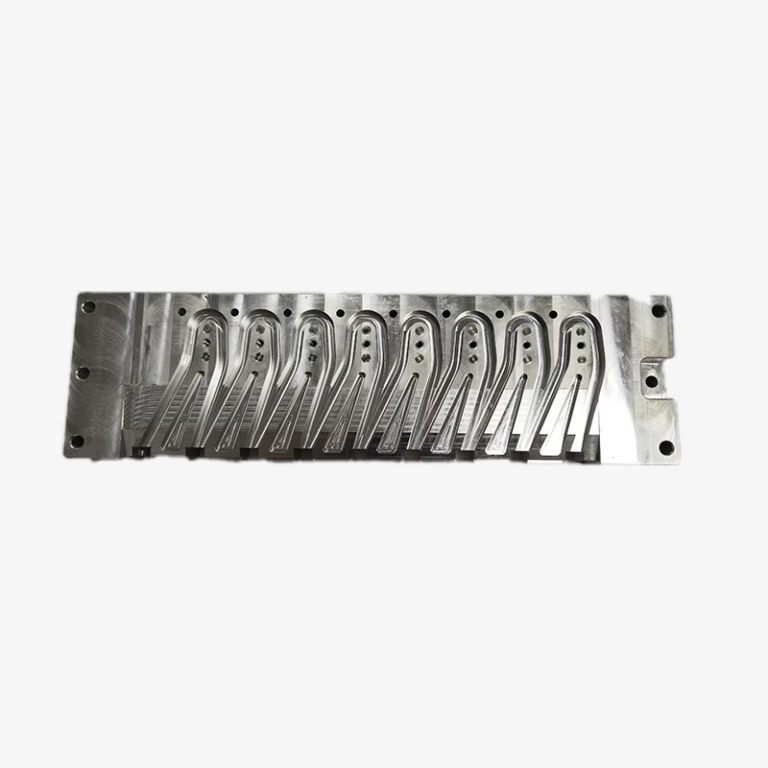
Where is hytek cnc machine made: the short answer
Hytek machine tools trace back to Taiwan. The castings, ballscrews, and spindle assemblies are produced and aligned there, then shipped to distributors worldwide. Taiwan has a dense supply chain for linear guides, spindles, and controller integration, so most of the structural work stays on the island.
That matters because the frame and guideway alignment set the machine's baseline geometry. A Taiwan-built VMC typically holds squareness and parallelism well enough for general machining, mold work, and job-shop production. It is not a high-end Japanese or German build, and it does not pretend to be.
The controller is a separate question. Many Hytek machines ship with Fanuc, Mitsubishi, or Syntec controls, depending on the model and the buyer's preference. The controller origin does not change the iron, but it does change the programming environment, the available canned cycles, and the service network you rely on.
So when someone asks where is hytek cnc machine made, the useful answer is not a single city. It is Taiwan for the mechanical build, with a controller sourced from Japan or Taiwan depending on the configuration. That split is normal in this price band.
How origin affects accuracy and repeatability
A Taiwan-built machine usually quotes positioning accuracy around ±0.005 mm to ±0.01 mm and repeatability near ±0.003 mm. Those numbers are acceptable for most automotive brackets, fixture plates, and enclosure panels. They are not enough for optical molds or aerospace flight hardware without extra hand work.
The limiting factor is rarely the casting alone. Thermal growth, spindle runout, and the quality of the ballscrew nut matter more at tight tolerances. A machine that sits in a warm shop with no thermal compensation will drift, no matter where it was built.
Repeatability is the number to watch for production. If a machine repeats within ±0.003 mm, you can run a batch and trust the spread. If it only holds ±0.01 mm, you will fight scrap on any feature tighter than ±0.02 mm. That is the real decision point.
For work that needs ±0.005 mm or better across a large part, a Taiwan-built Hytek is usually the wrong tool. The frame is not stiff enough for heavy interrupted cuts, and the thermal behavior is harder to predict. Know the limit before you buy.
Spare parts, service, and the hidden cost of origin
Origin decides who fixes the machine when it stops. A Taiwan-built Hytek has a broad parts channel through Asian distributors, so common items like belts, bearings, and way covers are usually available in days. Spindles and controller boards can take longer.
Ask the dealer for a written parts list with lead times before you sign. If a spindle takes eight weeks and you run one shift, that is a real risk. If you run three shifts on a single machine, the risk is unacceptable without a spare spindle on the shelf.
Service labor is the other gap. A local distributor with trained technicians can align a machine after a crash in a day. A remote dealer who flies someone in may take a week. That difference shows up in your schedule, not in the spec sheet.
The controller choice also shapes service. Fanuc has the widest independent technician pool, so repairs are faster and cheaper. Syntec and Mitsubishi are well supported too, but fewer independent shops carry the software and cables. Pick the controller with the local support you can actually reach.
When a Hytek-class machine is the right call
A Taiwan-built machine fits when your tightest tolerance is ±0.01 mm or looser, your parts are small to medium, and you need a reliable spindle for one or two shifts. Job shops, fixture builders, and product developers fit this profile well.
It also fits when you need a second machine for roughing or for a specific operation, like drilling a pattern or facing a plate. You do not need premium iron for that work. You need repeatability and uptime.
It does not fit when you chase ±0.005 mm across a 500 mm part, when you cut hardened steel all day, or when a single spindle failure stops a production line. In those cases, the price gap to a Japanese or European build is smaller than the cost of scrap and downtime.
The honest rule is simple. Match the machine to the tolerance band and the duty cycle, not to the badge on the door. A Hytek-class machine is a solid mid-tier tool. It is not a substitute for a high-end build, and it does not need to be.
What this means for your supply chain
If you are buying a machine, the origin question is about support, not pride. Confirm the controller model, the spindle taper, the guide type, and the local service radius. Those four items decide whether the machine earns its keep.
If you are sourcing machined parts, the machine origin matters less than the process control behind it. A shop with a Taiwan-built VMC, in-process probing, and a documented inspection routine will beat a shop with premium iron and no measurement discipline.
That is where we sit. GreatLight runs 127 high-precision CNC machines across three plants in Dongguan and Singapore, including 16 simultaneous 5-axis centers and 16 mill-turn centers. We hold ±0.005 mm on qualified features and inspect 100% of parts before shipment.
So the origin of the machine is one input. The control plan, the metrology, and the people running the spindle are what turn a machine into a dependable process. Judge the process, not just the nameplate.
Build origin vs. what you can machine
Use this to match a Hytek-class machine to a part family before you commit.
| Origin tier | Typical tolerance | Best part family | Watch out for |
|---|---|---|---|
| Taiwan (Hytek class) | ±0.005–0.01 mm | Brackets, plates, molds, job-shop parts | Thermal drift on long cycles |
| Japan premium | ±0.002–0.005 mm | Die molds, medical, tight aerospace | Higher price, longer lead time |
| China value tier | ±0.01–0.02 mm | Simple fixtures, roughing, non-critical | Spindle life, spare-part gaps |
| Europe high-end | ±0.001–0.003 mm | Optics, flight hardware, precision dies | Cost and service distance |
The verdict
Buy a Hytek-class machine when your tolerance band is ±0.01 mm or looser and uptime matters more than prestige. Go to a Japanese or European build when you need ±0.005 mm across large parts or run unattended production where one spindle failure stops the line.
Questions engineers ask next
Is a Hytek CNC machine made in Taiwan or China?
The mechanical build is Taiwan-based. Castings, ballscrews, and spindle assemblies are produced and aligned there.
Some models use a controller from Japan or Taiwan, so the finished machine is a mix of origins. Ask the dealer for the exact controller model on the unit you are buying.
Does origin change the tolerance I can hold?
It sets the baseline, but it does not fix the result. Thermal growth, spindle runout, and the control loop decide what you actually hold in production.
A Taiwan-built machine usually lands in the ±0.005 mm to ±0.01 mm band. Getting tighter needs a stiffer frame and better thermal control.
How long do spare parts take to arrive?
Common items like belts, bearings, and way covers usually ship in days through Asian distributors. Spindles and controller boards can take weeks.
Get a written parts list with lead times before you sign. If you run three shifts on one machine, keep a spare spindle on the shelf.
Which controller should I pick?
Fanuc has the widest independent technician pool, so repairs are faster and cheaper. Syntec and Mitsubishi are well supported too.
Pick the controller your local service network can actually reach. Programming support matters as much as the hardware.
Can a Hytek-class machine handle 5-axis work?
Some models offer 4-axis or 5-axis options, but the frame stiffness and thermal behavior set the limit. Light 5-axis work on aluminum is fine.
Heavy interrupted cuts in steel or tight 5-axis contouring usually need a premium build. Match the machine to the cut, not the brochure.
Should I buy the machine or outsource the parts?
Buy the machine if you need control over schedule and iteration speed. Outsource if your volumes are low or your tolerance band is tight.
A supplier with process control and metrology often beats a shop with premium iron and no measurement discipline.
Need parts that hold tolerance?
Send us your drawing and we will return a quote with a free DFM analysis within 12 hours. Production can start within 24 hours.
12-hour quote100% inspectionNo minimum order quantity
More from GreatLight
We publish setup notes, tooling trials and inspection data from the factory floor.











