
Where Is Legacy CNC Machine Made?
A legacy CNC machine is rarely made in one country. The bed, spindle, control and ballscrews usually come from different suppliers, and the nameplate only records final assembly. This page explains how to trace where a legacy CNC machine was made, what those origins mean for accuracy and spares, and when a used machine is the wrong purchase.
In this article
- 1
- 2
- 3
- 4
- 5
- 6
What "Made" Means for a Legacy CNC Machine
A CNC machine is an assembly, not a single product. The cast iron base may be poured in one country, the spindle ground in another, the servo drives wound in a third, and the control board populated somewhere else. The nameplate on the column records final assembly, not the origin of every subsystem. That gap is why buyers get confused when they ask where a legacy CNC machine was made.
Legacy machines make the question harder. Builders merged, brands were licensed, and some models were assembled under contract for years. A 1990s machining centre sold under a European badge may have a Taiwanese casting, a Japanese spindle and a US control. All of that can be true at once.
For most shops the practical question is not the flag on the door. It is whether the geometry still holds and whether parts are still obtainable. Origin tells you which supply chain to call and which documentation standard to expect. It does not, on its own, tell you whether the machine will hold ±0.005 mm on your part.
So treat origin as a lead, not a verdict. Use it to find drawings, spare lists and service networks, then verify the machine in front of you.
- 1Nameplate = assembly siteOnly the final build location is stamped, not each subsystem.
- 2Origin guides the supply chainIt tells you who to contact for drawings and spares.
- 3Condition beats geographyGeometry and wear decide what the machine can hold.
Where the Main Subsystems of a Legacy CNC Machine Are Usually Made
Castings are heavy and cheap to ship by sea, so beds and columns were often poured near the assembly plant. Taiwan, mainland China, Spain, Italy and Brazil all supplied iron to machine builders. A ribbed Meehanite casting from a good foundry can be excellent; the risk is a casting that was never stress-relieved before machining.
Spindles are the opposite case. Grinding a spindle taper to the required runout takes specialised equipment, so a small number of makers supplied most of the world. Cartridge spindles from European and Japanese brands appear in machines assembled almost anywhere. That is usually good news, because cartridge units can be swapped and rebuilt.
Controls and drives define the electrical generation of the machine. Fanuc, Siemens, Heidenhain, Mitsubishi and Fagor dominate legacy installations. The control's country of origin matters less than whether the builder kept the ladder logic and parameters, because without those files a control retrofit becomes a rebuild.
Ballscrews, linear guides and bearings follow the same pattern. A few global brands supplied most of them, and the part number stamped on the screw tells you more than the machine's country of assembly ever will.
- 1CastingsPoured near the assembly plant; check for stress relief records.
- 2SpindlesOften a cartridge from a specialist builder; rebuildable.
- 3ControlsFanuc, Siemens, Heidenhain, Mitsubishi, Fagor are common.
- 4Ballscrews and guidesGlobal brands with stamped part numbers; traceable.
Why the Origin of a Legacy CNC Machine Still Matters to Engineers
Origin decides which documentation set exists. Machines built for the European market were usually shipped with CE marking, a declaration of conformity and full electrical schematics. Machines built for other markets may have none of that. If you need to modify the electrical cabinet or add a safety circuit, missing schematics turn a two-day job into a two-week one.
Origin also sets the thread and unit conventions inside the machine. Legacy machines from different regions mix metric and imperial fasteners, pipe threads and hydraulic fittings. A maintenance technician chasing a leaking fitting on a Friday afternoon cares a great deal about that detail.
Support is the third factor. Some regional builders kept parts depots for decades and published rebuild procedures. Others disappeared entirely. Before you buy, ask for the spindle taper drawing, the ballscrew part number and the control parameter backup. If none exist, price the machine as a project, not a tool.
Finally, origin affects the paperwork you can hand to your own customer. Aerospace and medical work often requires traceability of the equipment used. A machine with a clear build record is easier to defend in an audit than one with a repainted nameplate.
- 1DocumentationCE files and schematics vary sharply by build market.
- 2Unit conventionsMetric and imperial fasteners are often mixed inside one machine.
- 3Audit trailA clear build record supports aerospace and medical traceability.
When the Question of Where a Legacy CNC Machine Was Made Does Not Matter
If the machine is going to run aluminium brackets at ±0.05 mm, origin is close to irrelevant. A worn Taiwanese mill and a worn German mill will both struggle equally. What matters is backlash, spindle runout and whether the control still interpolates arcs cleanly.
Origin also stops mattering when the machine will be rebuilt anyway. Shops that buy legacy iron for a control retrofit plan to replace the drives, the screws and often the spindle. At that point the casting and the slideways are the only original parts left, and you should inspect those directly rather than research their birthplace.
The one case where origin is decisive is a production machine that must stay in service for years with minimal downtime. There, a documented supply chain for spindles, drives and boards is worth more than a better casting. A machine with a known rebuild path beats a slightly tighter machine with no parts.
For one-off prototypes or fixtures, buy on measured geometry. Run a ballbar test and a test cut, check the spindle taper with bluing, and decide from the numbers.
- 1Loose-tolerance workBacklash and runout dominate; origin is secondary.
- 2Planned retrofitYou replace the subsystems anyway; inspect the iron.
- 3High-uptime productionA documented spares path outranks a better casting.
How to Verify the Origin Claim on a Legacy CNC Machine
Start with the serial number plate, not the sales listing. Photograph it, then ask the builder's successor or the regional distributor to decode it. Serial records usually show the build date, the control fitted at the factory, and the market the machine was shipped to. That single lookup settles most disputes.
Next, open the electrical cabinet and read the component labels. Contactors, breakers and drive modules carry their own country of origin and their own date codes. If the cabinet is full of components newer than the machine, the control was rebuilt at some point and the seller's story needs updating.
Then measure. A ballbar run gives circularity and backlash in minutes. A test cut in aluminium with a known cutter shows what the machine actually holds. Compare the result with the tolerance the seller claims. Numbers beat paperwork every time.
Finally, ask for the parameter backup and the ladder logic on a USB stick. A seller who can produce those files on the spot is usually a seller who maintained the machine. One who cannot is telling you something too.
- 1Serial decodeBuild date, factory control and destination market.
- 2Component date codesCabinet parts reveal any later rebuild.
- 3Ballbar and test cutCircularity and backlash measured in minutes.
- 4Parameter backupFiles on a USB stick signal real maintenance.
Legacy CNC Machine Origin: What to Check and Why
Use the middle column to decide whether the origin claim deserves further investigation.
| Origin signal | What it tells you | Action |
|---|---|---|
| Casting pour location | Where the iron was made and whether stress relief was applied | Ask for foundry records or hardness test |
| Spindle cartridge brand | Whether the spindle can be rebuilt or must be replaced | Check the taper drawing is available |
| Control make and generation | Which parameter set and ladder logic you need | Request the backup file before payment |
| Ballscrew part number | Whether a drop-in replacement still exists | Quote the screw and nut as spares |
| CE or other market marking | Whether full electrical schematics were issued | Missing files mean a longer retrofit |
| Component date codes | Whether the control was rebuilt after the original build | Re-price if the rebuild is undocumented |
| Distributor still active | Whether service and parts are reachable in your region | Call them before you commit |
Origin Is a Lead, Not a Verdict
If you need a machine with a documented spares path for years of production, buy the one with the traceable control and spindle brand. If you are retrofitting or running loose tolerances, buy on measured geometry and ignore the flag on the nameplate.
Frequently Asked Questions
Can a legacy CNC machine be made in more than one country?
Yes. Almost every machine is a multi-country assembly. The casting, spindle, control and ballscrews commonly come from four different suppliers, and the nameplate records only where final assembly happened.
That is normal rather than a defect. What matters is whether each subsystem can still be identified and replaced.
Does the country of origin affect the accuracy a legacy machine can hold?
Not directly. Accuracy comes from the condition of the slideways, ballscrews and spindle, plus the thermal behaviour of the casting. A well-kept machine from any region can hold tight tolerances.
Origin affects accuracy indirectly, through the quality of the original build and the availability of replacement parts.
How do I find out where an older machine was actually built?
Decode the serial number with the builder's successor or the regional distributor. Then check component date codes inside the electrical cabinet and look for market markings such as CE.
Those three sources usually agree. When they do not, the cabinet was probably rebuilt.
Is a legacy machine from a well-known builder always a safer buy?
No. Brand reputation says something about the original design, not about the specific machine in front of you. Two machines from the same year can differ hugely depending on how they were run and maintained.
Measure backlash, runout and circularity on the actual unit before you decide.
What documents should I ask for before buying a used CNC machine?
Ask for the control parameter backup, the ladder logic, the spindle taper drawing, the ballscrew part number and any electrical schematics. A maintenance log with spindle hours is useful too.
If those files do not exist, budget for a retrofit rather than assuming the machine will run as delivered.
When should a shop skip the used market and buy a new machine?
When the part requires simultaneous five-axis motion, when the tolerance is tighter than the legacy iron can hold after rebuild, or when downtime is not acceptable.
In those cases, a new machine with a current control and a supported spares chain costs less over the life of the job.
Send Us the Drawing, Not the Machine History
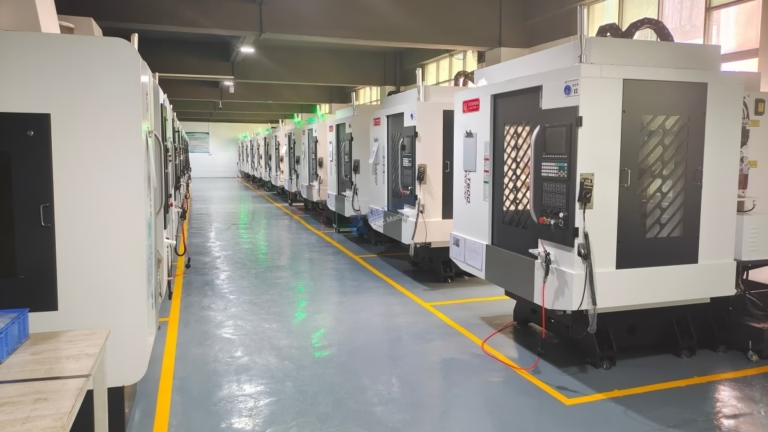
Upload your part and tolerance callouts. We reply with a quotation and a free DFM analysis within 12 hours, and we machine prototypes or production runs on 127 CNC machines in Dongguan and Singapore.
12-hour quoteNo minimum order quantity±0.005 mm tolerance100% inspection before shipment
More from GreatLight
We publish setup notes, tooling trials and inspection data from the factory floor.











