
Which CNC machine rotates an abrasive tool?
An abrasive tool is spun by a grinding spindle, a milling spindle running a mounted point, or a lathe-style workhead that turns the part instead. Which one you need depends on the surface you are finishing and the tolerance you have to hold. This page compares the three setups so you can pick before you cut metal.
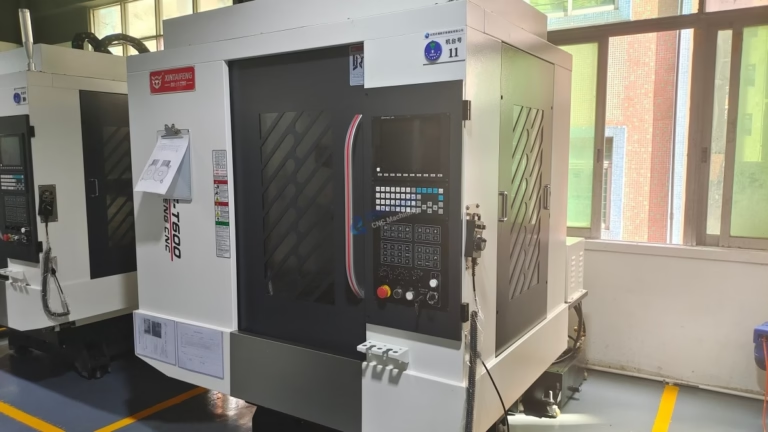
Which CNC machine rotates an abrasive tool: setup comparison
Speeds and tolerances below are typical shop ranges, not machine limits.
| Setup | What rotates | Typical speed | Best fit |
|---|---|---|---|
| Surface grinder | Abrasive wheel | 1,500–3,600 rpm | Flat faces, tight flatness |
| Tool grinder | Cup or dish wheel | 2,000–4,000 rpm | Cutters, drills, reamers |
| 3-axis mill, mounted point | Mounted point in spindle | 8,000–24,000 rpm | Blending, deburring, radii |
| Mill-turn center | Bar or chuck, tool static | 200–4,000 rpm | Cylindrical OD and ID |
| 5-axis machining center | Point on a tilting head | 10,000–24,000 rpm | Freeform and angled surfaces |
Three ways an abrasive tool gets turned
An abrasive tool removes material by scratching, not by slicing. That single fact decides everything else. Bonded wheels, mounted points, cartridge rolls and diamond pins all need surface speed at the contact zone, and the machine has to hold that speed while the tool loads up with swarf.
There are three common arrangements. The abrasive spins on its own spindle, as on a surface or tool grinder. The abrasive spins in a machine spindle, as when a mounted point runs in a 3-axis or 5-axis machining center with no wheel guard at all. Or the abrasive stays put and the workpiece turns, as on a lathe or mill-turn center with a static tool.
When people ask which CNC machine rotates an abrasive tool, the honest answer is that the abrasive usually rotates in a spindle. But that is only half the question. What matters more is which axis carries the tool and how rigid the path is between spindle nose and part.
Note the guard difference too. A dedicated grinding machine has a wheel guard rated for burst. A milling spindle running a mounted point does not, so you keep the point small and the speed moderate.
- 1Spinning abrasiveSurface grinders, tool grinders, ID grinders.
- 2Spinning workLathes, mill-turn centers, cylindrical grinders.
- 3Both spinningCenterless and some creep-feed setups.
Surface speed, not spindle rpm
Spindle rpm tells you very little on its own. Surface speed at the contact point is the number that governs burn, wheel wear and finish. A Ø150 mm wheel at 2,000 rpm runs about 15.7 m/s at the rim. A Ø6 mm mounted point at 20,000 rpm runs about 6.3 m/s. Same spindle class, very different cutting conditions.
For aluminum oxide and silicon carbide points on steel, keep surface speed in the 15–30 m/s band. Below that the point rubs and burnishes instead of cutting. Above roughly 35 m/s on a small shank, vibration and wheel burst risk climb fast.
Feed per pass matters just as much. For finish passes with a mounted point, 0.005–0.02 mm per pass at 300–800 mm/min feed is a reasonable start. Push harder and the point glazes, the load meter jumps, and you lose the radius you were blending.
Coolant changes the ceiling. Flood coolant lets you run faster and hold Ra 0.8–1.6 μm more reliably. Dry grinding on a milling spindle is fine for light deburring, but it will not hold a ground finish across a long edge.
- 115–30 m/sPractical band for most points on steel.
- 20.005–0.02 mmFinishing depth per pass with a mounted point.
- 3CoolantRaises the usable speed and stabilizes finish.
Matching the setup to the part geometry
Flat faces with a tight flatness callout belong on a surface grinder. A magnetic chuck or vacuum plate holds the part, the wheel crosses in strokes, and flatness under 0.005 mm is routine. No machining center matches that on a hardened block.
Outer diameters and bores belong on a lathe-type machine. Turn the part, feed a static or live abrasive tool, and you get roundness without a second setup. Mill-turn centers at our shop handle OD and ID blending this way, then cut threads in the same cycle.
Freeform surfaces, angled bosses and deep pockets are where the 5-axis machine wins. The tilting head keeps the abrasive normal to the surface, so you grind a radius and the adjacent wall without repositioning the part. That is the main reason to move grinding work onto a 5-axis platform.
Hardened tool steel above 50 HRC is the classic grinding case. If the part is soft and the tolerance is loose, do not grind at all. Mill it, then deburr with a nylon brush. Grinding a soft part adds cost and heat for no gain.
- 1Flat and hardSurface grinder with a magnetic chuck.
- 2Round and concentricLathe or mill-turn with a static abrasive tool.
- 3Freeform and angled5-axis center, abrasive normal to the surface.
- 4Soft and looseSkip grinding, mill and deburr instead.
When an abrasive in a milling spindle is the wrong call
Mounted points are flexible by design. Run one long or fast and it deflects, which means your blended wall is not where the code says it is. Keep the overhang under about 4× the shank diameter and reduce depth of cut as overhang grows.
Abrasive dust is the second problem. Aluminum oxide and silicon carbide grit gets into way covers, linear guides and spindle tapers. On a machine shared with production milling, that grit shortens slide life. Either dedicate a machine to abrasive work or seal the work zone properly.
Heat is the third. Grinding pushes almost all its energy into the part. On a thin wall or a small boss, that heat warps the feature faster than the wheel removes material. Take lighter passes, use coolant, and check the part between passes.
If the surface is already within Ra 1.6–3.2 μm and the tolerance is ±0.05 mm, a carbide end mill followed by a brush or bead blast is the cheaper route. Abrasive work earns its place when the spec is tight, the material is hard, or the geometry has to be blended smooth.
- 1OverhangKeep under about 4× shank diameter.
- 2ContaminationGrit damages ways and spindle tapers.
- 3HeatLight passes and coolant on thin walls.
The short answer
If you need flatness or a ground finish on hardened steel, choose a surface or tool grinder. If the abrasive has to follow a freeform surface or an angled wall, choose a 5-axis machining center with the point normal to the surface. For everything else, mill it and deburr.
Questions engineers ask next
Can a standard 3-axis mill run an abrasive point?
Yes, and it is common for deburring and light blending. Keep the point small, the overhang short and the spindle speed moderate.
You will not hold a ground finish across a long edge this way. For that, move the job to a machine with a rated guard and flood coolant.
Does a 5-axis machine grind better than a 3-axis machine?
Not because of the extra axes themselves. It grinds better because the tilting head keeps the abrasive normal to a curved surface, so contact is even along the path.
On a flat plate, a 3-axis machine and a 5-axis machine produce the same result. Pay for the extra axes only when the geometry needs them.
What tolerance can abrasive work hold at GreatLight?
Our general machining tolerance is ±0.005 mm, and fine abrasive work reaches Ra 0.2–0.8 μm on suitable materials.
Final inspection is 100% before shipment, with reports on request.
Which materials should not be ground?
Soft plastics such as PP and HDPE load the wheel instead of cutting it. They smear and generate heat.
For these, mill the feature and finish with bead blasting or tumbling. Abrasive work is for hard, brittle or already-hardened materials.
How do I keep abrasive grit out of the machine?
Use a dedicated machine where possible, seal the work zone, and clean the way covers after each abrasive job.
If the machine also runs production milling, inspect the spindle taper before the next setup. Grit left in the taper shows up as runout.
Can you quote both a milled and a ground version of the same part?
Yes. Send the drawing and tell us the finish and tolerance callouts. We return a quotation and a free DFM analysis within 12 hours.
Production can start within 24 hours of approval, and no minimum order quantity applies.
Send the drawing, get the machine recommendation
Tell us the geometry, hardness and finish callout. We will say which setup fits and why, not just quote a price.
12-hour quoteNo minimum order quantity100% inspection
More from the shop floor
We publish setup notes, tooling trials and inspection data from the factory floor.











