
Which Is True About Other CNC Machines?
Most claims about other CNC machines come from sales pages, not from setup sheets. This page compares 3-axis, 4-axis, 5-axis and mill-turn platforms by fixture count, tool access and cost per part. Read it before you send a drawing out for quote.
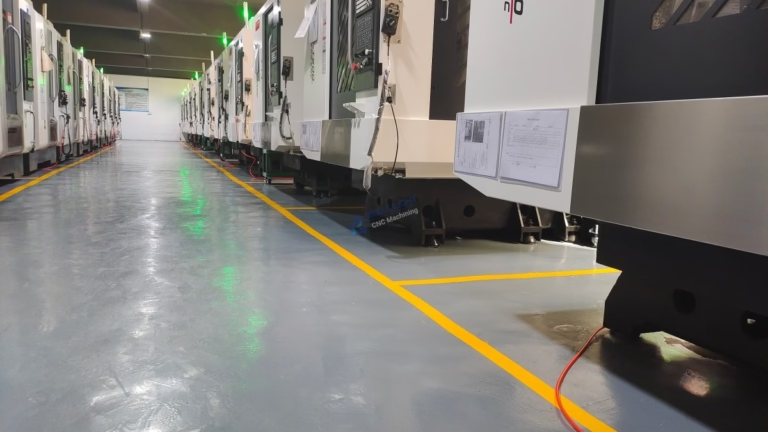
How the main CNC platforms actually compare
Numbers below reflect typical capability, not the best machine ever built.
| Platform | Setup count | Best for | Main limit |
|---|---|---|---|
| 3-axis | 1–3 fixtures | Prismatic parts, plates, simple pockets | No side access without re-fixturing |
| 4-axis | 1–2 fixtures | Shafts, slots, flats indexed around a bore | Cannot reach all six faces at once |
| 5-axis simultaneous | 1 fixture | Contoured surfaces, deep pockets, one-hit parts | Higher hourly rate, needs CAM skill |
| Mill-turn | 1 fixture | Cylindrical parts with milled features | Short Z travel on most models |
| 3-axis + second op | 2–4 fixtures | Low volume, loose tolerances, tight budget | Stacked setup error, longer queue time |
| 5-axis 3+2 indexed | 1 fixture | Angled holes, multi-face drilling | Not for continuous contour passes |
What is true about 3-axis CNC machines
A 3-axis mill moves X, Y and Z. The tool always points down at the part. That single fact explains both its strength and its ceiling. For flat plates, rectangular housings and parts with pockets on one face, nothing beats it on setup time or hourly rate.
The lie is that 3-axis work is low precision. It is not. A well-maintained 3-axis machine holds ±0.005 mm all day when the fixture is rigid and the tool is sharp. The limit is geometric, not dimensional. If a feature sits on the side of the part, you must unclamp, rotate and re-zero.
Every re-fixture adds a datum shift. Two setups can stack 0.02 mm of error before the cutter touches metal. On a bracket with a bearing bore and a mating face on opposite sides, that shift matters more than the machine's own accuracy.
So the real question is not how tight the machine can hold. It is how many times the part has to move. Count the setups before you compare quotes.
- 1Use it whenAll critical features are reachable from one or two directions.
- 2Skip it whenFeatures wrap around the part or sit at odd angles.
- 3Watch forThin walls that spring when the clamps release.
What is true about 4-axis CNC machines
A 4-axis mill adds a rotary table, usually Ø400 mm on our floor. The part turns while the tool stays in one plane. This is indexed work: cut, index 90°, cut again. It is not simultaneous motion.
For a shaft with flats, cross-drilled holes and a keyway, 4-axis cuts three setups down to one. Tolerance between features improves because the part never leaves the chuck. That is the honest gain, and it is a large one.
The myth is that 4-axis replaces 5-axis. It does not. A rotary table cannot tilt the tool into a deep pocket floor or reach under a flange. If the geometry needs the cutter to lean, 4-axis will stall on the drawing review.
Cost sits between the two. Hourly rate is lower than 5-axis, and CAM programming is simpler. For cylindrical parts with moderate complexity, it is often the cheapest correct answer.
- 1Use it whenFeatures repeat around a single axis of rotation.
- 2Skip it whenThe part needs true 3D contouring on a curved surface.
- 3Watch forLong parts that sag when only one end is supported.
Myths about other CNC machines worth dropping
Myth one: more axes always means tighter tolerance. Not true. A 5-axis machine with a worn rotary axis will lose position faster than a fresh 3-axis. Accuracy comes from calibration and maintenance, not from axis count.
Myth two: any shop with a 5-axis center can run any 5-axis job. Simultaneous motion needs post-processor work, collision checking and a programmer who understands tool vector control. The machine is the easy part.
Myth three: specialized machines are always slower to quote. In practice a mill-turn center can finish a part in one operation that would take three on separate machines. Fewer operations often means shorter lead time, not longer.
Myth four: cheap 3-axis is always the budget choice. Once you add three fixtures, two operators and a re-inspection between ops, the total can pass a single 5-axis run. Compare fully loaded cost, not hourly rate.
- 1Check calibration recordsAsk for the last rotary axis verification date.
- 2Check the post-processorAsk who wrote it and when it was last proven out.
How other CNC machines compare to 5-axis
Simultaneous 5-axis keeps the tool normal to the surface while it moves. That lets a short, stiff cutter reach into deep pockets and corners where a long 3-axis tool would chatter. Surface finish improves as a side effect, often to Ra 0.8–1.6 μm without extra hand work.
Our 16 simultaneous 5-axis centers run parts up to 4,000 mm in X on the large platform, with travel options of 750 × 1,150 × 550 mm and 600 × 600 × 600 mm on the mid-size machines. One fixture, one datum, all faces in a single program.
The trade-off is real. Programming takes longer, simulation is mandatory, and the hourly rate is higher. On a simple plate, 5-axis is wasted money. On a part with five setups and a ±0.02 mm true-position callout, it usually wins.
The 3+2 indexed mode sits in between. The table tilts to an angle and locks, then cuts like a 3-axis machine. You get multi-face access without the cost of full simultaneous motion. For angled holes and side drilling, that is often enough.
- 1Choose 5-axis whenFeature-to-feature tolerance depends on a single datum.
- 2Choose 3+2 whenFaces are flat but sit at many angles.
- 3Keep 3-axis whenThe part is a plate and volume is low.
The short answer
If your part has critical features on more than two faces, or a true-position callout under 0.05 mm, use 5-axis and pay for one setup. If features repeat around a single axis, 4-axis is the cheaper correct choice. If everything is reachable from the top, stay on 3-axis and spend the savings on material.
Questions engineers ask before choosing a platform
Does a higher axis count guarantee a tighter tolerance?
No. Tolerance comes from machine calibration, fixture rigidity, tool condition and thermal stability. A calibrated 3-axis machine holds ±0.005 mm reliably.
A 5-axis center with an unverified rotary axis can be worse. Ask for calibration records before you compare numbers.
When should I avoid 5-axis to save cost?
When every critical feature is reachable from one or two directions and the part is flat or prismatic. A plate with a few pockets does not need simultaneous motion.
Also skip it at very low volume where CAM programming time dominates the order. A 3-axis run with one extra fixture is often cheaper.
Can 4-axis handle undercuts?
Sometimes, if the undercut runs around the axis of rotation and a form tool can reach it. The rotary table indexes the part and the cutter approaches from the side.
If the undercut is on a curved surface that needs the tool to tilt, it will not work. That is 5-axis territory.
How do you decide the platform during quoting?
We read the drawing for feature direction, datum structure and the tightest true-position callout. Then we count setups on each candidate platform.
The quote includes a free DFM analysis within 12 hours, so you see the setup count and any tolerance risk before you commit.
What materials can run on these platforms?
Aluminium grades 6061, 7075, 2024 and ADC12; stainless 303, 304, 316L, 17-4PH; steels 1018, 4140, 4340; titanium TC4; Inconel; and plastics including POM, PEEK and PC.
Harder alloys cut slower on any platform, so the axis choice matters less than the toolpath and rigidity.
Do you support both prototyping and production runs?
Yes. There is no minimum order quantity, from one prototype to runs above 10,000 parts. Production can start within 24 hours of an approved program, and parts ship in 3–5 days.
150 technicians across 3 wholly-owned plants and 127 high-precision machines cover both ends of that range.
Send the drawing. We will tell you which platform fits.
Upload a STEP file and get a quotation with a free DFM analysis within 12 hours, including a recommended machine platform and setup count.
12-hour quote100% inspectionNDA on request
More machining notes
We publish setup notes, tooling trials and inspection data from the factory floor.











