
Who Is the Father of CNC Machine? Three Engineers, One Chain of Work
The question has a popular answer and a technically correct one. This page traces the father of CNC machine history from John Parsons' 1940s helicopter templates to the MIT servo-controlled mill and the punched tape that followed, then maps each step onto the G-code and toolpaths engineers run today.
In this article
- 1
- 2
- 3
- 4
- 5
- 6
Who Is the Father of CNC Machine? A Name and a Caveat
Ask ten machinists who the father of CNC machine is and most will say John T. Parsons. That answer is defensible. Parsons and his team at Parsons Corporation, working in Traverse City, Michigan, built the punched-card system that computed and cut the curved templates used to inspect helicopter rotor blades in the 1940s. His 1948 proposal to the U.S. Air Force for a digitally controlled contouring machine is what funded the next step. Without Parsons pushing the idea, the servo-driven mill would not have been commissioned when it was.
The caveat is that Parsons did not build a CNC machine. He built a numeric control system, a card reader, and a set of calculations. The machine that followed was designed by the Servomechanisms Laboratory at MIT, funded by the Air Force, and it cut metal in 1952. So the honest answer is a chain: Parsons defined the problem, MIT solved the servo problem, and the control builders turned it into a product.
Why engineers still argue about the title: the word 'father' implies one person, but numeric control needed three separate inventions to work. Position feedback, a stored program of coordinates, and a machine tool that could move on command. Each came from a different shop or lab. Parsons owned the first invention, MIT the second, and industry the third.
John Parsons and the Punched-Card Origin of Numerical Control
The problem Parsons faced in the mid-1940s was not machining. It was inspection. Helicopter rotor blades have a twisted, curved profile, and the check fixtures used to verify that profile had to be hand-filed from templates. Those templates were laid out by hand from coordinate tables, which took weeks and drifted from part to part. His fix was to compute the coordinate points on punched cards, then feed the cards to a machine that positioned a cutting head.
That machine was not a milling machine in the usual sense. It was a card-fed positioning system that drilled or cut a series of discrete points along a curve. The path was not smooth, but the coordinates were right. This is the first practical example of a stored program driving a machine tool. The program was a deck of cards, not a text file, but the logic is the same one a modern controller reads.
Parsons took the idea to the Air Force in 1948. The Air Force was buying swept-wing aircraft and needed contoured parts faster than hand layout could deliver. The contract that followed went to MIT, not to Parsons, because the servo problem was considered the harder engineering challenge. Parsons supplied the concept, the requirement, and the early hardware experience.
What Parsons did not have was closed-loop control. His system indexed to a position and stopped. It could not follow a continuous contour while the cutter was in the material at feed rate. That gap is the reason the MIT machine is usually treated as the first true NC mill and Parsons as the man who asked for it.
The MIT Servo Lab and the First Numerically Controlled Mill
In 1949 the Servomechanisms Laboratory at MIT began work on a milling machine controlled by a stored program of coordinates. The team included graduate students and staff who had worked on radar tracking and gun directors during the war. Their experience was in servo loops, not in chip making, and that shaped the design. The project was funded by the U.S. Air Force, which wanted contoured airframe parts cut without a skilled tracer hand.
The machine was a modified Cincinnati Hydro-Teletype vertical mill. Three axes were driven by hydraulic servo motors. Position feedback came from resolvers, and the command data arrived on punched paper tape. The tape held a sequence of coordinate instructions, read block by block. The controller compared commanded position to actual position and drove the servo until the error was near zero. That is a closed loop, and it is the defining feature of NC.
First cuts were made in 1952. The machine could follow a curved path at a controlled feed rate, which no tracer or template system could do as accurately on a complex contour. The tape was fragile, the electronics filled several racks, and the whole setup was far too expensive for a job shop. None of that mattered. The concept was proven.
Why this matters to a working machinist: everything in a modern controller descends from that loop. A Fanuc or Siemens control still reads a block, compares it to an encoder reading, and corrects the servo. The numbers have changed. The loop has not.
From Punched Tape to G-Code: Where the Computer Entered
For roughly two decades after 1952, NC machines were hard-wired. The controller could not be reprogrammed without changing the logic, and the tape had to be prepared on a separate machine. Changing a part meant making a new tape and often rewiring part of the control. Setup was slow and the machines were concentrated in large aerospace plants that could afford them.
The shift to CNC came when a general-purpose computer replaced the fixed logic. The first commercial CNC controller is usually credited to Fanuc, which introduced one in 1956, and the concept spread through the 1960s and 1970s. Now the control logic lived in software. A new part needed a new program, not a new circuit board. That single change is what pushed NC out of the aerospace plant and into general machining.
The programming language standardized as G-code, formalized in the 1960s and later published under ISO 6983. It survived because it describes motion in a way both humans and controllers can read. A line such as G01 X50.0 Y20.0 F250 tells the control to move in a straight line to a point at a feed rate. Every CAM system, from a small shop package to a full aerospace suite, posts to some dialect of that language.
The reason an engineer should care about the timeline is that machine behavior still reflects it. Old controls had limited look-ahead, so programmers used many short blocks and slowed down on corners. Modern controls look ahead hundreds of blocks and adjust feed automatically. Same G-code, very different motion.
What the Fathers of CNC Actually Invented, in Machining Terms
Strip away the history and the inventions reduce to three ideas that a machinist uses every day. The first is the stored program: the part geometry lives outside the operator's hands, as data. Once geometry is data, it can be edited, copied, sent over a network, and verified before the first cut. That is the reason a shop can machine a part in Dongguan from a file written in Ohio.
The second is the closed servo loop: the machine measures where it is and corrects toward where it should be. This is the difference between a machine that repeats a position and a machine that holds a tolerance. A control with position feedback can compensate for thermal growth, tool wear, and cutting force. It is why a modern machine can hold ±0.005 mm (±0.0002 in) on a production run.
The third is interpolation: the control computes the intermediate points between two programmed coordinates so the tool follows a smooth path. Straight-line and circular interpolation are the common forms. On a five-axis machine the control also interpolates the two rotary axes, which is what allows a ball nose cutter to stay normal to a curved surface.
None of these ideas is about a single machine. They are about moving control of geometry from the bench to the controller. Once that move happened, accuracy stopped depending on how steady a hand was and started depending on how good the loop and the program were.
Who Did What: Three Contributors Compared
Each row is one distinct invention. No single person covers all three.
| Contributor | Contribution | Years | Technical legacy |
|---|---|---|---|
| John T. Parsons | Punched-card coordinate system, Air Force proposal | 1940s-1948 | Stored program concept for machine tools |
| MIT Servo Lab | Closed-loop servo mill with tape reader | 1949-1952 | Position feedback and continuous contouring |
| Fanuc and control builders | Commercial computer-based controller | 1956 onward | Reprogrammable control logic, CNC |
| ISO and CAM vendors | Standardized G-code and post-processors | 1960s onward | Portable part programs across machines |
How to Answer the Question in a Meeting
Use Parsons if you mean the man who framed the problem and built the first card-driven positioning system. Use the MIT Servo Lab if you mean the first closed-loop machine tool that cut a continuous contour. Use Fanuc if you mean the first commercial CNC. All three are correct; the question is which link of the chain you are pointing at.
Frequently Asked Questions
Was the first numerically controlled machine a mill or a lathe?
The first NC machine tool was a vertical milling machine, a modified Cincinnati Hydro-Teletype, at MIT in 1952.
NC turning followed later. Lathes needed reliable tool changers and spindle indexing before the control could be useful on a production floor.
Why is MIT credited instead of Parsons for the first NC machine?
Parsons built a positioning system that moved to a point and stopped. It could not follow a contour while cutting.
MIT added closed-loop servo control, which let the machine track a continuous path at a controlled feed rate. That is the feature that defines NC machining.
Is there a single father of CNC machine, or was it a team?
It was a chain of teams. Parsons framed the requirement, MIT built the first working closed-loop mill, and Fanuc and other control builders turned it into a commercial product.
Picking one name is a shorthand. The technology needed a stored program, position feedback, and a reprogrammable controller before it worked.
When did hard-wired NC become CNC?
The change came when a general-purpose computer replaced fixed control logic. Fanuc introduced a commercial CNC controller in 1956, and the approach spread through the 1960s and 1970s.
After that, changing a part meant changing a program, not rebuilding the control.
Does this history change how I program a part today?
It explains a few habits. Old controls had limited block look-ahead, so programmers broke contours into many short moves and slowed the feed at corners.
Modern controls look ahead hundreds of blocks and adjust feed automatically, so a clean CAM toolpath usually runs better than a hand-broken one.
Why does the closed loop matter for tolerance?
A machine without feedback repeats a commanded position and drifts with heat and load. A machine with feedback measures actual position and corrects the error.
That correction is what lets a production run hold ±0.005 mm instead of drifting across the batch.
Have a Part That Needs the Modern Version of That Loop
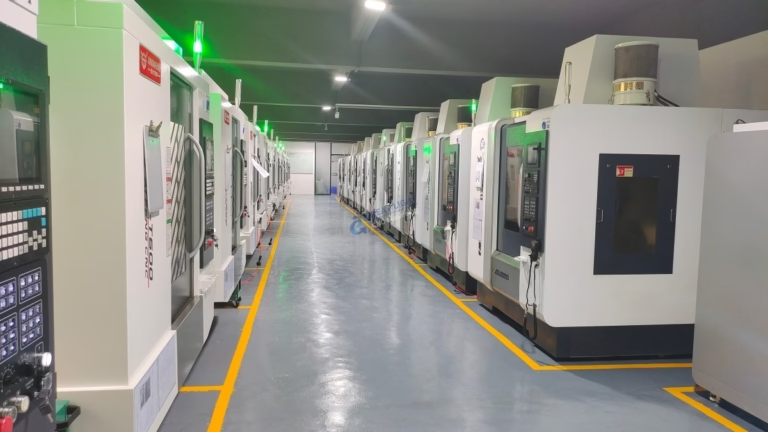
Send us your files and get a quotation with free DFM analysis within 12 hours. We machine prototypes and production runs on 127 high-precision CNC machines, including 16 simultaneous 5-axis centers, with 100% inspection before shipment.
12-hour quote100% inspectionNo minimum order quantity
More from GreatLight
We publish setup notes, tooling trials and inspection data from the factory floor.











