GreatLight CNC Machining Factory logo
CNC Machining
Rapid Prototyping
Materials
Industries
News
About GL

Get Instant Quote

Machinist Resources

Machinist Resources for CNC Part Design

Guides, comparison tables and material data written by machinists who run the parts. Use them to pick a grade, set a tolerance and avoid the design habits that add cost.

±0.005 mm toleranceRa 0.2–0.8 μm finish303 vs 304 vs 316Grade 2 titaniumAnodizing and platingNo minimum order
CNC Lathe Technical Specifications Terminology
15 yearsMachining since 2011
127High-precision CNC machines
±0.005 mmAchievable tolerance
3–5 daysTypical part shipment
Common Problems

Where Machining Projects Go Wrong

Four failures we see in incoming files every week. Each one is avoidable at the drawing stage.

01

The drawing says 316, the part needs 303

316 resists corrosion but galls and work-hardens, so it needs slower feeds and more inserts. On a part with no chloride exposure, you pay two to three times the cycle time for nothing. Ask what the environment actually is before you lock the grade.

02

Tolerance stacked on every dimension

A block with ±0.01 mm on all six faces gets probed, re-fixtured and re-cut. Only the mating features need tight limits. Blanket tolerances on a cosmetic face add cost and measure nothing. Mark the fits that matter and leave the rest at general tolerance.

03

A pocket the tool cannot reach

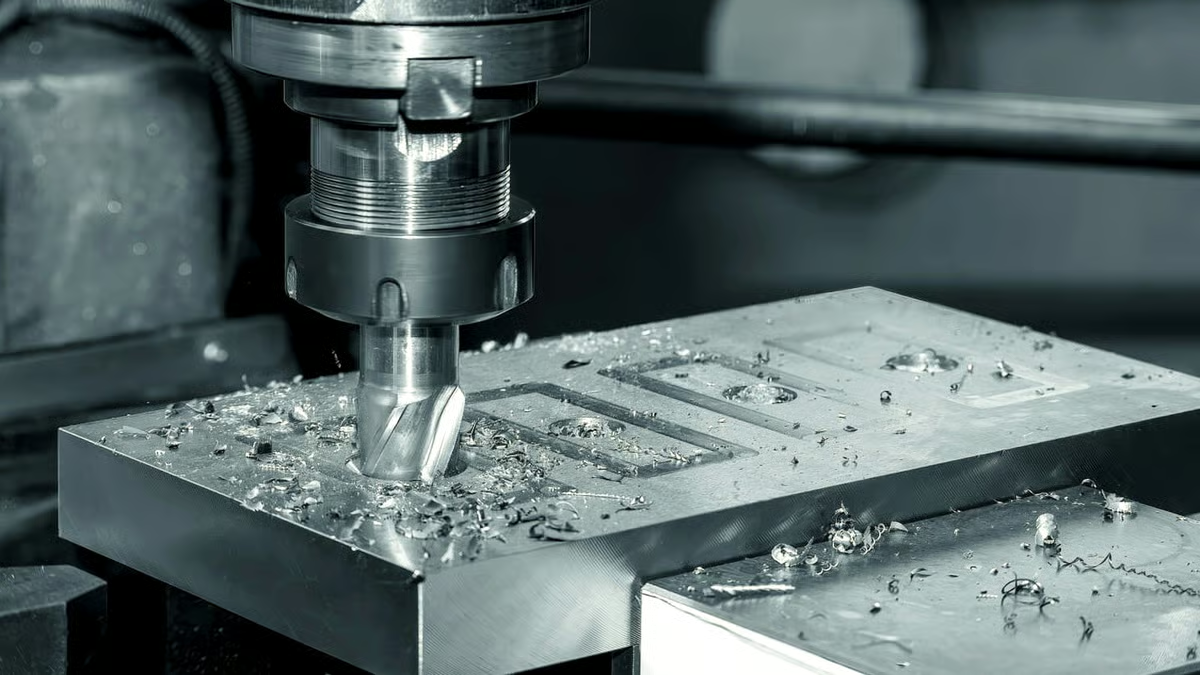
Deep pockets with sharp internal corners force a small end mill. Small tools deflect, so you lose accuracy and slow the spindle down. A 2 mm corner radius on a 10 mm deep pocket lets one larger tool finish it in a single pass. That single radius often removes a whole setup.

04

Wall thickness that moves after the cut

Thin floors and unsupported walls spring back when the vise releases. The part measures fine on the machine and out of spec on the bench. If the wall is under 1 mm, expect to stress-relieve the stock first or add a temporary rib.

How We Help

Data You Can Cut Parts With

Each guide answers one question and stops there.

CNC Machining Services Online
Material Selection

Pick the Grade by the Failure Mode

Most grade questions are really wear questions. 303 stainless machines fast and holds a good finish, but it corrodes in chloride. 304 costs a little more to cut and survives most indoor environments. 316 goes where salt or sterilisation is present.

Titanium follows the same logic. Grade 2 covers chemical and marine brackets. Grade 5 (Ti-6Al-4V) goes where the load is high and weight matters. Both cut at low surface speed, and both need sharp tooling with plenty of coolant.

  • 1
    303Free-machining austenitic. Best finish and cycle time, weakest corrosion resistance.
  • 2
    304 / 316Higher corrosion resistance, slower feeds, more tool wear. 316 for chloride.
  • 3
    Grade 2 / Grade 5Commercially pure for corrosion, Ti-6Al-4V for strength-to-weight.

Get Instant Quote

cnc machining
Prototyping

What Drives Prototype Cost

Prototype price is set by three things. Setup and programming is a fixed block no matter how many parts you run. Machining time scales with material removal and the number of setups. Inspection grows with the tolerance count.

A part that needs one setup and general tolerances can land on the bench in days. The same geometry split across four faces and three tight bores will cost several times more for the same volume of metal.

We quote the first article and the small batch together, so you can see where the curve flattens before you commit.

  • 1
    SetupsEach new face needs a fixture, a probe cycle and a re-datum.
  • 2
    TolerancesEvery tight feature adds a CMM step and a report.
  • 3
    MaterialBar stock, plate and near-net shapes differ in cost and lead time.

Get Instant Quote

Quick Reference

Grade and Finish Decision Table

Use the failure mode and the environment to narrow the choice.

RequirementMaterialNotes
Best machinability, dry indoor use303 stainlessFree-cutting, poor in chlorides
Cost plus corrosion resistance304 stainlessCommon for brackets and covers
Salt spray or sterilisation316 / 316LSlower feeds, more tool wear
Chemical or marine, low loadGrade 2 titaniumWeldable, needs slow speeds
High load, low weightTi-6Al-4V (TC4)Rigid setup, sharp tooling
Wear surface, tight fit440C or 17-4PHHeat treat after roughing
Cheap covers and housings6061-T6 aluminiumAnodizes well, stable
High-strength structural7075 aluminiumLower corrosion resistance
Services

What We Run From This Shop

One supplier from first article to production, with finishing in house.

01

5-Axis CNC Machining

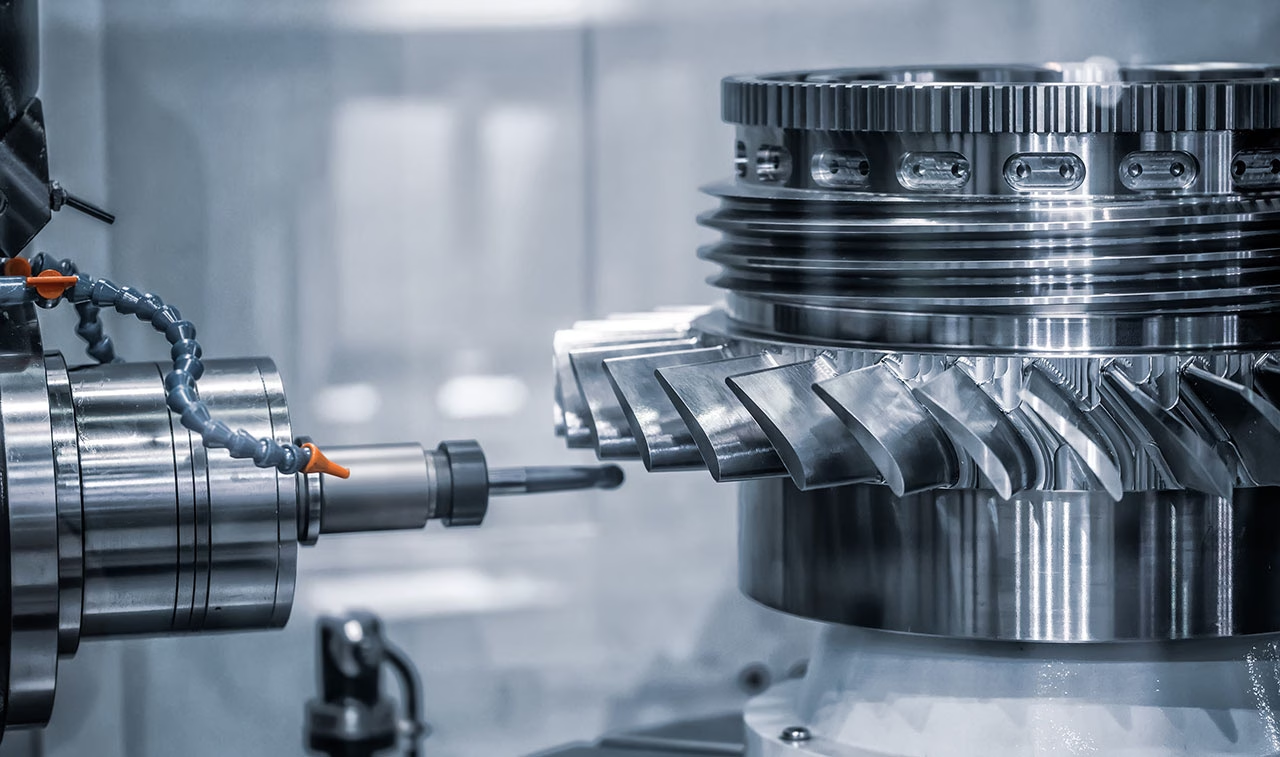
Sixteen simultaneous 5-axis centers handle contoured faces and multi-face work in one setup. Maximum processing size is 4,000 mm.

02

CNC Milling and Turning

Three-axis, four-axis and mill-turn capacity for prismatic parts and turned shafts, including a Ø400 mm rotary table.

03

Rapid Prototyping

First articles machined from solid, inspected and shipped in 3–5 days so you can test the design before tooling.

04

Sheet Metal Fabrication

Brackets, chassis and enclosures formed and finished alongside the machined parts, keeping one tolerance chain.

05

3D Printing and Vacuum Casting

Resin and polymer parts for fit checks and low-volume housings when machining is not the right answer.

06

Surface Finishing

Anodizing, plating, powder coating, bead blasting and laser marking to a minimum character height of 1.5 mm.

Scope

Capacity and Included Work

What a standard order covers.

ItemDetailValue
ToleranceAchievable on tight features±0.005 mm
FinishFine machiningRa 0.2–0.8 μm
FinishHigh-quality machiningRa 0.8–1.6 μm
Largest travelLarge gantry work4,000 × 400 × 150 mm
Batch sizeNo minimum order1 to 10,000+ parts
InspectionBefore shipment100% inspection
ReportingOn requestMaterial and dimensional
Why GreatLight

Numbers Behind the Shop

Six facts an engineer can check against a drawing.

15Y

Machining Since 2011

Fifteen years on the same site in Dongguan, plus a Singapore factory at No.3 Joo Koon Circle.

127

CNC Machines

Sixteen simultaneous 5-axis centers, twelve four-axis mills, twenty-seven three-axis machines and sixteen mill-turn centers.

±0.005

Achievable Tolerance

Held on production parts, not just on a sample. Equivalent to ±0.0002 in.

99.99%

Qualification Rate

Parts that pass final inspection on the first submission.

12h

Quote and DFM

Quotation and free DFM analysis returned within 12 hours of the upload.

24h

Production Start

Machining can begin within 24 hours after drawing release and material confirmation.

7,600 m²Manufacturing space
150Technicians on staff
3Wholly-owned plants
<2%Historical late-delivery risk
Delivered Work

What Industries Ask For

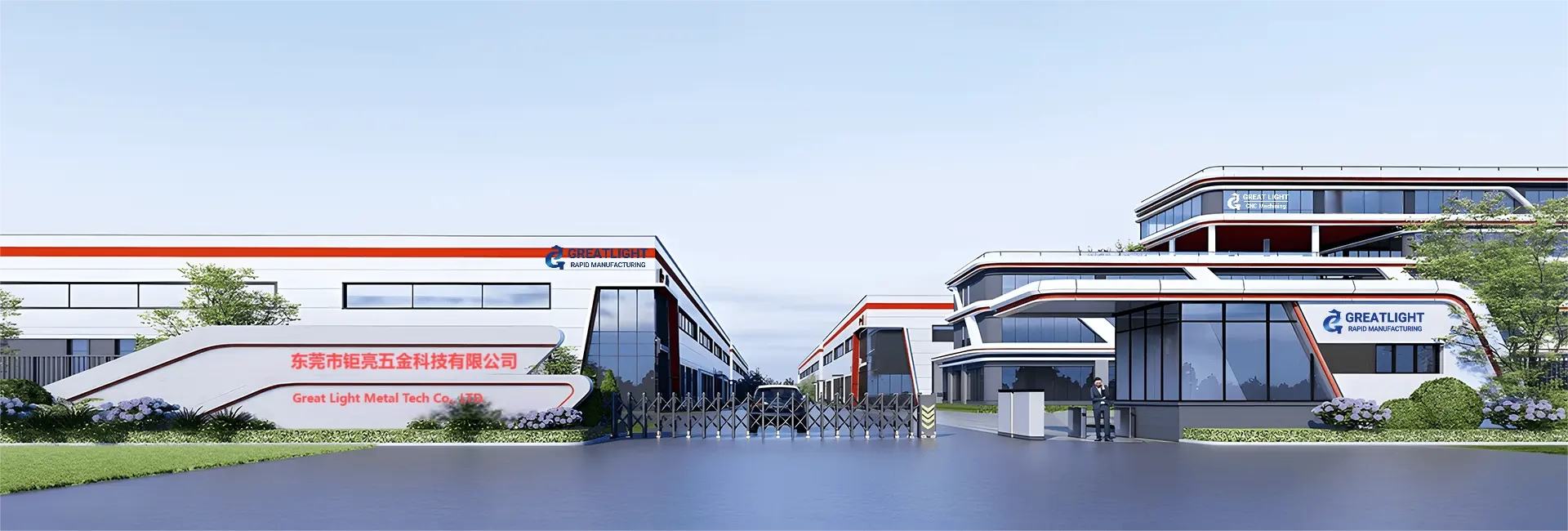
GreatLight Metal new factory building

Aerospace Brackets

Thin-wall aluminium brackets machined in one setup with witness marks for inspection.

  • ±0.005 mm
  • 100% inspection
  • DFM in 12 h
Leader in Cnc Machining Service China

Medical Device Housings

316L and titanium housings finished to Ra 0.8–1.6 μm with passivation and clean handling.

  • ISO 13485
  • Ra 0.8–1.6 μm
  • 316L
6011

Robotics Joint Parts

Mill-turn shafts and gearbox plates with bores held concentric across two setups.

  • Mill-turn
  • Concentric bores
  • 3–5 day ship
oplus_262178

Automotive Fixtures

4130 and 4140 fixture plates with hardcoat anodized locating faces and laser-marked IDs.

  • IATF 16949
  • 4140
  • Hardcoat anodize
FAQs

Questions From the Shop Floor

Which stainless grade should I pick for a general bracket?

304 covers most indoor brackets and covers. It machines slower than 303 but survives humidity and most cleaning agents.

Pick 303 only when cycle time matters more than corrosion, and there is no chloride in the environment. Go to 316 or 316L for salt spray, marine air or repeated sterilisation.

Is Grade 2 titanium good enough, or do I need Grade 5?

Grade 2 is commercially pure. It welds easily and resists chemicals, but its yield strength is roughly half that of Ti-6Al-4V.

Use Grade 2 for ducting, marine brackets and chemical fixtures. Move to Grade 5 when the part carries real load or when weight matters. Both need low surface speed and sharp tooling.

What does a prototype actually cost?

Three inputs set the price: programming and setup, machining time, and inspection. Setup is a fixed block regardless of quantity.

A single-setup part with general tolerances is the cheapest shape to quote. Every extra face, tight bore or specified finish adds a step you can count on the drawing.

How tight a tolerance can I reasonably call out?

±0.005 mm is achievable on a machined feature with the right setup and inspection. It is not free, and it does not belong on every dimension.

Put tight limits on fits and datum features. Leave cosmetic and clearance dimensions at general tolerance. Blanket tight tolerances add cost and do not improve function.

Can you machine a 4,000 mm part?

Yes. The largest travel is 4,000 × 400 × 150 mm. Medium machines cover 750 × 1,150 × 550 mm and 600 × 600 × 600 mm.

Long parts need support planning, because deflection in the middle is usually the limiting factor rather than the machine envelope.

Do you run one-off parts or only production?

Both. There is no minimum order quantity. We machine single prototypes and runs above 10,000 parts.

For one-offs we quote the first article and a small batch together, so you can see how the price changes with quantity before committing.

Which finishes can you apply in house?

Anodizing in clear, colour, hardcoat and conductive types; electroless nickel, zinc, silver and gold plating; powder coating and black oxide; bead blasting, tumbling, brushing and polishing.

Laser marking and engraving are available with a minimum character height of 1.5 mm. Tell us which features must stay bare for electrical contact.
How do you handle confidential drawings?

Uploads are secure and confidential. An NDA is available on request before you send files.

If the part is under NDA, tell us at the quote stage so we can keep the DFM report limited to the parties on the agreement.

Send the Drawing, Get the Answer

Upload a STEP file and we return a quotation with free DFM analysis within 12 hours.

12-hour quote100% inspectionNo minimum orderNDA on request

Trusted by engineers and manufacturers worldwide

Tesla Ford Motor Company BYD Auto Denso Magna International Boeing Airbus Medtronic KUKA FANUC