GreatLight CNC Machining Factory logo
CNC Machining
Rapid Prototyping
Materials
Industries
News
About GL

Get Instant Quote

Shop Reference

Machinist Resources

Reference notes for machinists and engineers: which alloys are magnetic, how 6061 and 7075 behave at the spindle, and what finish to specify. Written from the shop floor, not from a catalog.

±0.005 mm toleranceRa 0.2–0.8 μm finish6061 to 707515 years in Dongguan
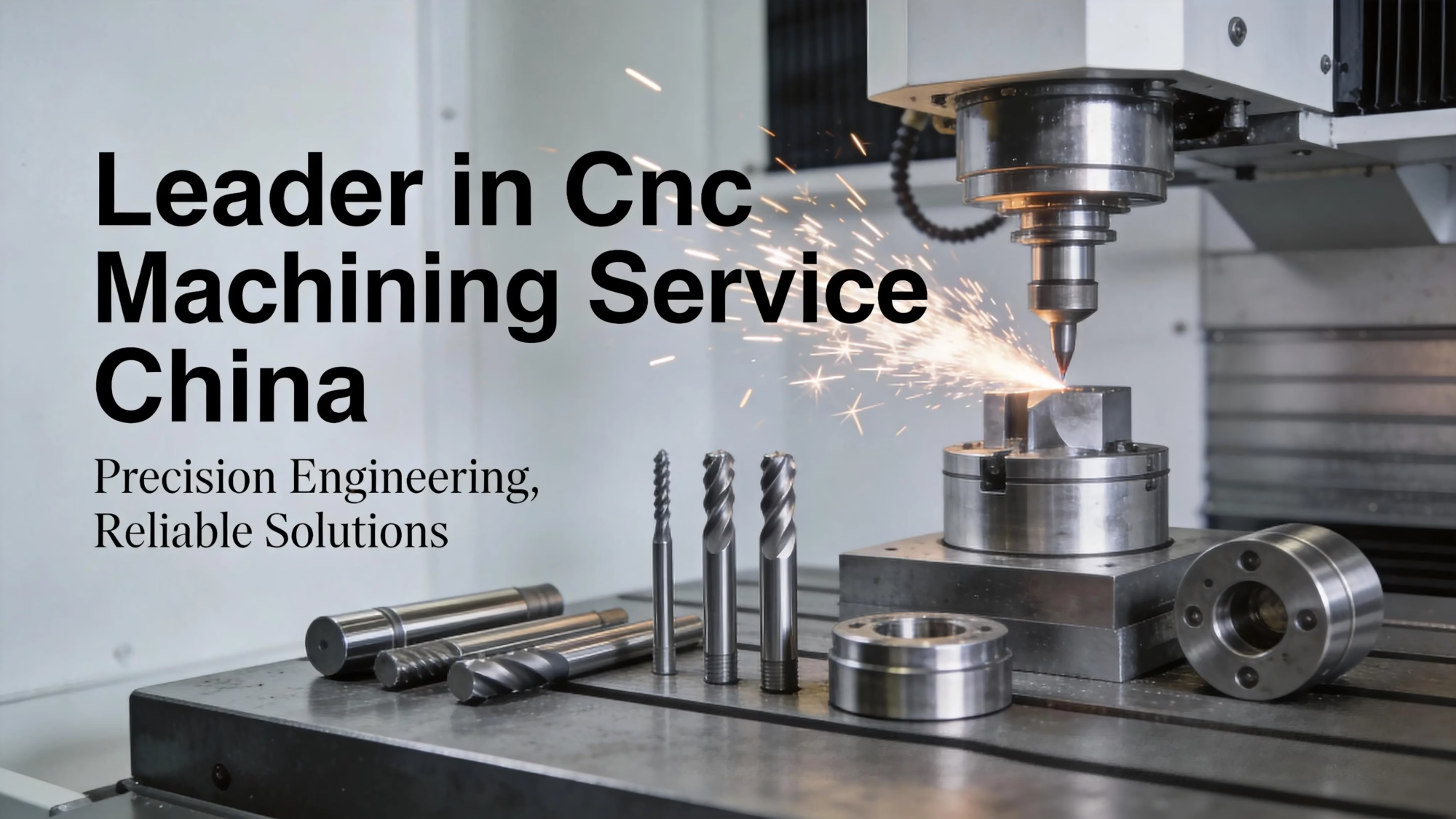
Leader in Cnc Machining Service China
127High-precision CNC machines
16Simultaneous 5-axis centers
±0.005 mmAchievable tolerance
15 yearsMachining since 2011
Common problems

Where a machinist question turns into a scrapped part

Most of the questions below cost money when they are answered late.

01

You picked 7075 for a part that needed weldability

7075 machines beautifully and finishes bright, then cracks at the weld or corrodes at a fastener interface. The material choice was made from a chart, not from the drawing's loading. Rework means restarting the part.

02

You assumed 304 was non-magnetic

Annealed 304 is nearly non-magnetic. Cold work from turning, thread rolling, or bending shifts it enough that a reed switch or a magnetic sensor starts reading the part. The fix is usually 316L or a redesign, not a tighter tolerance.

03

The finish call was made too late

Anodizing a part that already passed final inspection adds a 5–20 μm build on every surface, including the thread flanks and dowel bores. If the finish was not in the model from the start, the assembly no longer fits.

04

You quoted a tolerance the process cannot hold

A ±0.005 mm bore across a 400 mm length is not a lathe problem, it is a fixturing and thermal problem. Quoting it without a process review puts the whole order at risk before the first chip is cut.

How we help

Answers you can put on the shop floor

Material behavior, finish build, and process limits, explained with numbers.

CNC Lathe Technical Specifications Terminology
Material selection

Magnetic behavior decides the alloy, not the data sheet

A magnet is a quick check on any incoming bar stock. Aluminum, copper, brass, and austenitic stainless in the annealed state do not hold a magnet. Carbon steel, 400-series stainless, and any cold-worked austenitic grade will. That single test catches mixed material before it reaches the spindle.

The harder case is when a part has to stay non-magnetic after machining. Turning and thread rolling cold-work the surface, so 304 can pick up enough permeability to trip a sensor. For those parts we go to 316L with a passivation step, or to titanium and aluminium if the load allows it.

  • 1
    Magnet test incoming stockSorts 304 from 316 and 400-series in seconds.
  • 2
    Grade change beats tolerance chasingIf a sensor reads the part, move to 316L.
  • 3
    Document the grade on the travelerHeat number and condition travel with the part.

Talk to an Engineer

6011
Alloy behavior

6061 vs 7075 is a tool life decision

6061-T6 cuts clean at high spindle speed, welds, anodizes evenly, and holds a thread without drama. For brackets, housings, and anything that will be welded or hardcoated, it is the default for good reason. The ceiling is strength: about 276 MPa yield.

7075-T6 roughly doubles that yield strength, which is why it shows up in airframe fittings and high-load linkages. It also chips differently, work-hardens at the cutter, and does not weld. Anodizing it needs care because the copper content darkens the coating and can leave it brittle at sharp corners. Pick 7075 for stiffness and load, not because it machines faster.

  • 1
    6061-T6Weldable, anodizes evenly, 276 MPa yield.
  • 2
    7075-T6Roughly double the yield, no welding, shorter tool life.
  • 3
    6063Extrusion-friendly and easier to polish, lower strength.

Get Instant Quote

Selection table

Alloy and finish calls that stop rework

Use this when the drawing leaves the grade or finish open.

DecisionPick thisWatch out for
Non-magnetic housing316L, 6061, brassCold-worked 304 turns magnetic
High load, no weld7075-T6No welding, harder on tooling
Weldment bracket6061-T6, 5052Not 7075 or 2024
Mirror polish6063, 6061Soft alloys gouge easily
Corrosion plus load17-4PH, 316LHeat treat before finish
Cheap prototype6061, ABSCheck tolerance before finish
Tight bore, long partStress-relieved 4140Machining stress moves the bore
Services

What we run when the calls are made

One shop for the prototype and the production run.

01

5 Axis CNC Machining

16 simultaneous 5-axis centers handle contoured faces, deep pockets, and features that would need three setups on a 3-axis machine.

02

CNC Milling & Turning

27 three-axis mills, 12 four-axis mills, and 16 mill-turn centers cover prismatic parts and turned parts down to a Ø400 mm rotary table.

03

Rapid Prototyping

From a single prototype to 10,000+ part runs, with no minimum order quantity and production starting within 24 hours.

04

Sheet Metal Fabrication

Brackets, enclosures, and chassis work that pair with machined inserts and need consistent bend allowances.

05

Part Surface Finishing

Anodizing, plating, powder coating, bead blasting, brushing, and laser marking with a 1.5 mm minimum character height.

06

Custom 3D Printing

Plastic and carbon-fibre parts for fit checks and fixtures before the machined version is cut.

Capability

Machine and process scope

Numbers straight from the floor.

ItemRangeNotes
Maximum part size4,000 mmLargest travel 4,000 × 400 × 150 mm
Standard travels750 × 1,150 × 550 mmAlso 600 × 600 × 600 mm
Tolerance±0.005 mm±0.0002 in on qualified features
Fine finishRa 0.2–0.8 μmAs-machined is Ra 1.6–3.2 μm
MaterialsAl, steel, stainlessPlus titanium, Inconel, brass, plastics
Inspection100% before shipmentReports on request
Qualification rate99.99%In-process monitoring plus final check
Why GreatLight

Shop data, not slogans

The reasons that show up in a first-article report.

15Y

Machining since 2011

Three wholly-owned plants and 150 technicians, with the process knowledge that comes from running the same alloy families for years.

127

CNC machines under one roof

Milling, turning, mill-turn, and 5-axis capacity in one plant means fewer handoffs and one inspection record for the whole order.

12H

Quote and DFM in 12 hours

Send a model and get a quotation plus a free DFM analysis back within 12 hours, including callouts on features that will not hold.

24H

Production starts in 24 hours

Once the drawing and finish calls are locked, material is issued and the first setup goes on the machine the next day.

100%

Inspection before shipment

Raw material check, in-process monitoring, and final inspection on every order. Measurement reports on request.

1 pc

No minimum order quantity

One prototype or 10,000+ parts, quoted on the same process plan so the production run matches the sample.

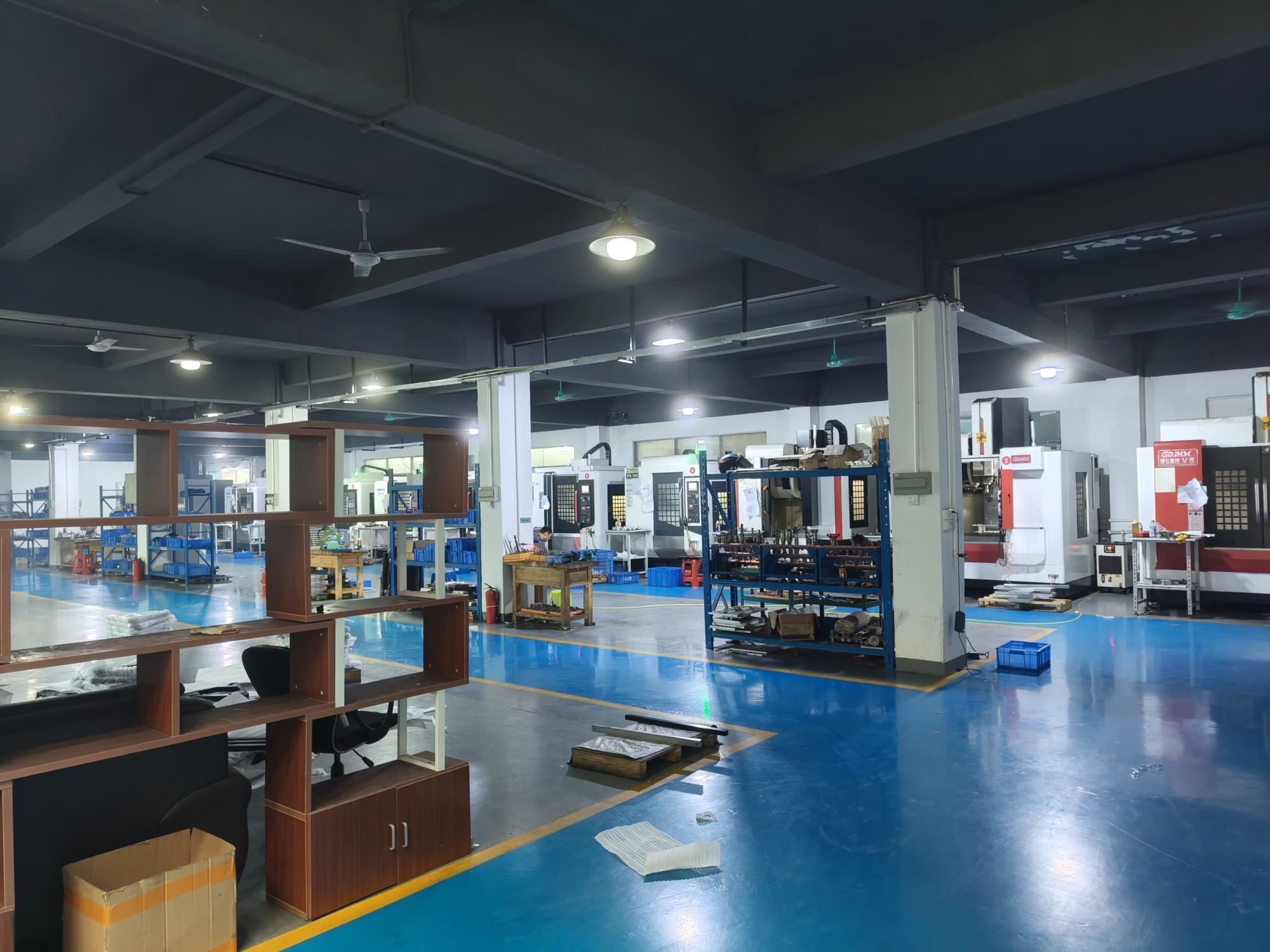
7,600 m²Manufacturing space
3Wholly-owned plants
<2%Historical late-delivery rate
99.99%Qualification rate
What we deliver

Industry requirements and how we meet them

GreatLight Metal new factory building

Automotive & EV

Housings and brackets that must hold position through heat cycles and vibration.

  • IATF 16949
  • ±0.005 mm
  • 100% inspection
CNC Machining Services Online

Medical Devices

Non-magnetic 316L and titanium parts with clean, burr-free edges and documented material.

  • ISO 13485
  • Ra 0.2–0.8 μm
  • 316L
oplus_262178

Robotics & Automation

Linkages and end-effector plates in 7075 where stiffness drives the design.

  • 7075-T6
  • 5-axis
  • 3–5 day ship
CNC Machining Services Comparison 2026 Fictiv vs Xometry vs GreatLight

Industrial Machinery

Large 4,000 mm frames and weldments that need flatness after machining.

  • 4,000 mm
  • 4140
  • Stress relief
FAQs

Questions we get from machinists and buyers

Is aluminum magnetic?

No. Aluminum and its alloys are paramagnetic, which means they respond to a magnetic field only microscopically and will not hold to a magnet.

That is one reason aluminum housings are used around magnetic sensors and reed switches. If a part must be non-magnetic, 6061, 6063, 2024, and 7075 all qualify.

Is titanium magnetic?

Commercially pure titanium and Ti-6Al-4V are both non-magnetic in practice. They will not stick to a magnet.

The exception is contamination. Titanium that has picked up iron from tooling or handling can show a weak pull. Clean the part and re-test before you reject it.

Is copper magnetic?

No. Copper, brass, and bronze are non-magnetic, which is why C101, C110, and C36000 are common around electrical and sensor assemblies.

Beryllium copper is also non-magnetic after the usual heat treatment, though it costs far more and needs its own handling rules.

Is steel magnetic?

Carbon steel and most alloy steels are strongly magnetic. That covers 1018, 1045, 4130, 4140, 4340, and tool steel.

Stainless is the mixed group. Ferritic and martensitic grades such as 430, 420, and 440C are magnetic. Austenitic grades such as 304, 316, and 316L are near non-magnetic when annealed and become weakly magnetic after cold work.

What is the difference between 6061 and 6063 aluminum?

6063 is made for extrusion and anodizing. It polishes and takes a clear anodize more evenly, but it is softer and lower in strength than 6061.

6061-T6 is the structural choice. It welds, machines cleanly, and holds threads. Use 6063 for trim, frames, and cosmetic parts; use 6061 when the part carries load.

How do I choose between 6061 and 7075?

Start from the load case. If the part is welded, hardcoated, or cost-sensitive, 6061-T6 is the answer at roughly 276 MPa yield.

If stiffness or strength drives the design and there is no weld, 7075-T6 gives roughly double the yield strength. Expect shorter tool life, more attention to chip evacuation, and a darker anodized finish.

Polished nickel or chrome for a wear surface?

Electroless nickel lays down an even 5–25 μm layer and covers inside corners and bores that a plating line cannot reach evenly. It is the safer call for complex geometry.

Chrome is harder and more wear-resistant on an exposed surface, but it builds on edges and needs a polishing step. For a shaft in a bushing, chrome. For a complex bracket, nickel.

How does a finish change my dimensions?

Anodizing adds roughly half the coating thickness to each surface, so a 20 μm coating grows a feature by about 20 μm overall. Threads, dowel bores, and press fits are where this shows up first.

Tell us the finish before we cut. We can leave stock, mask the critical features, or hold the pre-finish dimension so the part still fits after coating.

Send the drawing, get a process answer

We reply with a quotation and a free DFM analysis within 12 hours, and we flag any callout the process cannot hold.

12-hour quote100% inspectionNo minimum order quantityNDA on request

Trusted by engineers and manufacturers worldwide

Tesla Ford Motor Company BYD Auto Denso Magna International Boeing Airbus Medtronic KUKA FANUC