
5 Essential Index CNC Techniques to Drastically Cut Your Machining Costs
Indexing means moving the part or the spindle to a new orientation without re-clamping, so one setup does the work of three or four. This guide covers five index CNC techniques and the part shapes each one actually suits. Written for design engineers and sourcing staff who quote multi-face parts.
Where the Money Actually Goes on a Multi-Face Part
A three-axis machine needs a new setup for every new face. The operator unclamps the part, wipes the vise, re-dials the datum, and re-probes. That is 20 to 45 minutes of spindle-down time per flip, and each flip adds a tolerance stack on top of the last one.
Indexing removes most of that. The part stays clamped while a rotary table or trunnion rotates it to the next orientation, so the datum never gets re-established by hand. Setup time drops, operator variation drops, and the quoted price stops carrying four separate fixturing events.
The saving is not automatic. A part with one flat face and a few holes is cheaper to run on a three-axis machine with a simple vise. Indexing earns its keep when a part has features on three or more faces, tight true position between those faces, or geometry that cannot be reached without tilting.
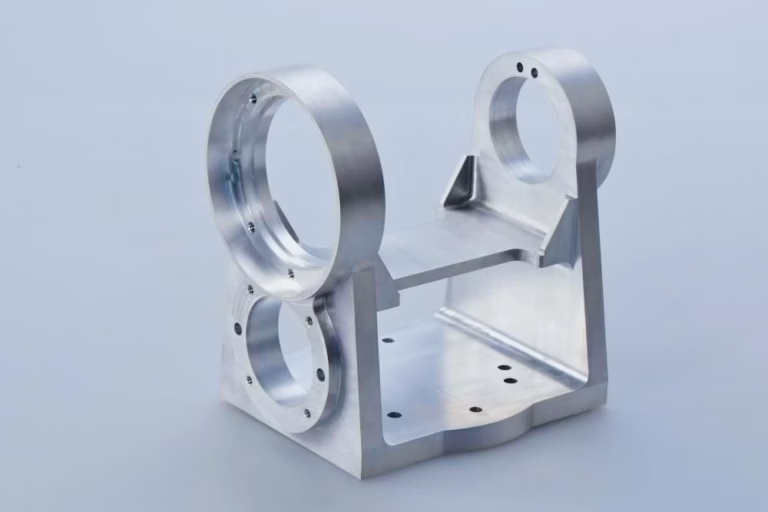
- 1Good fitHousings, brackets, manifolds, and joints with features on three or more faces
- 2Poor fitFlat plates and single-face parts; setup savings do not cover programming time
Indexable Fixtures: One Clamp, Six Faces
The first of the five index CNC techniques is workholding design. Build the fixture so the part can be rotated or tilted between operations with no human intervention. A programmable index table or a five-axis trunnion lets you cut the top, bottom, and all four sides in a single clamping cycle.
The tolerance argument matters more than the labor argument. Every re-clamp reintroduces datum error, and on a part with a ±0.005 mm bore-to-bore callout that error is often the difference between passing and reworking. Holding one datum for the whole cycle keeps the stack short.
This approach suits medium-complexity parts with undercuts, side ports, or angled faces. It does not suit parts so large that the trunnion cannot swing them, or parts with a single critical face where a dedicated vise is faster to set up.
Which Indexing Setup Fits Which Part
Match the geometry to the machine before you commit to a quote.
| Part characteristic | Setup to use | Why |
|---|---|---|
| Features on 2 faces | 3-axis with a vise | Indexing programming cost is not recovered |
| Features on 3-4 faces | 4-axis with rotary table | One clamp, sides reached by rotation |
| Undercuts and angled faces | 5-axis trunnion | Tool can tilt to reach the feature |
| Long shaft with end features | Mill-turn center | Turning and milling in one cycle |
| Thin wall, 0.8 mm | 5-axis, light indexed passes | Support stays under the wall |
| Deep holes plus side holes | 4-axis with indexed drilling | Drill cycle runs at each index |
Toolpath Indexing: Cutting Out the Air Moves
The second technique is CAM work, not hardware. Program the toolpath so it coincides with the part's natural indexing positions. Rotate only when the next feature actually needs a new orientation, and the machine stops sweeping through empty space between faces.
Most CAM packages can output an indexing strategy that groups operations by part orientation. Group them badly and the table rotates back and forth twenty times per cycle. Group them well and it rotates three or four times. On a part with a 40-minute cycle, that alone can recover several minutes of non-cutting motion.
Watch the clearance planes. A toolpath written for a three-axis machine often retracts to a safe Z that no longer exists once the part is tilted. Recheck every retract and approach on the indexed setup, or the first run will scrap the part.
Indexed Deep-Hole Drilling with Peck Cycles
Deep holes are where index CNC techniques drastically change the cost picture. Drilling a Ø6 mm hole 90 mm deep on a three-axis machine means either a long, fragile drill or a second setup on a different machine. Index the part and the same spindle can drill from both ends.
Use a peck cycle matched to the depth-to-diameter ratio. For a 15× ratio in 6061, a peck of one diameter with full retract clears chips reliably. In 316L stainless, shorten the peck and slow the feed, or the drill work-hardens the bottom of the hole.
Indexing also lets you drill cross-holes without breaking the setup. The main bore stays on the same datum as the cross-hole, so concentricity and intersection angle hold without a second operation.
- 1Chip clearingFull retract on deep aluminum holes; partial retract on shorter stainless holes
- 2CoolantThrough-tool coolant where the drill allows it; otherwise aim external nozzles at the entry
- 3When to stopBeyond roughly 20× diameter, consider gun drilling instead of a peck cycle
Index Milling for Thin Walls and Tight Corners
Thin walls deflect. The usual fix is to leave material and take light finishing passes, which costs time. Index milling offers a second option: rotate the part so the tool approaches the wall from a direction that lets the remaining stock support it.
A wall machined at 0.8 mm thickness in aluminum will chatter if the tool pushes straight into it with no backing. Index the part 90° and the wall becomes a floor for that pass, stiff in the direction of the cutting force. Then rotate back and finish the other side.
The same trick helps with deep pockets and internal corners. Indexing lets a shorter, stiffer tool reach a corner that would otherwise need a long reach tool running at reduced feed. Short tools chatter less, so you can hold Ra 0.8–1.6 μm without a separate finishing operation.
Combining Turn and Mill in One Indexed Cycle
The fifth technique is process integration. A mill-turn center does turning and milling on the same spindle, indexing the part between the two without a second machine or a second fixture. For a shaft with a turned diameter and milled flats or a cross-hole, that removes an entire queue move.
The gain is largest on parts that would otherwise travel between a lathe and a mill. Each trip adds handling, a new datum, and a day of lead time. Keeping both operations in one cycle keeps the datum and the schedule intact.
It is not the right call for everything. A simple turned bushing with no milled features belongs on a lathe. A part with heavy milling relative to turning may cut faster on a dedicated mill. The mill-turn advantage shows up when both operations are substantial and the part is awkward to re-chuck.
Questions Engineers Ask About Indexing
How much setup time does indexing actually save?
It depends on how many faces the part has. A part with features on four faces that would need four three-axis setups collapses into one indexed cycle.
The saving comes from removing the re-clamp, re-dial, and re-probe steps, not from faster cutting. Quoted on a per-part basis, the effect grows with order quantity because the setup is amortized over more parts.
At what quantity does index CNC become worth it?
There is no threshold that fits every part. The deciding factor is feature count and tolerance, not volume.
A one-off prototype with undercuts on five faces can still be cheaper on a 5-axis indexed setup, because the alternative is five setups. A flat bracket at any volume stays cheaper on a three-axis machine.
Does indexing reduce achievable tolerance?
It usually improves it. Features cut in one clamping cycle share a single datum, so the stack between them is shorter than across multiple setups.
Our 5-axis centers hold ±0.005 mm on indexed features when the fixture is rigid and the part is supported. Loose fixturing will cost you more than the extra setup would.
Which materials suit indexed deep-hole drilling?
Aluminum grades such as 6061 and 7075 drill cleanly with a standard peck cycle. Stainless 303 and 316L need shorter pecks and more coolant.
Titanium TC4 (Ti-6Al-4V) and Inconel generate more heat at the drill tip, so feed and speed need to come down and the peck depth needs to shrink further.
Can you quote an indexed setup from a 3D file?
Yes. Send the STEP or native CAD file and we return a quotation plus a DFM analysis within 12 hours.
The DFM note will flag any feature that would be cheaper to redesign for indexing, and any wall or corner that will need a specific approach.
What is the maximum part size for indexed machining?
Our largest travel is 4,000 × 400 × 150 mm, and we run a Ø400 mm rotary table for indexed work.
Parts beyond those envelopes can still be machined, but the fixture design has to be reviewed before we quote.
Send the Part, Get an Indexing Plan
Upload your CAD file and we return a quotation with a free DFM analysis within 12 hours, including a note on which indexing setup fits the geometry.
12-hour quote100% inspection±0.005 mmNDA on request









