
7 Secrets to Find the Best CNC Machine Companies Near Me
A practical checklist for engineers and sourcing teams comparing local CNC suppliers. It covers what to ask, which numbers matter, and when a shop is the wrong fit for your part.
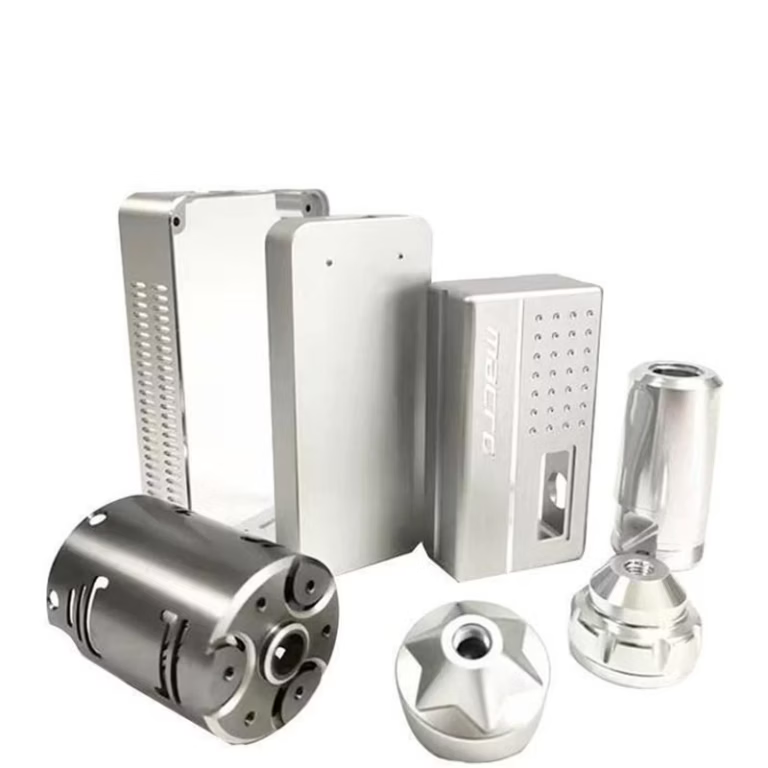
Seven checks that separate a real shop from a good website
Search results all look the same. The differences show up on the floor, in the inspection room, and in the documents a supplier is willing to send before you place an order.
Request the machine list instead of trusting the word advanced
Every supplier page says advanced equipment. That phrase tells you nothing. What you need is a table: machine type, axis count, work envelope, spindle, and control.
Axis count sets the ceiling on geometry. A shop running only three-axis mills can still make excellent prismatic parts, but undercuts and contoured pockets need multiple fixtures. Each refixture adds stack-up error and handling time.
Our own floor runs 127 high-precision CNC machines across three wholly-owned plants covering 7,600 m² in Dongguan and Singapore. That includes 16 simultaneous 5-axis machining centers, 12 four-axis mills, 27 three-axis machines, 16 mill-turn centers, wire EDM, mirror-spark EDM, and metal 3D printers. Maximum processing size is 4,000 mm.
When quoting a job, we match the part to the machine before we talk about price. A 4,000 × 400 × 150 mm travel machine suits long structural parts. Compact 500 × 500 × 450 mm travels suit small, tight-tolerance work where thermal stability matters more than envelope.
- 1Machine listType, axis count, travel, spindle speed, control model
- 25-axis countSimultaneous 5-axis, not indexed 3+2 only
- 3Support processesEDM, mill-turn, and additive in the same building
- 4Envelope fitConfirm your largest part fits with room for fixtures
Certifications should match your industry, not just your inbox
ISO 9001:2015 is the baseline. It proves a quality system exists, nothing more. If your part goes into a car, a ventilator, or an aircraft, that baseline is not enough.
IATF 16949:2016 comes from the automotive world. It forces documented traceability, process capability tracking, and change control. Automotive buyers who skip it often pay for re-certification later when the part moves into production.
ISO 13485:2016 applies to medical devices. It covers design transfer, clean handling, and record retention. For aerospace and defense work, ask how the shop handles material certs, first-article inspection, and nonconformance reports.
We hold ISO 9001:2015, IATF 16949:2016, ISO 13485:2016, and ISO 27001:2022. Those four cover quality, automotive, medical, and information security. A supplier holding only one of them is fine for general machining and risky for regulated programs.
Tolerance claims need data behind them
Anyone can print ±0.001 mm on a landing page. The question is whether that number holds across a production run, on a Friday shift, in summer humidity.
Our stated tolerance is ±0.005 mm (±0.0002 in). Surface finishes run Ra 0.2–0.8 μm for fine work, Ra 0.8–1.6 μm for high-finish requirements, and Ra 1.6–3.2 μm as-machined. Qualification rate across shipped lots is 99.99%.
Process capability is the number that predicts yield. Ask for Cpk on the critical dimensions of a similar part. A Cpk below 1.33 means the process is marginal and inspection will catch rejects instead of preventing them.
Then request a first-article inspection report. If the supplier hesitates, that is your answer. A shop that measures its own work will send the data without being pushed.
- 1Tolerance±0.005 mm (±0.0002 in) across production
- 2Finish rangeRa 0.2–0.8 μm fine, Ra 1.6–3.2 μm as-machined
- 3Cpk threshold1.33 or better on critical dimensions
- 4FAI reportDimensional data on the first part, before volume
What to weigh when comparing two nearby shops
Use the same questions on every supplier and score them side by side.
| Check | Weak signal | Strong signal |
|---|---|---|
| Equipment list | Brochure photos only | Machine table with travels |
| Certifications | ISO 9001 alone | IATF 16949 or ISO 13485 added |
| Tolerance proof | Claim on the website | Cpk data and FAI reports |
| Process chain | Machining only | Finishing, heat treat, assembly in-house |
| Engineering input | Order taking | DFM feedback before quoting |
| Data handling | Email attachments | ISO 27001 and signed NDA |
Check the process chain, because parts rarely end at the spindle
A machined part is not a finished part. It may need anodizing, plating, heat treatment, powder coating, or assembly before it ships. Every handoff to a second vendor adds lead time and a new place for damage or mix-ups.
Ask which finishing steps happen under the supplier's own roof. Anodizing, electroless nickel, zinc, silver and gold plating, powder coating, black oxide, bead blasting, tumbling, brushing and polishing, and laser marking can all be handled in one facility.
We also run vacuum casting, sheet metal fabrication, die casting, and 3D printing alongside CNC. That matters when a program needs a machined prototype and a cast production part from the same drawing. The geometry review happens once.
The trade-off is real. A shop that does everything in-house may not be the cheapest on any single step. What you gain is one inspection record, one shipping schedule, and one point of contact when something changes.
Good suppliers push back on your drawing before they quote
Order takers accept any file and quote it as-is. That feels efficient until the first parts arrive with a wall too thin to hold tolerance or a feature the tool cannot reach.
We send a quotation and a free DFM analysis within 12 hours. That review flags deep pockets that need a smaller tool, sharp internal corners that will need EDM, and datum schemes that will not survive a second operation.
Engineering collaboration also shows in material choice. Picking 7075 over 6061 for a bracket that sees no load adds cost with no benefit. Switching from 304 to 316L matters when the part sees chlorides. Those calls belong in the review, not in a revision cycle.
Production can start within 24 hours once the drawing and material are confirmed. Parts ship in 3–5 days. Historical late-delivery probability sits below 2%.
Traceability and data security are part of the part
Traceability starts at the raw material certificate and runs through in-process monitoring to final inspection. We inspect 100% of parts before shipment and keep raw material checks, in-process records, and final reports on file. Reports go out on request.
Ask how nonconformances are handled. A shop that tracks rejects, finds the root cause, and tells you before you ask is a shop that will not hide a bad lot.
Data security matters more than most buyers admit. Your files include geometry, tolerances, and sometimes the product itself. ISO 27001:2022 covers information security management: access control, incident handling, and supplier risk.
Uploads are secure and confidential. An NDA is available on request if your program needs one before files move. For defense, medical, or unreleased consumer products, that paperwork should exist before the first STEP file is uploaded.
Questions engineers ask before sending a drawing
How do I verify a tolerance claim without visiting the shop?
Request a first-article inspection report and Cpk data on a comparable part. Look for the measurement method, the instrument used, and the ambient temperature at inspection.
If the supplier sends a certificate with no numbers, treat the tolerance claim as unverified.
Do I need IATF 16949 if my part is not automotive?
Not always. General industrial and robotics parts usually run fine under ISO 9001:2015. The automotive standard matters when your customer requires PPAP documentation or when the part will move into a vehicle program later.
Medical work is different. ISO 13485:2016 is the relevant system there.
What is the smallest order a CNC supplier will take?
This varies widely. Some shops set a minimum of several hundred parts to justify setup. We have no minimum order quantity and run from a single prototype up to 10,000+ part runs.
For one-off work, expect the setup and programming cost to dominate the unit price.
Which materials can be machined in one shop?
Aluminium grades 6061, 7075, 2024, 5052 and ADC12; stainless 303, 304, 316L, 17-4PH and 440C; steels including 1018, 4140 and 4340; copper and brass such as C110 and C36000; titanium TA2 and TC4; Inconel; magnesium AZ31B and AZ91D; and plastics from ABS and POM to PEEK and carbon fibre.
Material availability drives lead time more than machine capacity does.
How should I send files to protect the design?
Send a STEP or native CAD file through a controlled channel, not a personal email account. Ask for a signed NDA before the first upload if the product is unreleased.
A supplier with ISO 27001:2022 has documented controls for access and incident response.
When is a local CNC shop the wrong choice?
If your part needs a process the shop does not run, such as large-format forging or a specialty coating, you will end up managing a subcontractor anyway.
Also walk away if the shop cannot show inspection data on request. Price will not fix an unverifiable tolerance.
Send a drawing and get a straight answer
Upload your files for a quotation and free DFM analysis within 12 hours. Uploads are secure and confidential, and an NDA is available on request.
12-hour quote100% inspectionNo minimum order quantity±0.005 mm tolerance









