
A Brief Introduction to the Vertical Machining Center
This page explains what a vertical machining center is, how its spindle orientation shapes the parts it can cut, and how to tell when a VMC is the right machine for a job. Written for design engineers and sourcing teams who need to read a quote or a process plan and know what drives cost.
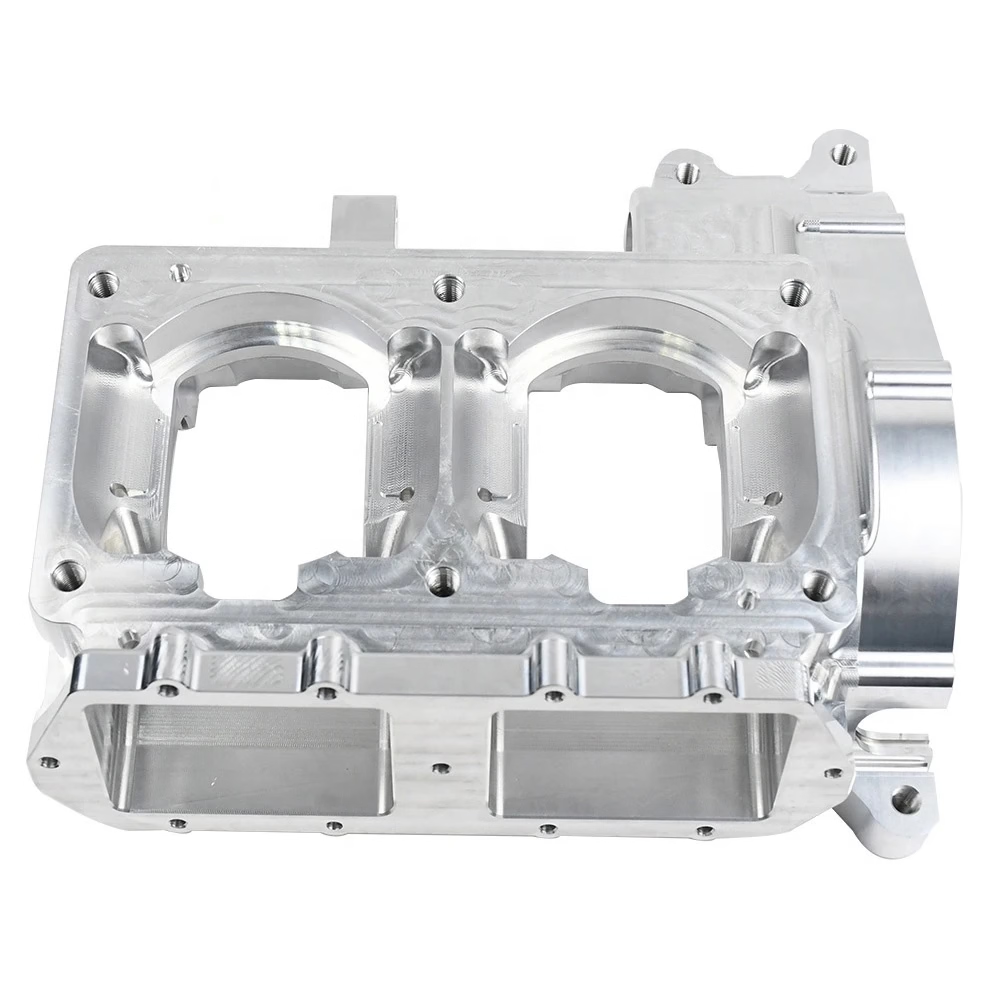
What a vertical machining center actually is
A vertical machining center (VMC) holds the spindle vertically and moves the worktable or the column underneath it. Everything else in the machine follows from that one decision.
Spindle orientation and what it decides
The spindle on a VMC points down at the table. Gravity helps here: chips fall away from the cut instead of sitting on the workpiece, and coolant drains naturally. Fixturing is straightforward because the operator loads the part from the front, flat on the table, with no need to reach around a horizontal spindle.
That vertical layout also sets the limit. A part taller than the spindle can reach, or one that needs deep pockets on four sides, may force a rethink. A horizontal machining center handles those cases better because the spindle comes in from the side and the part can be rotated on a tombstone.
For most plate work, brackets, housings, molds and small shells, the vertical arrangement is the simpler answer. Setup takes less time, the part is easier to measure, and the operator can see the cut.
Axis configurations: 3-axis, 4-axis, 5-axis
A 3-axis VMC moves X, Y and Z. The tool stays perpendicular to the table, so every face you cut must be reachable from the top or from a re-fixture. Simple parts run fast and cheap this way.
Add a rotary table and you get a 4-axis machine. The part can index to different faces without a second setup, which helps for parts with features on four sides. We run 12 four-axis mills, some with a Ø400 mm rotary table.
A 5-axis VMC adds tilt and rotation together. The tool can approach the part from almost any angle, so undercuts, angled holes and contoured surfaces come off in one setup. We keep 16 simultaneous 5-axis machining centers. The trade-off is programming time and a tighter setup window, so we only route a job to 5-axis when the geometry genuinely needs it.
For long parts, a travel of 4,000 × 400 × 150 mm covers most of what a vertical machine can hold. Medium work fits 750 × 1,150 × 550 mm or 600 × 600 × 600 mm. Compact work runs on 500 × 500 × 450 mm or 500 × 310 × 200 mm travels.
Matching the machine to the part
Use this as a first filter when you are reading a process plan or writing an RFQ.
| Part feature | Best fit | Why |
|---|---|---|
| Flat plate, pockets top only | 3-axis VMC | One setup, no rotary table needed |
| Features on four sides | 4-axis VMC | Index instead of re-fixture |
| Angled holes, undercuts | 5-axis VMC | Tool reaches without a second op |
| Part taller than Z travel | Horizontal or split op | Vertical spindle cannot reach |
| Long shaft, 4,000 mm | Large-travel VMC | Table and travel match the length |
| High-volume simple part | 3-axis with fixture | Fast cycle, low programming cost |
Tooling, workholding and the real cycle time
A VMC is only as good as its tooling. A tool holder with low runout keeps the cutter on size, especially in small-diameter end mills where deflection shows up as taper in the wall. We hold ±0.005 mm on parts that call for it, and that number depends on the holder, the cutter and the material as much as the machine.
Workholding drives cycle time more than spindle speed in many jobs. A soft jaw set cut to the part profile lets you load and unload in seconds. A vise with a stop is fine for one-offs. For a 10,000-part run, a dedicated fixture pays back within days.
Surface finish is a process choice. As-machined surfaces land around Ra 1.6–3.2 μm. A finishing pass gets to Ra 0.8–1.6 μm. Fine finishing with a small stepover reaches Ra 0.2–0.8 μm, but it costs time, so we only quote it where the drawing calls for it.
- 1Tool holder runoutLow runout protects hole size and wall straightness on small cutters.
- 2Fixture designLoad and unload time is often the largest cycle-time lever.
- 3Finishing strategyStepover and feed set the finish; tighter finish means more time.
- 4MaterialAluminium cuts fast; titanium and Inconel need slower feeds and lighter passes.
What we cut on vertical machines
Aluminium is the workhorse. Grades 6061, 6061-T6, 2024, 5052, 5083, 6063, 6082, 7075 and ADC12 all run on a VMC, with 7075 and 2024 giving higher strength where a part needs it. Stainless comes next: 303, 304, 316, 316L, 420, 430, 431, 440C and 17-4PH each machine differently, and 17-4PH in the H900 condition is hard on tooling.
Steel grades 1018, 1045, 4130, 4140, 4340, A36 and tool steel are common for structural and wear parts. Copper and brass families C101, C103, C110, beryllium copper, C27400, C28000 and C36000 cut cleanly and hold tight tolerances. Titanium TA1, TA2, TC4 (Ti-6Al-4V), Inconel and magnesium AZ31B / AZ91D are also in scope, though they need slower parameters.
Plastics run on the same machines with different cutters and feeds. ABS, PC, PMMA, POM, PA, PEEK, PP, HDPE and carbon fibre all appear in prototype and low-volume work. Carbon fibre is abrasive, so tool life is short and we plan for it.
Finishing follows the material. Anodizing in clear, colour, hardcoat or conductive versions suits aluminium. Electroless nickel, zinc, silver and gold plating cover conductive and wear needs. Powder coating, black oxide, bead blasting, tumbling, brushing and polishing handle appearance and surface prep. Laser marking and engraving work down to a minimum character height of 1.5 mm.
Where a VMC stops being the right answer
A VMC is not always the cheapest route. If a part is a thin-walled tube with cross holes on every face, a mill-turn center may finish it in one cycle while a VMC needs three setups. We keep 16 mill-turn centers for exactly that case.
If the part is a flat sheet with simple bends, sheet metal fabrication beats milling on cost. If it is a complex internal cavity, die casting or vacuum casting may be the better first step, with machining only on the critical faces.
The honest rule: use a VMC when the geometry is prismatic, the features are reachable from a few directions, and the tolerance is tighter than a casting can hold. When the part is mostly flat or mostly formed, ask before assuming the mill is the answer.
We run 127 high-precision CNC machines across three wholly-owned plants in 7,600 m², with 150 technicians, so the routing decision is made on geometry and volume, not on what happens to be free.
Common questions
How tight a tolerance can a vertical machining center hold?
We hold ±0.005 mm (±0.0002 in) on parts that require it. That number depends on the material, the feature and the setup, not on the machine alone.
Every order goes through a raw material check, in-process monitoring and a final inspection before shipment. Reports are available on request.
When should I choose 5-axis over 3-axis?
Pick 5-axis when the part has angled holes, undercuts or contoured surfaces that would otherwise need two or three re-fixtures.
If every feature is reachable from the top, 3-axis is faster and cheaper. Programming time on 5-axis is higher, so it only pays off when the geometry needs it.
What is the largest part you can machine on a vertical center?
Our largest travel is 4,000 × 400 × 150 mm. Medium work fits 750 × 1,150 × 550 mm or 600 × 600 × 600 mm. Compact work runs on 500 × 500 × 450 mm or 500 × 310 × 200 mm.
If your part exceeds those envelopes, tell us the dimensions and we will route it to the right machine.
How do you handle prototypes and small batches?
There is no minimum order quantity. We run from one prototype to 10,000+ part runs on the same equipment.
Quotation and a free DFM analysis come back within 12 hours, and production can start within 24 hours. Parts typically ship in 3–5 days.
Can you machine titanium and Inconel on a VMC?
Yes. TA1, TA2, TC4 (Ti-6Al-4V) and Inconel are in our standard material list, along with magnesium AZ31B and AZ91D.
These grades need slower feeds, lighter passes and more attention to tool wear, so cycle time is longer than the same part in aluminium.
How do you protect my drawings and data?
Uploads are secure and confidential. We hold ISO 27001:2022 for information security and can sign an NDA on request.
Our quality system is certified to ISO 9001:2015, IATF 16949:2016 and ISO 13485:2016 for medical work.
Send us the drawing and we will tell you the right machine
Upload a STEP or DXF file. You get a quote and a free DFM analysis within 12 hours, with the routing explained.
12-hour quote100% inspectionNo minimum orderNDA on request









