
Aluminium CNC Machining Services: Alloy, Tolerance and Finish Decisions
This page is for design engineers and buyers who need machined aluminium parts and want to specify them correctly the first time. It covers which alloy fits which job, what tolerance and surface finish are realistic, how part geometry drives cost, and where aluminium stops being the right choice. Read it and you can write a drawing that a machine shop will quote without a round of questions.
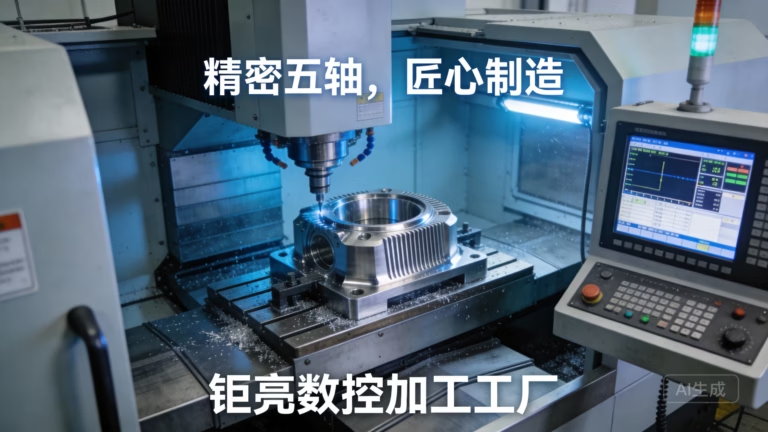
What decides an aluminium part's cost and quality
Three variables control almost everything: alloy choice, feature geometry, and how the part is held during cutting.
Pick the alloy before you pick the tolerance
Aluminium is not one material. A drawing that says "aluminium, 6061-T6" machines and behaves very differently from one that says 7075-T6 or 2024-T351. The alloy sets your strength, your corrosion resistance, how the part finishes, and how much the blank costs before a cutter touches it.
For most brackets, housings and fixtures, 6061-T6 is the safe default. It welds, anodizes cleanly, holds ±0.005 mm on stable features, and is cheap relative to the high-strength grades. When weight matters more than cost, 7075-T6 gives roughly twice the yield strength of 6061 but machines slower and does not weld. Fatigue-critical or aerospace work often points to 2024, which machines well but needs protection against corrosion.
The 5000 and 6000 series fill the gaps. 5052 and 5083 bend and form without cracking, so they suit sheet-style parts and enclosures. 6082 sits close to 6061 with slightly better strength. ADC12 is a die-casting alloy, not a billet grade, so it only appears in this shop when a casting needs secondary machining.
A simple rule: match the alloy to the load path and the environment, then let the tolerance follow. Choosing 7075 for a part that sees no real stress just adds cost and tool wear.
- 16061-T6General purpose, welds, anodizes well, good strength-to-cost ratio.
- 27075-T6High strength for weight-critical parts; poor weldability, slower cutting.
- 32024-T351Fatigue resistance; needs anodize or coating for corrosion.
- 45052 / 5083Best formability; used for bent and formed aluminium parts.
How part geometry decides the machine and the price
A part that can be cut from three sides is a three-axis job. Add an angled face, an undercut, or a hole that meets a curved surface at an odd angle, and the setup count climbs. Each additional setup adds fixturing time, and fixturing time is often the largest single line on an aluminium quote.
Five-axis work pays for itself when a feature would otherwise need three or four separate operations. Impellers, optical mounts, medical housings and manifolds with cross-drilled ports all fall into that group. On our floor, 16 simultaneous 5-axis centers and 16 mill-turn centers handle the parts that cannot be re-fixtured without losing position. For everything else, a well-designed 3-axis setup with soft jaws is faster and cheaper.
Thin walls are the other cost driver. Aluminium cuts easily, but a 0.8 mm wall will deflect under tool pressure and chatter. Below roughly 1 mm, expect to add support material, light passes and extra inspection. The same applies to deep pockets with small corner radii: a Ø3 mm end mill in a 40 mm deep pocket means a long, thin tool and a slow feed rate.
Send the 3D model and the critical dimensions early. We run a free DFM review and reply within 12 hours, which is usually enough time to flag a wall thickness or a corner radius before the design freezes.
We keep tolerances at ±0.005 mm when the drawing calls for it, but not every dimension needs that. Tolerancing only the features that mate with something else keeps the part machinable and the price honest.
Aluminium grades we machine and what they are for
A quick selection guide. All grades are held as bar or plate stock.
| Grade | Typical use | Machinability | Notes |
|---|---|---|---|
| 6061-T6 | Brackets, housings, fixtures | Good | Welds and anodizes cleanly |
| 6061 | General machining, prototypes | Good | Softer temper, easier to cut |
| 7075-T6 | Aerospace, weight-critical parts | Moderate | High strength, no welding |
| 2024-T351 | Fatigue-loaded components | Good | Needs corrosion protection |
| 5052 | Enclosures, formed panels | Fair | Excellent bendability |
| 5083 | Marine, welded structures | Fair | Good corrosion resistance |
| 6063 | Extrusions, frames | Good | Common in profile stock |
| 6082 | Structural parts | Good | Similar to 6061, slightly stronger |
| ADC12 | Die-cast parts, secondary ops | Fair | Cast alloy, not billet |
Surface finish and inspection: what to specify
As-machined aluminium sits around Ra 1.6–3.2 μm. If a sealing face or a bearing bore needs better, we machine to Ra 0.8–1.6 μm, and fine finishing reaches Ra 0.2–0.8 μm on demand. Tighter finish costs cycle time, so put it only on the surfaces that need it.
Anodizing is the default protective and cosmetic finish. Clear anodize keeps the metal look, colour anodize adds a controlled tone, hardcoat raises wear resistance, and conductive anodize keeps electrical contact where a masking step is not practical. Type and thickness should be on the drawing, because they change the final dimension by a few micrometres per surface.
Other options include electroless nickel, zinc, silver and gold plating, powder coating, black oxide, bead blasting, tumbling, brushing and polishing. Laser marking handles part numbers and logos down to a minimum character height of 1.5 mm. Masking and finish build-up are worth a note on any part with tight mating surfaces.
Inspection runs at 100% before shipment: raw material check, in-process monitoring, and final inspection, with reports available on request. For a first article, ask for the report and check the critical dimensions against your model before the run continues.
Our qualification rate sits at 99.99%. That number comes from catching problems in-process rather than at final inspection, which is why we monitor dimensions while the part is still on the machine.
Where aluminium is the wrong choice
Aluminium loses to steel when the part needs high stiffness in a small section, wears against another metal, or sees high temperatures. A steel or stainless part may cost more per kilo but survive in service where an aluminium one would not.
Very high volumes also change the picture. Above roughly 10,000 parts a year, die casting or forging with secondary machining often beats cutting from solid, because the blank cost and cycle time drop. We offer metal die casting for exactly that transition, and we machine the castings afterward.
Extreme aspect ratios are another limit. A 2 mm wide, 100 mm deep slot in aluminium will chatter or break tools regardless of the machine. Redesigning the feature as an open channel or splitting the part usually costs less than forcing the cut.
If your part is a thin shell with no tight features, sheet metal fabrication or vacuum casting may serve better. Aluminium CNC machining services earn their place when the part has real 3D geometry, tight tolerances, or a small-to-medium quantity that does not justify tooling.
Common questions
What tolerance can you hold on aluminium parts?
We hold ±0.005 mm (±0.0002 in) on features that need it. That figure depends on the feature, not the whole part.
Tell us which dimensions are critical and we will confirm what is achievable before quoting.
What is the smallest order you accept?
There is no minimum order quantity. We run from one prototype to 10,000+ part runs.
A single part goes through the same inspection as a production batch.
How fast can I get parts?
Quotation and free DFM analysis come back within 12 hours. Production can start within 24 hours, and parts ship in 3–5 days.
Historical late-delivery probability is below 2%.
Which aluminium grades do you stock and machine?
6061, 6061-T6, 2024, 5052, 5083, 6063, 6082, 7075 and ADC12. Other grades are sourced on request.
The grade table above shows typical uses for each.
Can you sign an NDA before I send drawings?
Yes. An NDA is available on request, and uploads are secure and confidential.
We do not share customer files or part designs with third parties.
Send a model, get a machinability answer
Upload your aluminium part and we will return a quote plus a free DFM review within 12 hours. No minimum order quantity, NDA on request.
12-hour quote±0.005 mm100% inspectionNo MOQ









