
Anodized CNC Parts: Alloys, Types and Tolerance Control
Anodizing turns an aluminum surface into an oxide layer that resists corrosion and wear. It also changes dimensions, and that is where most problems start. This page covers which alloys anodize well, how Type II and Type III differ, and how to keep tolerances on anodized cnc parts after the bath.
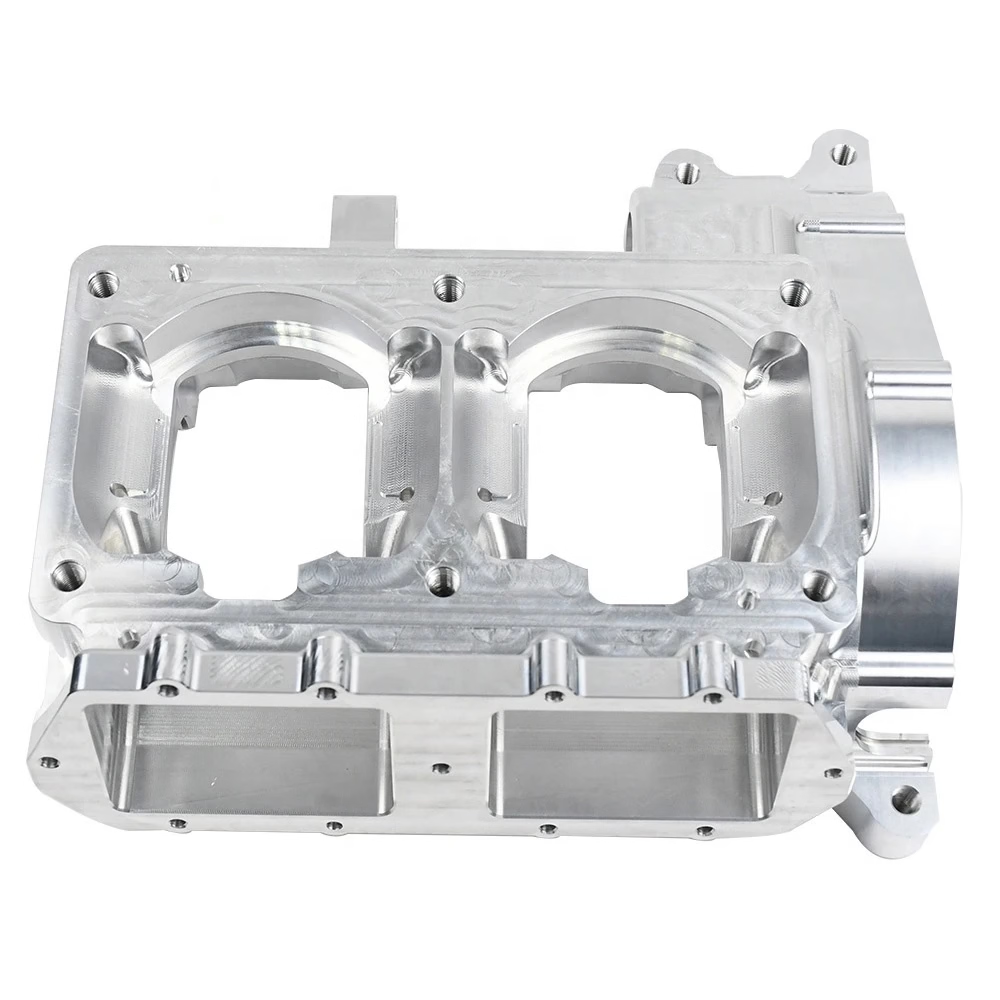
Anodizing a machined part is a design decision, not a last step
Read this before you send a drawing out for anodizing. It changes dimensions and surface condition in ways the machine shop cannot undo.
What anodizing actually does to a machined surface
Anodizing is an electrochemical conversion, not a coating. The part goes into an acid electrolyte and current is passed through it. The aluminum surface converts to aluminum oxide, and roughly half the oxide grows inward while half grows outward. Nothing is deposited on top, so the layer cannot chip off the way paint can.
The oxide is hard and electrically insulating. On 6061 it protects well in outdoor and mildly chemical environments. But the same growth that makes it durable also moves the surface. A Type II coating at 10 μm adds about 5 μm to each side. A tight bore gets tighter after anodizing, and a shaft gets larger. Design the machined dimensions around the finished ones, not the other way around.
Not every aluminum grade behaves the same in the tank. 6061, 6063, 6082, 5052 and 7075 anodize predictably. High-silicon die casting alloys such as ADC12 do not. The silicon does not convert, so the coating comes out dark, patchy and sometimes non-uniform in thickness. If a part is die cast and needs a decorative finish, plan for a different process or accept a darker hardcoat look.
- 1Half in, half outA 10 μm Type II layer adds roughly 5 μm per surface.
- 2Not a coatingThe oxide is converted from the base metal, so it cannot peel.
- 3Alloy mattersSilicon-rich casting alloys finish unevenly and dark.
- 4Mask before, not afterContact areas and threads need masking decided at quoting.
Type II, Type III and conductive anodizing: which one to specify
Type II sulfuric anodizing is the common choice. Layer thickness runs about 5–25 μm, it takes dye well, and it is used on enclosures, brackets, handles and consumer-facing panels. Type III, usually called hardcoat, runs 25–50 μm and is noticeably harder and more wear-resistant. Use it on sliding surfaces, wear plates, valve bodies and parts that see abrasion.
Both types grow with thickness, and hardcoat grows more. On a hardcoat part at 50 μm, expect roughly 25 μm per side. A Ø10 H7 bore can close enough to lose its fit. The practical fix is to machine the bore oversize by twice the growth and then anodize to final size, or to mask the bore and keep it bare.
Conductive anodizing is a narrower case. Normal anodizing is an insulator, which is a problem for grounding paths, EMI shielding contact points and electrical connector housings. A conductive or masked anodize keeps selected areas bare so the part still bonds electrically. If your drawing shows a ground tab, mark it explicitly.
Color choice also carries engineering meaning. Clear and natural show the alloy and any surface scratches plainly. Black hides tool marks and is common on optical and camera parts. Dyed colors are cosmetic, and they fade under prolonged UV. For outdoor parts where appearance matters over years, black or clear is usually the safer specification.
- 1Type II5–25 μm, dyeable, general purpose.
- 2Type III hardcoat25–50 μm, abrasion resistance, more growth.
- 3ConductiveMasked areas stay bare for grounding and shielding.
- 4ColorCosmetic dyes fade; black and clear age better outdoors.
Anodizing types and what they do to a part
Growth figures are per surface and are approximate. Confirm against the finisher's process sheet before releasing a drawing.
| Type | Layer | Growth per side | Typical use |
|---|---|---|---|
| Type II clear | 5–25 μm | ≈ 2.5–12.5 μm | Enclosures, brackets, handles |
| Type II dyed | 5–25 μm | ≈ 2.5–12.5 μm | Consumer panels, branding |
| Type III hardcoat | 25–50 μm | ≈ 12.5–25 μm | Wear plates, sliding surfaces |
| Conductive / masked | Same as base type | Zero on masked areas | Grounding tabs, EMI contacts |
| Bead blast + Type II | 5–25 μm | ≈ 2.5–12.5 μm | Matte cosmetic housings |
| Polished + Type II | 5–25 μm | ≈ 2.5–12.5 μm | Bright trim, visible faces |
Holding ±0.005 mm on parts that go into an acid bath
Anodizing is the last operation, but tolerance decisions happen at the machine. If a dimension is critical, decide whether it will be anodized or masked. An anodized surface cannot be held to the same callout as a bare one, because the layer thickness varies by a few microns across a large part and by more near edges and high-current contact points.
Our working rule is simple. Anodize first, then machine, whenever the geometry allows it. That way the finishing step is done and the final cut sets the dimension. When the part must be anodized after all machining, we machine the anodized features oversize by the expected growth and specify the growth on the drawing. Threads get the same treatment: a 1/4-20 tapped hole grows inward and can bind a screw if the pitch diameter is not planned.
Inspection is where this gets verified. We measure before anodizing and after, and we can supply reports on request. Because the tolerance is ±0.005 mm (±0.0002 in), any shop that skips the pre-anodize measurement is guessing. For parts where the fit is critical, we inspect at both stages and compare.
Surface finish interacts with the coating too. A bead-blasted surface at Ra 1.6–3.2 μm takes dye evenly and hides tool marks. A polished surface at Ra 0.2–0.8 μm shows every scratch, including ones introduced in handling. If the part is both cosmetic and functional, split the drawing: cosmetic faces polished, functional faces as machined.
- 1Anodize first, machine secondBest route when geometry allows a final cut.
- 2Oversize by growthAdd expected layer growth to bores and threads.
- 3Measure twicePre- and post-anodize inspection catches drift.
- 4Split the drawingCosmetic faces and functional faces can carry different finishes.
Alloys that anodize well, and the ones that fight back
The 6xxx family is the default for anodized cnc parts. 6061-T6 machines cleanly, takes clear and dyed anodize evenly, and holds tight tolerances. 6063 and 6082 behave similarly and are common on extrusions and housings. 5052 gives good corrosion resistance for sheet metal parts that will be anodized after forming.
2024 and 7075 are stronger but contain copper, which makes the oxide darker and less uniform. They still anodize, and they are used in aerospace brackets and structural parts, but a bright clear finish is not realistic. Expect a darker, slightly mottled appearance, and specify hardcoat if wear resistance is the goal rather than appearance.
On the stainless and titanium side, anodizing does not apply in the same way. Titanium can be anodized for color and a thin oxide layer, and we list TA1, TA2 and TC4 (Ti-6Al-4V) in our material range, but the process and results differ from aluminum. Stainless grades such as 303, 304, 316L and 17-4PH are usually passivated or electroless nickel plated instead. If you are unsure which finishing route suits your alloy, send the drawing and we will say so at quoting.
Plastics are outside the anodizing conversation entirely. ABS, PC, POM, PEEK and the rest get painted, laser marked or left as machined. If a part needs a metallic look and anodizing is not possible, powder coating or a plated finish is the practical alternative.
- 1Best for anodizing6061, 6063, 6082, 5052, 5083.
- 2Anodize with care2024 and 7075 come out darker and less uniform.
- 3Different processStainless is passivated or plated, not anodized.
- 4Not applicablePlastics and die castings with high silicon content.
Where anodized cnc parts earn their place
Aerospace and drone hardware uses anodized aluminum for weight, corrosion resistance and a hard surface that survives handling. Hardcoat is common on wear points; clear Type II on structural brackets where the alloy and any cracks need to stay visible during inspection.
Automotive and EV parts use anodizing on brackets, housings and under-hood components that see road salt and moisture. Medical device housings and instrument panels use it because the oxide layer tolerates repeated cleaning and disinfection better than an untreated aluminum surface, though the part still needs to be designed so cleaning agents do not sit in crevices.
Consumer electronics, camera bodies and robotics covers use dyed anodize for appearance. Industrial machinery uses hardcoat on guide rails, wear plates and fixtures where abrasion is constant. In every case the same questions come back: which alloy, which type, and which dimensions are critical after the bath.
We machine and finish in-house at three wholly-owned plants, with 127 high-precision CNC machines including 16 simultaneous 5-axis machining centers. Maximum processing size is 4,000 mm, and we can reach ±0.005 mm with a fine finish of Ra 0.2–0.8 μm on features that stay unmasked. Anodizing is offered as one of our surface finishing options alongside plating, powder coating, bead blasting and laser marking.
Uploads are handled as confidential, and an NDA is available on request. Quotation with a free DFM analysis comes back within 12 hours, production can start within 24 hours, and parts typically ship in 3–5 days. No minimum order quantity, from one prototype to 10,000+ part runs.
- 1AerospaceHardcoat at wear points, clear Type II on structural brackets.
- 2Automotive & EVBrackets and housings exposed to salt and moisture.
- 3MedicalHousings that tolerate repeated cleaning and disinfection.
- 4Electronics & roboticsDyed anodize for visible covers and panels.
What to put on the drawing for an anodized part
| Drawing item | What to state | Why it matters |
|---|---|---|
| Alloy and temper | 6061-T6, 7075-T6, 5052 | Drives color, hardness and finish uniformity |
| Anodize type | Type II or Type III, thickness range | Sets growth and wear resistance |
| Color | Clear, black, dyed, natural | Cosmetic dyes fade with UV exposure |
| Masked areas | Threads, bores, grounding tabs | Keeps fits and electrical paths usable |
| Critical dimensions | Anodize before or after machining | Decides the order of operations |
| Surface prep | Bead blast, polish, as machined | Controls sheen and scratch visibility |
Common questions about anodized CNC parts
Can anodized threads still be used?
Yes, but they need planning. The oxide grows inward on a tapped hole and reduces the pitch diameter, so a screw can bind. The usual approach is to mask the threads, or to tap oversize and let the coating bring the thread back to size.
Tell us at quoting which threads are functional and which are cosmetic. Masking is a small step at the finisher and a large problem later if it is missed.
Does anodizing change a hole diameter?
It does. A Type II layer at 10 μm grows about 5 μm per surface, so a bore closes by roughly 10 μm on diameter. Hardcoat at 50 μm can close it by about 50 μm on diameter, which is enough to lose an H7 fit.
For critical bores, either mask them or machine them oversize by the expected growth. We decide the route during DFM review before the first cut.
Which aluminum alloys should not be anodized?
High-silicon casting alloys are the main problem. The silicon does not convert to oxide, so the coating comes out dark and uneven. ADC12 is a common example.
Copper-bearing alloys such as 2024 and 7075 will anodize, but the color is darker and less uniform than on 6061. If the part is visible, plan for that look rather than expecting a bright clear finish.
Can you hold ±0.005 mm on a part that gets anodized?
On the machined features, yes. The tolerance describes what the machine holds, and the anodize layer then adds to it. That is why the order of operations and the masking plan have to be settled before machining starts.
When the geometry allows, we anodize first and take a final cut so the critical dimension is set after finishing. We inspect before and after anodizing and can supply reports on request.
What is the difference between clear anodize and hardcoat?
Clear Type II is a thinner decorative and protective layer, roughly 5–25 μm. Hardcoat Type III runs 25–50 μm, is harder, and resists abrasion far better. Hardcoat also grows more, so it affects fits more.
Pick hardcoat for sliding and wear surfaces. Pick Type II when appearance, dyeing or tighter dimensional control matters more.
Can anodized parts stay electrically conductive?
The standard anodize layer is an insulator, so a fully anodized part will not ground. For grounding paths, EMI contact points and connector housings, we mask the contact areas so they stay bare metal.
Mark those areas on the drawing. If they are not marked, the finisher has no way to know which surfaces must stay conductive.
Send your drawing and get a DFM review with the quote
We machine and anodize in-house, so the tolerance plan and the finishing plan come from the same team. Quotation and free DFM analysis within 12 hours.
12-hour quote±0.005 mm100% inspection before shipmentNDA on request









