
Application of Complete Sheet Metal Processing in the Household Appliance Industry
This guide is for appliance engineers and sourcing teams weighing complete sheet metal processing against casting, molding and extrusion. It covers which enclosure, bracket and internal parts suit sheet metal, which material and finish to pick, and where the process stops making sense.
What Complete Sheet Metal Processing Covers
One supplier, from blanking to finished part.
Appliance Parts That Suit Sheet Metal
A household appliance is mostly a steel or aluminium shell wrapped around a motor, a heater and a control board. The shell has to hold its shape for ten years, survive a damp kitchen or a laundry room, and hide the fasteners that hold it together. Sheet metal covers most of that work: outer panels, back plates, door skins, control-box chassis, motor mounts, brackets and internal shields.
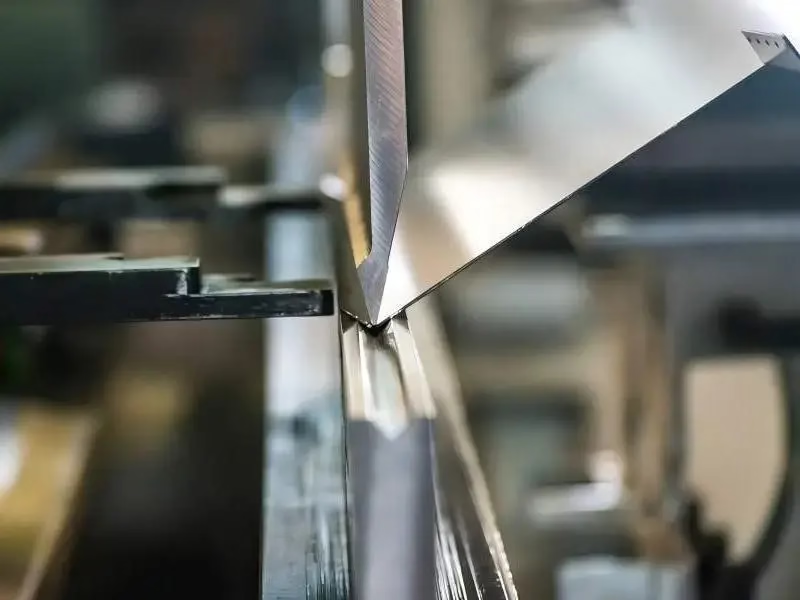
Complete sheet metal processing means one supplier runs the whole chain. Laser cutting or punching blanks the flat pattern. Press brake forming sets the bends. Welding, riveting or clinching joins the sub-assemblies. Then comes deburring, pretreatment, powder coating or plating, and a final dimensional check before the parts ship. Splitting those steps across four vendors is where tolerance stack-up and finish mismatch usually start.
Not every appliance part belongs in sheet metal. A thick, load-bearing hinge boss with internal ribs is a die casting. A complex curved handle with a hollow grip is injection molded. The useful line is wall thickness and stiffness: below roughly 1.0 mm the part usually needs forming, while a solid 12 mm block with cross-ribs is cheaper as a casting.
- 1Good fitFlat or bent panels, chassis, brackets, covers, mounting plates, shields.
- 2MarginalVery small parts under 15 mm, or shapes needing deep internal ribs.
- 3Poor fitSolid bosses, thick load paths, hollow grips, optical-grade curved surfaces.
Material Choices for Appliance Enclosures
Cold-rolled steel 1018 and 1045 are the default for painted panels. They form cleanly, weld easily and take powder coating without special pretreatment. For wet areas such as a washer base or a dishwasher frame, switch to 304 or 316L stainless. 316L costs more but handles chloride and detergent splash far better than painted carbon steel.
Aluminium 5052 is the workhorse for appliance fascia and internal brackets. It bends well, resists corrosion without coating, and weighs about a third of steel. 6061-T6 is stiffer but cracks at tight bend radii unless you anneal first. For heat shields near a heater element, 430 stainless or an aluminized steel keeps the surface stable at higher temperatures.
Copper C110 and brass C36000 show up in terminals and bus bars rather than panels. Titanium and Inconel are rarely an appliance material, except in a few high-end or commercial cooking products where the element housing runs very hot.
- 1Painted panels1018 or 1045 cold-rolled steel, 0.8–2.0 mm.
- 2Wet or washdown304 or 316L stainless, 0.8–1.5 mm.
- 3Lightweight fascia5052 aluminium, 1.0–2.5 mm.
- 4Heat shield430 stainless or aluminized steel.
Process Comparison for Appliance Parts
Use this when the first drawing review starts.
| Process | Best part type | Typical wall | Cost driver |
|---|---|---|---|
| Sheet metal | Panels, chassis, brackets | 0.5–3.0 mm | Forming steps and finish |
| Die casting | Thick housings with ribs | 2.5–6.0 mm | Tooling and cycle time |
| Injection molding | Complex plastic covers | 1.5–4.0 mm | Mold cost and resin |
| Extrusion | Constant cross-section frames | 1.0–4.0 mm | Die and cut length |
Tolerances, Bends and Fit-Up
The tolerance that matters on a bent panel is not the laser cut edge; it is the accumulated bend position. A typical press brake setup holds ±0.1 mm on a single bend, but four bends in a row can stack to ±0.4 mm across the part. If a mounting hole has to line up with a cast boss on the other side of the appliance, that stack decides whether the assembly closes.
Our general machining tolerance is ±0.005 mm on milled features, and we hold ±0.0002 in where a mating insert or bearing seat calls for it. On the formed sheet part itself, the practical tolerance band is set by material springback and tooling, not by the machine. Send the mating parts with the drawing and we will flag the stack before cutting metal.
Bend radius follows material thickness. A safe minimum inside radius is roughly one times the thickness for mild steel and 5052 aluminium, and higher for 6061-T6 or 304 stainless. Sharp corners on a heavy gauge panel crack on the outside of the bend. A relief notch at the corner costs almost nothing and removes most of that risk.
- 1Single bend±0.1 mm with a fixed tooling setup.
- 2Four-bend stackBudget ±0.3 to ±0.4 mm unless you control datum.
- 3Minimum bend radiusAbout 1× thickness for mild steel and 5052.
Finishing and Assembly for Appliance Metalwork
Appliance finishes carry two jobs: corrosion protection and appearance. Powder coating gives a thick, chip-resistant layer on painted steel panels and hides minor surface marks. Electroless nickel and zinc plating work better where the part is a conductive chassis or a grounded bracket. Anodizing suits aluminium fascia where you want the metal grain visible.
Assembly method changes the drawing. Spot welding is fast on steel panels under 2 mm but leaves marks on the outside face unless the electrode contacts the hidden side. Riveting and clinching avoid heat distortion and work on mixed materials, so an aluminium panel on a steel frame is usually riveted. For a part that must be opened in service, use machine screws with captured nuts rather than self-tapping screws into thin sheet.
Every metal part we ship goes through 100% inspection before shipment, with raw material check, in-process monitoring and a final dimensional report on request. On an appliance program, that report is what protects you when a field return is traced back to a bent bracket.
- 1Painted panelsPowder coat or black oxide.
- 2Conductive chassisZinc or electroless nickel.
- 3Visible aluminiumClear or colored anodize.
- 4Mixed material jointRivet or clinch instead of weld.
From Prototype to Volume Appliance Runs
Appliance programs usually start with a small batch to prove fit, then scale to thousands of identical parts. Complete sheet metal processing handles both ends without a tooling change. The first run can be laser cut and formed on a press brake; the volume run can move to a turret punch and hard tooling once the design is frozen. The drawing stays the same.
There is no minimum order quantity here, so a single prototype panel and a 10,000-part run use the same process route. Quotation and a free DFM analysis come back within 12 hours, production can start within 24 hours, and parts typically ship in 3–5 days. If the design is still moving, keep the bends simple and put the tight tolerances only on mating features. That keeps the first article cheap to change.
We run three wholly-owned plants with 127 high-precision CNC machines, including 16 simultaneous 5-axis centers and a Ø400 mm rotary table for parts that need machined features on a formed panel. Sheet metal, machining and finishing sit under one roof, so a bracket that needs a milled bearing seat after forming does not travel between suppliers.
- 1PrototypeLaser cut and press brake, no hard tooling.
- 2VolumeTurret punch and dedicated tooling after design freeze.
- 3Mixed processFormed panel plus CNC machined mating features.
Common Questions
When should we use sheet metal instead of die casting for an appliance housing?
Use sheet metal when the part is a shell or a bracket with a fairly uniform wall. Casting wins when the part needs thick bosses, internal ribs or a solid load path that a bent panel cannot carry.
A quick test: if the section is under about 3 mm and mostly flat, sheet metal is usually cheaper and faster. Above that, compare the casting tooling cost against the volume.
What tolerance can you hold on a formed appliance panel?
Milled features are held to ±0.005 mm. On the formed part, the practical band is ±0.1 mm for a single bend and wider across a multi-bend stack.
Send the mating parts with the drawing and we will review the stack before production so the fit is settled on paper, not on the assembly line.
Which finish protects a washer or dishwasher part from moisture?
For wet areas, 304 or 316L stainless with no coating is the most reliable route. If the part has to be steel for strength, powder coating over a proper pretreatment works for most splash exposure.
Zinc plating is a good middle option for internal brackets that see condensation but not direct spray.
Can you combine sheet metal forming with CNC machined features?
Yes. A formed panel often needs a milled bearing seat, a threaded hole or a flat mating face. We machine those after forming so the datum reflects the final shape.
This matters on parts where welding or bending moves the surface. Machining after forming keeps the feature aligned to the assembled geometry.
What is the minimum order quantity for appliance sheet metal parts?
There is no minimum. We run from one prototype to 10,000+ part runs on the same process route.
For a first article, keep tight tolerances on mating features only. That limits the cost of a design change after the fit check.
How do you handle confidentiality on a new appliance design?
Uploads are secure and confidential, and we sign an NDA on request before reviewing drawings.
If the program is under a development agreement, tell us at the quote stage so the files are handled under that agreement from the first review.
Send the Drawing, Get a Process Review
Upload the appliance part and we will return a quote with DFM notes on bends, material and finish within 12 hours.
12-hour quoteFree DFM analysis100% inspectionNo MOQ









