
Arcane 3D Printing Figures in Metal
This page is for collectors, modelers, and product engineers who want Arcane figures that will not yellow, warp, or crack. It covers file prep, wall thickness, support strategy, shrinkage, and surface finishing for SLM and DMLS parts. After reading, you can judge whether a given model belongs in metal or should stay in resin.
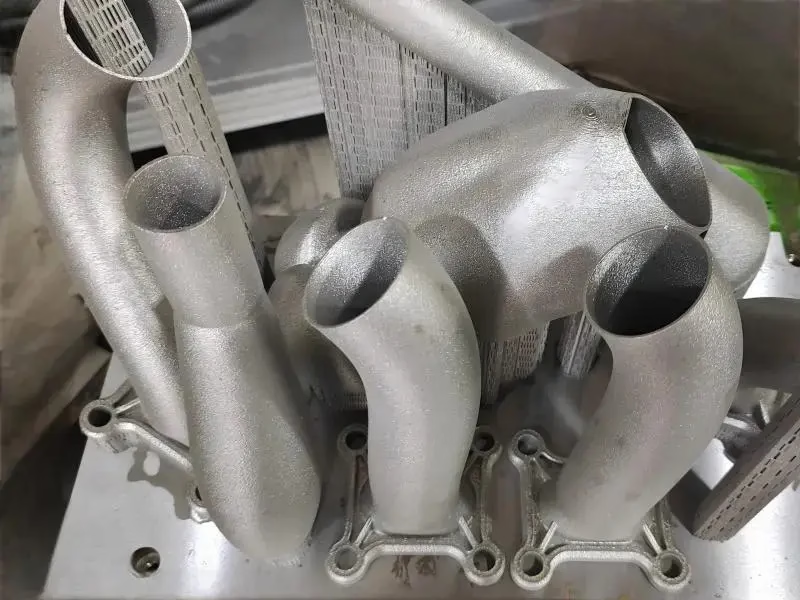
What Changes When a Figure Becomes Metal
Resin prints capture detail. Metal prints capture detail and survive being handled.
How Metal Arcane Figures Are Actually Built
Most Arcane figure files start as digital sculpts or game rips. The mesh is dense, non-manifold in places, and scaled for a 1/6 or 1/8 display piece. We do not print that file as-is. The first step is a DFM pass: check wall thickness, find self-intersections, close open shells, and split the model into printable chunks.
A typical figure is split into four to eight pieces. Head, torso, arms, legs, base. Splitting lets us orient each piece so the critical surfaces face away from the build plate. It also keeps support marks off the face and hands, which is where buyers look first.
Layer height runs 20–30 μm for SLM on a 1/8 figure. A 200 mm tall piece takes roughly 18–30 hours of machine time depending on volume and part density. After the build, the part goes to stress relief, then support removal, then baseplate cut-off.
Metal SLM does not print color. If a buyer wants the Arcane palette, we finish it in post. Anodizing gives clear, black, or dyed tones. Gold and silver plating read well on small jewelry-scale pieces. Powder coating is too thick for facial detail, so we avoid it on faces.
Wall Thickness, Overhangs, and Where SLM Fails
Minimum wall for reliable SLM in aluminum is about 0.4 mm. In stainless and titanium, 0.3 mm holds if the wall is short and supported. Thin walls below 0.3 mm look fine in the slicer and fail in the machine. They curl at the top edge.
Overhangs below 45° from horizontal need support. On a figure, hair, cloaks, and weapon blades are the usual offenders. We can rotate the part to reduce support, but the rotation must keep the thin sections stable.
Small features like fingers, jewelry, and hair strands are where resin still wins. A 0.5 mm finger in resin prints clean. In metal it may survive but it will be fragile and cost more to finish than it is worth.
If a model has fine surface texture meant to look like cloth weave, SLM will soften it. The laser melt pool is roughly 0.1–0.15 mm wide. Detail smaller than that gets averaged out. For those files, resin or vacuum casting is the better route.
Process Selection for Arcane Figures
Pick the process from the feature size and the handling the part will see, not from the character name.
| Process | Best for | Min feature | Surface after finishing |
|---|---|---|---|
| Metal SLM (AlSi10Mg, 316L) | Display pieces, bases, props | 0.3–0.4 mm wall | Ra 1.6–3.2 μm as-built; Ra 0.8–1.6 μm after bead blast |
| SLA resin | Fine faces, hair, fingers | 0.1 mm | Smooth; yellows under UV over time |
| Vacuum casting | Short runs of 20–200 copies | 0.3 mm | Matches the master; paint by hand |
| CNC machining | Flat bases, plaques, stands | 0.5 mm | Ra 0.8–1.6 μm; ±0.005 mm on bores |
| Die casting | Runs above 1,000 units | 1.0 mm wall | Needs post-machining on mating faces |
Shrinkage, Fit, and Assembly on Multi-Part Figures
Metal SLM parts shrink as they cool. For 316L we plan on roughly 0.2–0.3 percent linear shrink; for AlSi10Mg, closer to 0.3–0.5 percent. That matters when a shoulder peg has to slide into a socket.
The fix is not to fight shrinkage. It is to machine the joints. We print the peg and socket slightly oversize, then turn or mill them to a slip fit. Bores and pins hold ±0.005 mm on the 5-axis centers.
For figures that need to stand on a base, we machine the base underside flat. A printed bottom face is never flat enough to sit without a wobble. One facing pass on a 3-axis mill solves it.
Magnetic joints are common on display figures. We machine a small pocket in the torso and the base, then press in a neodymium magnet. The pocket holds ±0.02 mm so the magnet does not rock. Epoxy fills the gap.
Threaded connections are possible but avoid them below M3 in metal. A printed M2 thread has poor fatigue life. Use a machined insert instead, or a press-fit pin with a set screw.
Post-Processing That Survives Handling
As-built SLM has a matte, slightly rough skin. Bead blasting with fine glass media brings it to a uniform matte and removes loose powder from internal channels. That is the baseline for a display figure.
For a polished look, we hand-polish the high points and leave recesses matte. That contrast is what makes small details read at a distance. Full mirror polish on a whole figure looks flat and hides the sculpt.
Colored finishes follow the character palette. Clear anodize keeps the metal tone. Black anodize on aluminum gives a dark base that takes acrylic or enamel well. Gold plating works on small accessories and jewelry-scale parts.
Laser engraving marks names, edition numbers, or a base plate. Minimum character height is 1.5 mm so the mark stays legible after finishing. Below that it fills in.
Every part is inspected before it ships. We check critical dimensions, joint fits, and surface condition. Reports are available on request.
Common Questions
Can you print from an STL or OBJ I already have?
Send the file and we run a free DFM analysis within 12 hours. We check wall thickness, manifold status, and feature size against the process you picked.
If the mesh needs repair or splitting, we do that before quoting so the price reflects the real work.
Will a metal figure survive a drop?
A solid metal figure handles a drop far better than resin. Thin protrusions like sword blades and hair strands are still the weak points, same as on any material.
If the piece will be handled often, we thicken those features or switch them to a separate pinned part.
How does the cost compare to resin printing?
Metal SLM costs more per part than resin because the machine time is longer and the powder is expensive. The trade-off is durability and the finish.
For a single display piece, resin is usually cheaper. For a piece that will be handled, plated, or sold as a durable product, metal is often the better spend.
Can you match the Arcane color palette?
We do not print in color. Color comes from anodizing, plating, powder coating, and hand painting.
Tell us the target color and we will propose a finish stack. Anodize dye lots vary, so send a reference sample when color is critical.
What file format and scale should I send?
STL, STEP, or OBJ all work. STEP is preferred when the model has flat mating faces or threads, because it carries exact geometry.
Send the model at final scale in millimeters. Note any part that must fit an existing peg or base.
Is my model kept confidential?
Uploads are secure and confidential. We do not share customer files or use them in marketing without written permission.
An NDA is available on request before you send anything.
Send the Model, Get a Metal Quote
Upload your Arcane figure file and we return a quote plus DFM notes within 12 hours.
12-hour quote100% inspectionNo MOQNDA on request









