
01
A sealing face that weeps
As-built SLM surfaces carry Ra 8–12 μm and partly bonded powder. Bolt it against a gasket and it leaks at 2 bar. The mating face needs to be cut, not printed.
Print the geometry first, then cut the critical faces. We run SLM metal and SLA/SLS plastic for auto parts 3D printing, and finish sealing faces, bores and threads on 127 CNC machines to ±0.005 mm.
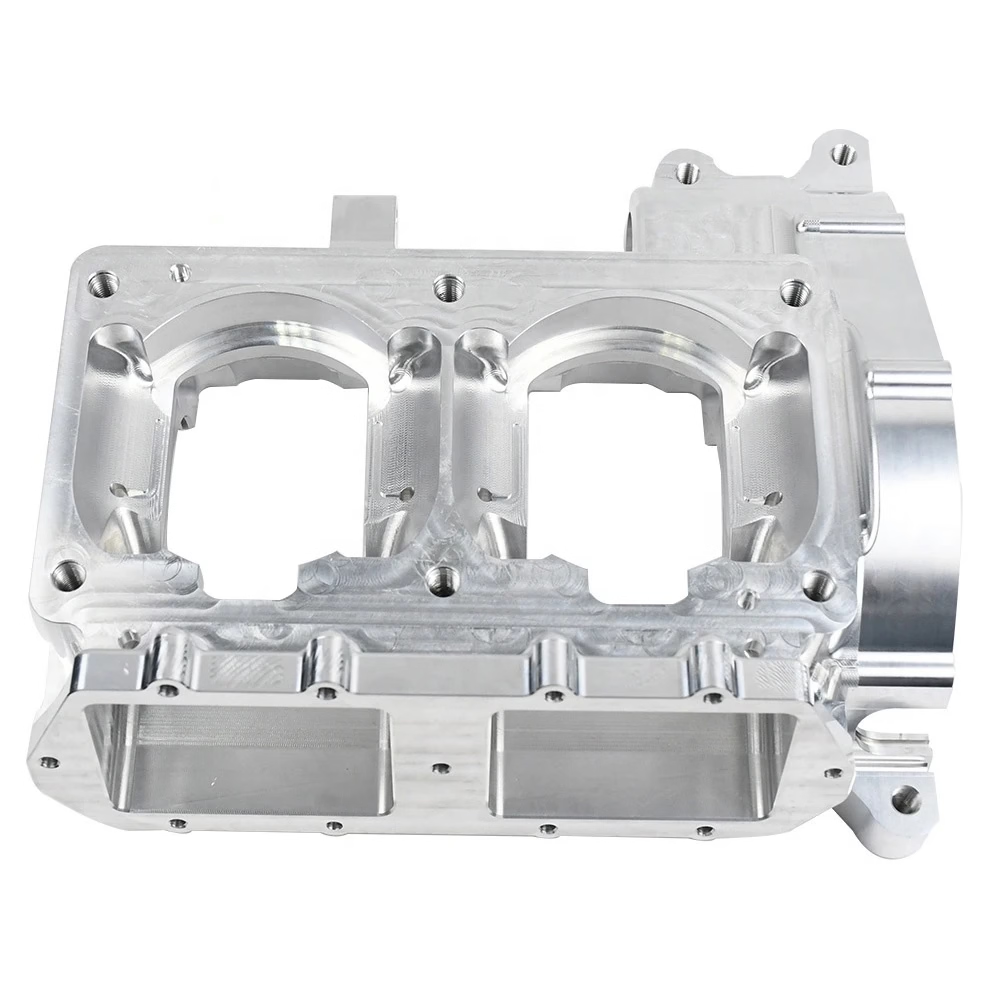
Printing gets the shape. These four problems show up at test fit, at pressure check, or on the dyno.
As-built SLM surfaces carry Ra 8–12 μm and partly bonded powder. Bolt it against a gasket and it leaks at 2 bar. The mating face needs to be cut, not printed.
Print tolerance is usually ±0.1 mm on a good day. Press a bearing into that and the fit is either loose in the housing or cracked during installation.
Printed threads in aluminum or nylon shear at the root. A 3D printed bracket is fine for a cable clip, not for an M8 mount pulled to 25 N·m.
The print price looks low, then the sealing face, bearing bore and thread inserts get quoted separately. The real cost only appears after two rounds of RFQs.
One shop handles both steps, so the print and the cut are planned together instead of arguing over who missed the tolerance.
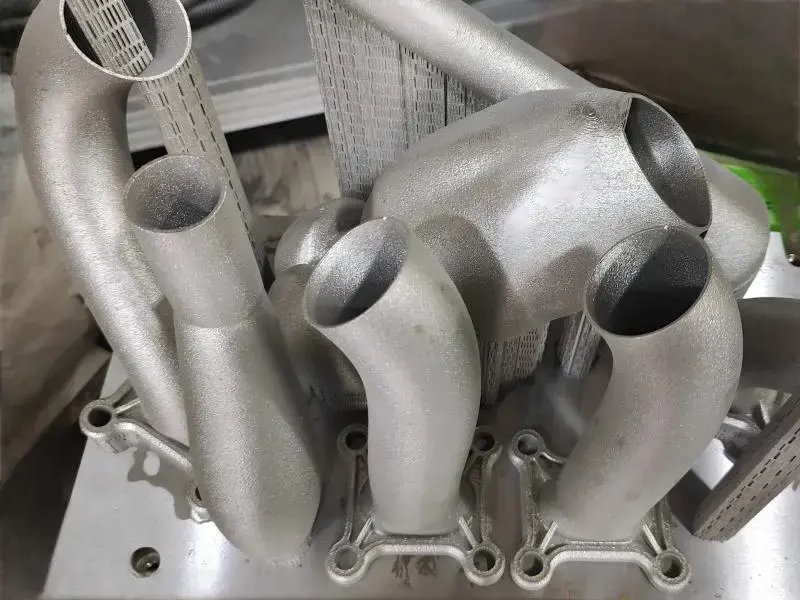
For parts that see heat, pressure or vibration, we print in metal by SLM. Titanium TA1, TA2 or TC4 (Ti-6Al-4V), Inconel and 17-4PH stainless cover most brackets, manifolds, heat shields and lightweight housings. Aluminum grades such as 6061 and 7075 can also be printed, though for a flat plate a machined blank is still cheaper.
Print orientation decides the outcome. A housing printed flat has different layer lines at the flange than one printed upright, and the layer direction sets the fatigue path. We set orientation so that load goes along the layers, not across them, then machine the sealing face, bearing bores and threads.
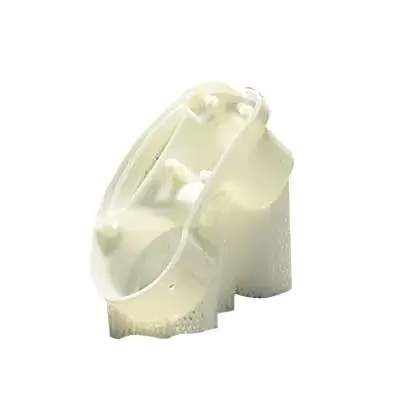
Plastic covers the early rounds. SLA in ABS-like resin and SLS in PA or glass-filled nylon give you a part in your hand weeks before tooling. Use them for connector housings, ducting, clips, covers and dash parts where the question is fit and shape, not strength.
Plastic auto parts have a short list of failure modes: creep under a constant load, UV fading, and heat softening near an engine bay. We call those out in the DFM note before printing, so the material choice matches where the part actually sits. Carbon fibre reinforced nylon is the usual pick when a clip needs stiffness.
Use this to pick the route before you request a quote.
| Route | Best for | Limits |
|---|---|---|
| SLA resin print | Fit checks, covers, interior trim | Not for load or heat |
| SLS nylon print | Clips, ducts, brackets under light load | Creeps under constant load |
| SLM metal print | Complex organic shapes, low volume | Needs bore and face finishing |
| SLM plus CNC | Functional prototypes, small runs | Highest cost per part |
| 5-axis CNC from billet | Flanges, manifolds, suspension links | Tool access limits deep pockets |
Printing is one step. These are the rest of the shop, so a part does not leave here half finished.
SLM metal, SLA resin and SLS nylon. Orientation, supports and heat treatment planned before the build.
16 simultaneous 5-axis centers cut sealing faces, bearing bores and threads on printed blanks.
16 mill-turn centers handle shaft and housing features in one setup, so concentricity holds.
From one prototype to a 10,000+ part run. No minimum order quantity at either end.
ADC12 and aluminum castings once the printed design is frozen and volume justifies tooling.
Anodizing, electroless nickel, bead blasting, black oxide and laser marking down to 1.5 mm characters.
Numbers we work to every day.
| Item | Capability | Note |
|---|---|---|
| Achievable tolerance | ±0.005 mm | On machined features |
| Fine finish | Ra 0.2–0.8 μm | Bores and sealing faces |
| High finish | Ra 0.8–1.6 μm | General mating surfaces |
| Maximum part size | 4,000 mm | Largest machine travel |
| Materials | Aluminum, stainless, steel, titanium, plastics | Full list on the quote page |
| Inspection | 100% before shipment | Reports on request |
Six things that decide whether a printed auto part ships or sits in a rework bin.
15 years of prototype and low-volume auto work across 3 wholly-owned plants and 7,600 m² of floor space.
Machined features reach ±0.005 mm, so a printed housing can carry a press-fit bearing.
Raw material check, in-process monitoring and final inspection on every order.
Complex printed blanks get cut in one setup, which keeps datums consistent.
Quotation and free DFM analysis within 12 hours. Production can start within 24 hours.
Parts ship in 3–5 days on the standard route, and we track the exceptions.
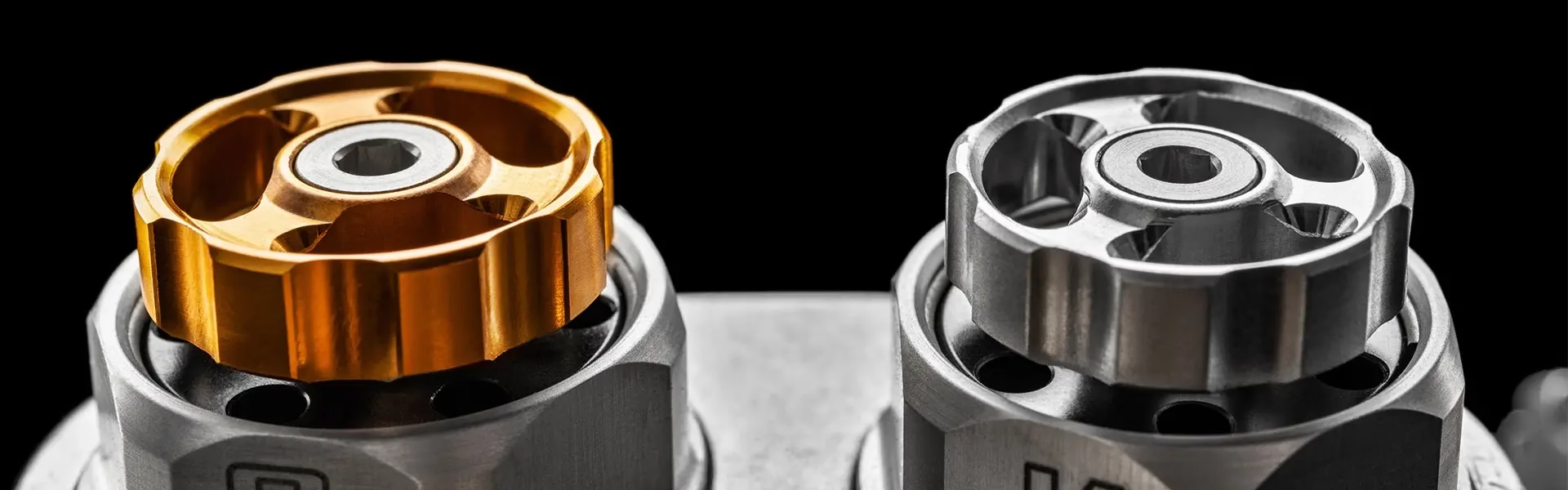
Printed intake and bracket shapes, then sealing faces and bolt holes cut flat.

Busbar covers and mounting frames printed for fit, then machined at the contact faces.
Load paths run along the print layers; bearing bores and threads are cut afterward.
Heat and vibration decide the material; we flag creep and softening before printing.
When the part carries a repeating load, sees more than about 120 °C, or has a sealing face. Printed layers are the weak direction, and as-built surfaces leak.
A machined billet part is usually cheaper than a printed one on simple geometry, so printing only pays off when the shape is genuinely complex.
Not as printed. The bore needs to be machined after the build, which is why we keep 5-axis centers next to the printers.
With a machined bore at ±0.005 mm, a printed aluminum housing can take a bearing the same way a billet housing does.
Ti-6Al-4V (TC4) for strength at low weight, 17-4PH stainless when corrosion and hardness matter, Inconel for exhaust-side heat.
For a bracket that only needs stiffness, printed aluminum or a machined 6061 blank is the cheaper answer.
We set the build orientation so the main load runs along the layers rather than across them. On a bracket that means printing it upright so the tensile load follows the layer plane.
Where the load direction changes, we thicken the section or move that feature to a machined insert.
Around ±0.1 mm on a well-supported SLA or SLS part, and similar on SLM metal before finishing.
Machined features reach ±0.005 mm. Plan your critical dimensions on faces that a cutter can reach.
Yes for SLM and SLA. Internal channels need drain paths, or supports stay trapped inside the part.
We review the model during the DFM pass and tell you where a channel will trap material before the build starts.
Quotation and free DFM analysis come back within 12 hours, and production can start within 24 hours.
Parts ship in 3–5 days on the standard route. The historical late-delivery probability is below 2%.
Uploads are secure and confidential. We hold ISO 27001:2022 for information security.
An NDA is available on request before you send any model file.
Upload the CAD file and we come back within 12 hours with a quote and a free DFM analysis covering print orientation, support strategy and which faces need cutting.
12-hour quote100% inspectionNo minimum order quantityNDA on request
Trusted by engineers and manufacturers worldwide










Upload your 3D model or 2D drawing and get a quotation with a free DFM analysis. Maximum processing size 4,000 mm.
CNC Metals 13 grades
CNC Plastics 10 grades
Machines & processes 12 options
Surface & post-processing 10 options
Material: not selected Machine: not selected Post-process: not selected
Fill in this short form and we'll open WhatsApp with your message ready to send. We only use these details to reply to you.
Nothing is sent until you press send inside WhatsApp.