
How to Choose a CNC Machining Service Manufacturer
This guide is for design engineers and sourcing teams comparing CNC machining service manufacturers before a first order. It covers the checks that actually change part quality, cost and delivery, and it says when a shop is the wrong fit.
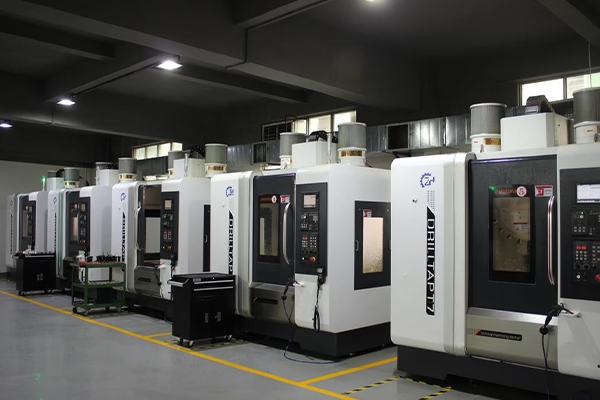
What matters most
What to check against what it tells you
Compare a shop's answer on the left with what that answer actually reveals about its setup.
| Check | What a strong answer looks like | What a weak answer sounds like |
|---|---|---|
| Tolerance claim | States a number and the machine class that holds it | "High precision" with no figure |
| Travel limits | Names maximum size, e.g. 4,000 mm | Avoids the question or asks you to send files first |
| MOQ | No minimum, one prototype to 10,000+ parts | Minimums quoted before drawing review |
| Certifications | Names scope: ISO 9001, IATF 16949, ISO 13485 | Shows a logo with no certificate number |
| Quote turnaround | DFM analysis plus price within 12 hours | Price only, no manufacturability notes |
| Inspection | 100% inspection before shipment, reports on request | Sampling only, no report offered |
| Lead time | Parts ship in 3–5 days after production start | Vague window, no start date given |
| Finishes | Lists processes with thickness and color options | "We can do any finish" |
The short version
Pick the shop whose stated limits match your part, not the shop with the widest claim. Tolerance, travel, material, certification scope and inspection format decide the outcome. Price decides the rest.
Match the tolerance to the machine, not the brochure
Every shop quotes a tolerance. Fewer explain how they hold it. On a 3-axis vertical mill with a good fixture, ±0.005 mm is realistic on features that can be reached in one setup. Add a second setup, a deep pocket, or a thin wall, and the same machine may only hold ±0.02 mm. The number on the website is a best case, not a promise for your part.
Ask which machine class will run your job. A 5-axis machining center removes the second setup for many parts, which is where the accuracy gain comes from. A mill-turn center keeps a turned diameter and a milled flat in one clamping, so concentricity stays tight. If the shop cannot name the machine, it has not planned the job yet.
Thermal drift matters on long cuts. A spindle that has run for three hours is not the same as one that started cold. Shops that hold tight tolerances either rough and finish in separate operations or let the part stabilize before the finishing pass. Ask if they do either.
Surface finish follows the same logic. Ra 1.6–3.2 μm is normal as-machined output. Ra 0.8–1.6 μm needs a finishing pass and often a different tool. Ra 0.2–0.8 μm usually means a secondary process. If a shop quotes the finest finish with no extra operation, the quote is not complete.
- 1One setup beats a tight claimFewer clampings means fewer stacked errors.
- 2Ask for the machine class3-axis, 4-axis, 5-axis or mill-turn, named for your part.
- 3Separate rough and finishThis is how tight tolerances survive long cuts.
- 4Finish grade has a costRa 0.2–0.8 μm is rarely a single-pass result.
Know the travel envelope before you commit
Travel limits decide whether a part is even quotable. A large gantry machine with 4,000 × 400 × 150 mm of travel handles long extrusions and frame rails. A compact machine with 500 × 500 × 450 mm handles most brackets and housings. Send a bounding-box drawing, not a finished CAD model, and you will get a straight answer faster.
Material choice narrows the list too. Aluminum 6061, 7075 and 6082 cut easily and finish well. Stainless 316L and 17-4PH work-harden, so feeds and speeds need care, and deep pockets in 316L are a common source of broken tools and scrapped parts. Titanium TC4 (Ti-6Al-4V) and Inconel move the job into a different cost band entirely.
Some materials force a process change. Magnesium AZ31B and AZ91D need chip control and fire-safe handling. Beryllium copper machines well but the dust needs containment. Plastics such as PEEK and POM behave differently again: PEEK needs sharp tools and slow feeds, POM can move after machining if stress is left in the stock.
If a shop lists every material but cannot name one that gives it trouble, it is quoting from a catalog, not from the floor.
- 1Send a bounding box firstMaximum X, Y and Z tells the shop whether the part fits.
- 2Work-hardening alloys need experience316L and 17-4PH punish light finishing passes.
- 3Exotic alloys change the cost bandTitanium and Inconel are not aluminum pricing.
- 4Plastics have their own rulesPEEK and POM need different tools and stress control.
Lead time, MOQ and quotingscope worth checking
Lead time has two parts: quote turnaround and production. A 12-hour quote with free DFM analysis tells you the shop has an engineering review in the loop. Production that starts within 24 hours tells you the schedule has slack. Parts shipping in 3–5 days is a normal range for small and mid-size runs, not a guarantee for a 10,000-part order.
MOQ is a signal about how the shop is organized. No minimum order quantity, from one prototype to 10,000+ part runs, means quoting, setup and inspection are built for mixed volume. A shop with a high minimum is set up for long runs and will price your prototype badly on purpose.
Certifications only count if you match the scope. ISO 9001:2015 is a general quality system. IATF 16949:2016 applies to automotive production. ISO 13485:2016 applies to medical devices. ISO 27001:2022 covers information security, which matters if you are sending unreleased CAD files.
Confidentiality is a separate question from quality. Uploads should be secure and confidential, and an NDA should be available on request before you send drawings. If a shop will not sign one, stop there.
- 1Separate quote time from build time12-hour quote, 24-hour start, 3–5 day ship.
- 2Low MOQ signals mixed-volume setupOne prototype and 10,000+ parts on the same floor.
- 3Match certification to your industryAutomotive, medical and IT security are different scopes.
- 4Get the NDA before the drawingsNot after the quote.
Signals that the fit is wrong
Not every shop suits every job. If your part needs Ra 0.2–0.8 μm on an internal bore, and the shop has no honing or polishing line, the finish will not arrive. If your order is 20 pieces and the shop's floor is booked with 50,000-part automotive work, you will wait. Neither is a bad shop. Both are a bad match.
Watch for quotes that arrive without any manufacturability comment. A thin wall, a deep slot, a 0.5 mm corner radius or a thread that cannot be cut with a standard tool should trigger a note. Silence usually means the file was priced by software and nobody looked at it.
Also check how inspection is described. 100% inspection before shipment, with raw material check, in-process monitoring and a final report on request, is a working quality loop. "We check everything" is not. Ask what the report contains and whether it can be tied to your part serial number.
Finally, check the delivery record. A historical late-delivery probability below 2% is a measured number. If a shop has no figure at all, treat the timeline as an estimate.
- 1Finish and volume must match the floorFine bores and small batches need the right line.
- 2No DFM notes means no reviewThin walls and deep slots should raise a flag.
- 3Inspection must be traceableReports tied to a part number, not a verbal promise.
- 4Ask for the late-delivery figureA number beats an adjective.
Seven steps before you place the order
Run these in order. Each step removes a category of risk before you commit tooling time.
- 1Send a bounding box, not a full assemblyGive maximum X, Y and Z in millimeters. This confirms the part fits the travel envelope before anyone opens the CAD file.
- 2State the tolerance per featureDo not put one blanket tolerance on the drawing. Mark the two or three features that matter and leave the rest at general tolerance.
- 3Name the material grade exactlyWrite 6061-T6 or 316L, not "aluminum" or "stainless". Grade changes feeds, speeds and price.
- 4Ask for a DFM note with the quoteA good response flags thin walls, deep pockets and tool-radius problems. Expect it within 12 hours.
- 5Confirm the certification scope you needAutomotive work points to IATF 16949. Medical parts point to ISO 13485. Unreleased files point to ISO 27001.
- 6Agree the inspection report formatDecide up front whether you need dimensional data, material certificates, or both, and who receives them.
- 7Fix the finish grade in writingRa 1.6–3.2 μm as-machined, Ra 0.8–1.6 μm fine, or a named coating with thickness. Verbal finish agreements cause most rework disputes.
Questions buyers ask next
How tight a tolerance should I actually specify?
Specify the tightest tolerance only on the features that need it. A blanket ±0.005 mm across a whole drawing raises cost and inspection time with no functional gain.
General features can sit at ±0.1 mm. Two or three critical bores, fits or sealing faces can carry the tight callout.
What does no minimum order quantity mean in practice?
It means the shop quotes a single prototype and a 10,000+ part run on the same floor, without a setup penalty that makes the small order uneconomic.
You still pay for programming and fixturing. The difference is that those costs are not hidden behind a minimum quantity.
Which certification do I need for automotive parts?
IATF 16949:2016 covers automotive production. ISO 9001:2015 is a general quality system and does not replace it.
For medical device work, look for ISO 13485:2016. If you are sending unreleased designs, ISO 27001:2022 covers information security.
How fast can parts realistically ship?
A quote and free DFM analysis can come back within 12 hours. Production can start within 24 hours of approval.
Parts typically ship in 3–5 days. Larger runs and secondary finishing add time, so treat the range as typical, not fixed.
What file formats and details should I include in the RFQ?
Send STEP or IGES for geometry plus a 2D drawing for tolerances, threads and finish callouts. Add the material grade and quantity.
Note any critical function, such as a sealing face or a bearing fit. That one sentence changes how the job is planned.
How is my design protected?
Uploads are handled as secure and confidential, and an NDA can be signed on request before drawings are shared.
If your program requires a specific security standard, say so in the first message rather than after the quote.
Send your drawing, get a real answer
We review manufacturability and return a quote with DFM notes within 12 hours. One prototype or 10,000+ parts, no minimum order quantity.
12-hour quote100% inspectionNo MOQNDA on request
More from the floor
We publish setup notes, tooling trials and inspection data from the factory floor.











