
A Budget CNC Machining Service: What Drives Cost, and Where Cheap Goes Wrong
This page is for engineers and buyers who need low unit cost without losing tolerance. It explains which cost drivers you can actually change, which parts suit low-cost machining, and how to read a low quote before you place the order.
What Actually Sets the Price of a Machined Part
A quote is mostly setup time, cutting time, material, and inspection, in that order on small batches. Setup is fixed per operation, so a part that needs four setups pays for four setups no matter how many you order. Cutting time follows the volume of metal removed and the tool diameter that can reach it. Material cost is the raw stock size, not the finished part weight. Inspection is the time someone spends measuring what you asked for.
Small batches and one-offs feel expensive because setup is spread over few parts. At 10 pieces, a 40-minute setup adds 4 minutes of machine time to every part. At 1,000 pieces, that same setup is 2.4 seconds. This is why a low-cost shop pushes you toward batch sizes that amortize tooling and programming, and why a run of 10,000+ parts usually lands at a much lower unit price than a run of 50.
Material choice moves the number more than most engineers expect. Aluminium 6061 cuts fast and costs little, so it is the default for housings and brackets. Stainless 316 machines at roughly half the feed rate and wears tools faster. Titanium TC4 and Inconel cut slower still and often need carbide or ceramic tooling. If a part does not need corrosion resistance or high temperature strength, switching from 316 to 6061 can cut the cut cycle and the raw stock bill at the same time.
Tolerance and finish are the last two levers. General dimensions held at ±0.1 mm are cheap. Hitting ±0.005 mm means slower passes, more measuring, and sometimes a second operation on a different machine. A fine Ra 0.2–0.8 μm finish may need a separate polishing step after machining. Ask which features truly need the tight callout, because one tight bore is far cheaper than a drawing where every dimension is ±0.005 mm.
- 1Setup countFewer faces machined means fewer fixtures and hours.
- 2Stock sizeBuy near-net stock; removing 40 mm of bar costs money.
- 3Feature accessDeep pockets and thin walls slow the cycle down.
Which Parts Fit a Low-Cost Machining Route
Low cost does not mean low quality. It means the geometry, material, and tolerance band let the shop run fast without special tooling. A bracket, a manifold block, a sensor housing, or a gearbox cover usually qualifies. These parts have open faces, reachable features, and a small number of critical dimensions. A 5-axis center can cut them in one or two setups, which removes the biggest fixed cost.
Parts that fight the budget route have deep cavities, long thin ribs, or tolerances on every face. A 300 mm long part with a 2 mm wall will move as the tool pushes through it. Holding it means light passes, extra supports, and often a stress-relief step. The cycle time doubles or triples, and no shop can hide that in the quote. Design reviews catch these cases before the drawing is frozen, which is why we include free DFM analysis with every quote.
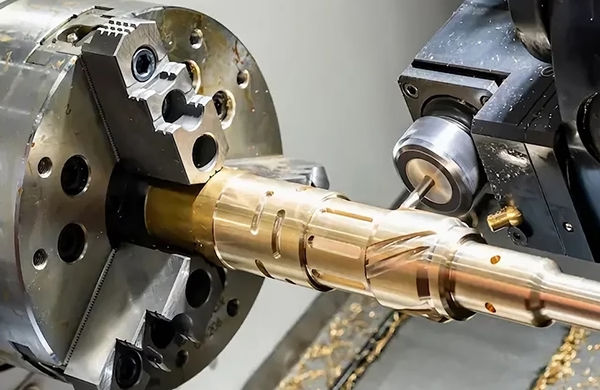
Geometry that is mostly turned is often cheaper than geometry that is mostly milled. A Ø60 mm shaft with a few grooves runs on a lathe in one setup and may need no secondary operation. The same part with six milled flats and two cross holes moves to a mill-turn center, which adds a setup but keeps the part in one machine. Mill-turn centers are worth it when the alternative is two fixtures and two operators.
Prototypes and small runs are where cost control matters most, because you pay for learning. If the design is still moving, it is cheaper to machine a near-final version, test it, and re-cut one feature than to order a hard tool. We run from one prototype to 10,000+ part runs with no minimum order quantity, so you can start small and scale the same program.
How to Read a Low Quote Before You Order
A quote that is far below the others is not automatically a trap, but it usually means something is missing. Check the scope first. Does the price include material, finishing, and inspection, or just machine time? Does it list the tolerance band, or leave it open? An open tolerance band lets the shop ship parts that pass their internal check and fail your assembly.
Then check the process notes. A good quote names the material grade, the number of setups, and any secondary operations such as anodizing or heat treatment. If the price assumes raw stock that is smaller than your finished part, there is an error waiting to surface. If it assumes no inspection report, you will pay for one later, or you will measure every part yourself.
Lead time and quality hold up better when the shop controls its own process. We run 127 high-precision CNC machines across three wholly-owned plants, including 16 simultaneous 5-axis machining centers and 16 mill-turn centers. That capacity means a rush job does not push your parts onto a machine that is already loaded. Quotation and free DFM analysis come back within 12 hours, production can start within 24 hours, and parts usually ship in 3–5 days.
One more question is worth asking: what happens if a dimension is out. A cheap shop may offer no rework and no refund, which turns a small saving into a scrapped batch and a missed build date. We inspect 100% of parts before shipment, covering raw material checks, in-process monitoring, and final inspection, and we provide reports on request. That is the real difference between a low price and a low total cost.
Cost and Capability Reference
Typical values from our Dongguan and Singapore plants. Actual quotes depend on geometry and quantity.
| Item | Value | Notes |
|---|---|---|
| Tolerance | ±0.005 mm (±0.0002 in) | Tighter calls need slower passes and extra measuring. |
| As-machined finish | Ra 1.6–3.2 μm | Default on most milled and turned surfaces. |
| Fine finish | Ra 0.2–0.8 μm | May need a separate polishing step. |
| Maximum part size | 4,000 mm | Larger travel: 4,000 × 400 × 150 mm. |
| 5-axis centers | 16 simultaneous | One or two setups on complex parts. |
| Mill-turn centers | 16 | Turned parts with cross features. |
| Minimum order | None | From one prototype to 10,000+ parts. |
| Quote turnaround | 12 hours | Includes free DFM analysis. |
| Shipping | 3–5 days | After production starts. |
Questions Engineers Ask About Cost
Does a lower price mean looser tolerances?
Not by itself. Cost and tolerance are linked, but a shop with the right machines can hold ±0.005 mm and still quote low on a simple part. The savings come from fewer setups, near-net stock, and a short cycle.
The warning sign is a quote that does not state a tolerance band at all. A written band tells you what you are buying.
How much can I save by changing material?
It depends on the part, but the cut cycle is the main factor. Aluminium 6061 machines fast, stainless 316 cuts at roughly half the feed rate, and titanium TC4 or Inconel is slower again with faster tool wear.
If the part does not need corrosion resistance or high-temperature strength, aluminium is usually the cheapest route. We can compare two materials on the same drawing during the quote.
Is it cheaper to machine a prototype or to order a small batch?
For one or two parts, a prototype run is cheaper because you pay setup only once and skip tooling. For 50 or more, the same setup is spread across the batch and the unit price drops.
There is no minimum order quantity here, so you can start with one part and scale the same program later without re-quoting the geometry.
What finishing options keep cost down?
As-machined surfaces at Ra 1.6–3.2 μm need no extra operation. Bead blasting and tumbling are low-cost ways to even out tool marks.
Anodizing, plating, and powder coating add a step and a queue. Laser marking is cheap but needs a minimum character height of 1.5 mm to stay legible.
Can I get a quote without sending a full drawing?
A STEP file plus a short note on critical dimensions is usually enough to quote. We return the price with a DFM analysis that flags features which will raise cost or risk.
If the design is confidential, an NDA is available on request and uploads are kept secure.
How do you keep lead times short on a budget job?
Capacity is the main answer. With 127 machines across three plants, a new order does not wait for a single machine to free up.
Production can start within 24 hours of an approved quote, and parts usually ship in 3–5 days. Historical late-delivery probability is below 2%.
Send a Drawing, Get a Costed Quote in 12 Hours
Upload your CAD file and we will return a price with a free DFM analysis. No minimum order, 100% inspection before shipment, NDA on request.
12-hour quoteNo MOQ100% inspection3–5 day shipping









