
Cheap Plastic CNC Machining Service: What Sets the Real Cost
A working guide for engineers and buyers who need plastic parts at a low unit price without losing the tolerances on the drawing. It covers material choice, setups, wall thickness, finish, and the points where a low quote usually turns into a rework bill.
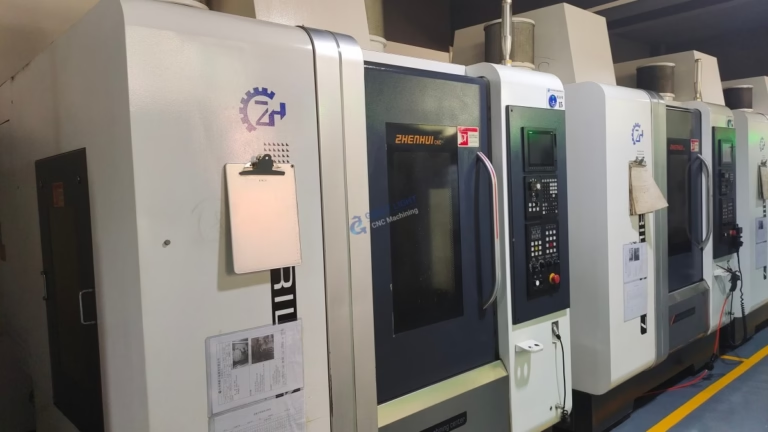
Where the Money Actually Goes
Plastic is cheap per kilogram. Machining time is not. Almost every price difference between two shops comes from how many setups, how much hand work, and how much inspection a part needs.
Why Two Quotes for the Same Plastic Part Differ by 3×
A plastic blank costs very little. What you pay for is spindle time, programming, fixturing, and inspection. When one shop quotes a part at a third of another shop's price, the gap is almost never in the material. It sits in the number of setups, the tool path, and how much of the work is finished by hand.
Setup count is the biggest single lever. A part that can be cut from two sides on a 3-axis machine with soft jaws is fast. The same part with undercuts, deep pockets on five faces, and a cosmetic surface needs more positioning, more fixturing, and more chances to scrap a workpiece. Each extra setup adds load and unload time, and it adds a new datum error.
Tool wear matters more in plastics than most people expect. Glass-filled PA and carbon-fibre sheet eat carbide quickly. Abrasive stock raises the cutting cost even when the material itself is inexpensive, because tools get changed more often and the feed rate has to come down.
Inspection is the last line item. A bracket checked with calipers is not the same job as a medical housing that needs a dimensional report and surface finish readings. Both are plastic. Only one carries the paperwork cost.
- 1Fewer setups winDesign so most features are reachable from one or two directions.
- 2Abrasive fillers cost moreGlass and carbon fibre shorten tool life and slow the feed.
- 3Tolerance drives timeTight bands mean slower passes, more checks, and more scrap risk.
- 4Finish is laborPolishing and blasting are hand operations, billed by the hour.
Which Plastics Machine Well and Which Fight Back
ABS, POM, PC, and PA cover most functional plastic parts. ABS is forgiving and takes a clean edge. POM machines like a dream and holds size well, which makes it a good pick for gears, bushings, and sliding parts. PC is tougher but gummy, so it needs sharp tools and light cuts. PA is strong and slightly flexible, though it absorbs moisture and can move after machining if it was not dried properly.
PEEK and carbon-fibre stock sit at the top of the price range. PEEK handles heat and chemicals that would destroy ABS, and it is used for seals, insulators, and parts that see steam or solvents. Carbon-fibre sheet is stiff and light, but it is abrasive, dusty, and expensive to cut. Use it when stiffness per gram matters, not as a default.
Soft and low-melting plastics are a different problem. PP and HDPE are cheap and chemical resistant, but they are flexible, so holding a tight tolerance on a thin wall is hard. They also burr easily. If your drawing calls for ±0.005 mm on a thin PP wall, expect to pay for it or change the material.
Thermal expansion is the quiet cost. Plastics grow and shrink far more than aluminium or steel for the same temperature swing. A part measured right off the machine may not pass inspection hours later in a cooler room. Letting the part stabilize before final measurement is part of the job, not an extra.
- 1POMBest all-round machinability for precision plastic parts.
- 2PEEKPay for it only when heat or chemicals demand it.
- 3PP and HDPECheap stock, difficult to hold tight on thin walls.
- 4Carbon fibreStiff and light, but abrasive and costly to machine.
Plastic Machining at a Glance
Typical values for machined plastic parts. Exact numbers depend on geometry and wall thickness.
| Plastic | Machinability | Typical tolerance | Common use |
|---|---|---|---|
| ABS | Good | ±0.05 mm | Enclosures, housings, covers |
| POM (acetal) | Excellent | ±0.02 mm | Gears, bushings, sliders |
| PC | Fair | ±0.05 mm | Guards, lenses, impact parts |
| PA (nylon) | Good | ±0.05 mm | Brackets, wear strips, rollers |
| PEEK | Fair | ±0.02 mm | Seals, insulators, hot parts |
| PP / HDPE | Fair | ±0.1 mm | Tanks, ducts, chemical parts |
| PMMA (acrylic) | Good | ±0.05 mm | Clear panels, displays |
Design Choices That Cut the Price
Wall thickness is the first thing to fix. Thin walls flex under cutting force, so the tool has to take lighter passes and the operator has to check more often. A wall of 1.5 mm to 2.5 mm is a comfortable range for most plastics. Going below 1 mm is possible, but the price climbs and the scrap rate follows.
Corner radii help more than they look. Sharp internal corners need a small tool, and small tools break and must run slowly. A radius of at least one third of the pocket depth lets a larger cutter in, which removes material faster and leaves a better floor finish.
Holes and threads have their own costs. Deep holes need peck drilling and clear chips. Threads cut with a tap are quick; threads milled into a wall are slower. Where a fastener only needs to hold, a through hole with a nut is cheaper than a tapped blind hole.
Tolerances should be called only where they are needed. Blanket ±0.02 mm across a whole drawing forces the shop to treat every feature as critical, and the price reflects that. Mark the two or three features that matter, and leave the rest at general tolerance.
- 1Keep walls 1.5–2.5 mmThicker is stiffer, thinner flexes and slows the cut.
- 2Radius internal cornersLarger cutters run faster and leave a cleaner floor.
- 3Avoid deep narrow pocketsLong reach tools deflect in plastic.
- 4Tighten only key featuresA blanket tolerance raises the price for no gain.
When Machining Is the Wrong Answer
A machined plastic part makes sense from one prototype up to low and mid volume runs. It holds shape, takes inserts and threads, and needs no tooling. When a design is still moving week to week, machining is the cheapest way to keep testing.
Injection moulding takes over when the geometry is frozen and the annual volume is high. A mould costs far more up front, but the per-part cost drops hard. If you are ordering 10,000 identical small parts and the design will not change, machining is not the cheapest route even at a good hourly rate.
3D printing is the third option. It wins on hollow or lattice shapes and on parts with internal channels that a cutter cannot reach. It loses on surface finish, on tight tolerance, and on mechanical strength along the layer lines. For a functional part that must hold a bearing or seal a face, machining is usually the better call.
Some shapes simply cannot be cut. A closed internal cavity, a deep undercut on all sides, or a part that needs a soft durometer will push you toward moulding, casting, or printing. Knowing that early saves a quote round trip.
- 1MachiningPrototypes to mid volume, tight tolerance, no tooling cost.
- 2Injection mouldingHigh volume, frozen design, lowest unit price.
- 33D printingHollow and lattice geometry, internal channels, fast turnaround.
- 4Check the feature firstClosed cavities and full undercuts are not millable.
Common Questions on Plastic CNC Machining
How is a cheap plastic CNC machining quote built up?
Most quotes bundle material, programming, machine time, fixturing, finishing, and inspection. Material is usually the smallest share for plastics. Machine time and hand work dominate.
Ask the shop to break out setup count and finishing hours. That tells you where to cut cost without touching the tolerance.
Can I get one plastic prototype without a minimum order?
Yes. There is no minimum order quantity, so a single prototype and a run of 10,000+ parts use the same process.
One-off parts are priced higher per unit because programming and fixturing are spread over a single piece. That overhead stays the same whether you order one or fifty.
What tolerance can machined plastic actually hold?
Our general machining tolerance is ±0.005 mm, and fine surface finish reaches Ra 0.2–0.8 μm. That is the capability, not an automatic result on every feature.
Plastics move with temperature and absorb moisture. A thin wall or a long unsupported section will not hold the same band as a solid block. Mark the critical features and let the rest run at general tolerance.
Which finishing options are available for plastic parts?
Bead blasting, tumbling, brushing, and polishing are the usual plastic finishes. Laser marking and engraving work too, with a minimum character height of 1.5 mm.
Plating and anodizing are metal processes and do not apply to plastic. For colour, choose a coloured stock or a painted finish instead.
How fast can plastic parts ship?
Quotation and DFM analysis come back within 12 hours, and production can start within 24 hours. Parts typically ship in 3–5 days.
Abrasive materials and heavy finishing add time because tools wear faster and hand work cannot be rushed.
How do you protect my design files?
Uploads are secure and confidential, and an NDA is available on request. Design data is not shared outside the project.
If your program requires it, we can work under your own NDA template instead.
Send a Plastic Part and Get a Real Number
Upload your STEP file and drawing. We return a quote and a free DFM analysis within 12 hours, with the setup and finishing costs broken out so you can see where the money goes.
12-hour quoteFree DFM analysisNo MOQ100% inspection









