
Cheap CNC Milling Machining Service: What Actually Drives the Price
For engineers and buyers comparing milling quotes that sit far below the market average. This page breaks a milling price into its real drivers, shows which parts can be milled cheaply and which cannot, and gives you the numbers to check before you place an order.
A milling quote is a sum of decisions, not a single rate
Break the price into machine time, setup, material, tooling and inspection, and a low number stops being mysterious. It tells you which of those five the workshop decided to skip.
Where the money in a milling job goes
Every milling quote contains the same five lines: machine time, setup, material, tooling and inspection. A cheap CNC milling machining service is simply one that has reduced one or more of them. Knowing which line was cut matters more than the total on the page.
Machine time depends on the spindle hour rate and how many hours the part holds the machine. A 3-axis mill running at 8,000 rpm costs less per hour than a simultaneous 5-axis center, but it may need three fixtures and three operations to reach the same geometry. On a simple bracket, the 3-axis route wins. On a part with compound angles and deep pockets, it usually loses.
Setup is the fixed cost that hurts small batches. Vises, soft jaws, custom fixtures and first-article checks can add hours before the first good part appears. A shop that spreads this over a 5,000-part run barely notices it. A shop quoting one prototype feels all of it.
- 1Machine timeSpindle hours × shop rate. Falls with fewer setups and higher material removal rates.
- 2SetupFixed per order. Dominates the price of one-off and low-volume work.
- 3MaterialBar, plate or near-net stock. Buy-to-size plate saves roughing time.
- 4InspectionCMM, first article and reports. Often the first line removed by low bidders.
Tolerance is the biggest single price lever
Loosening a tolerance from ±0.005 mm to ±0.05 mm can cut machine time by a third or more on the same part. The cuts get lighter, the tool paths get simpler, and the scrap rate drops. Ask yourself whether the mating component truly needs the tight number, or whether it was copied from an older drawing.
A tight callout affects everything downstream. It forces a finishing pass, sometimes a separate grinder, and a slower feed rate. It also forces more frequent tool changes, because a worn cutter drifts out of band before the shift ends.
Surface finish behaves the same way. Ra 1.6–3.2 μm comes off the machine with a normal face mill. Ra 0.2–0.8 μm needs a fine finishing pass, a sharp cutter and often a second operation. If the drawing says Ra 0.4 μm but the part is a mounting plate, you are paying for a number nobody will measure.
Which parts can be milled cheaply, and which cannot
Good candidates share a few traits. Prismatic shapes, open pockets, through holes, reachable faces from two or three directions, and features that fit inside a 500 × 500 × 450 mm envelope. Aluminium 6061 and 6061-T6 cut fast and hold tolerance well, so they forgive aggressive parameter choices. Brass and free-machining stainless 303 also price out low.
Hard or gummy materials push the price up. Titanium TC4 (Ti-6Al-4V) and Inconel require low surface speeds, rigid setups and carbide that wears quickly. Stainless 316 work-hardens if the cutter dwells, so the programmer cannot simply slow down to fix a chatter problem. Magnesium AZ31B cuts easily but needs chip handling rules.
Geometry that hides the cost is the real trap. Deep pockets with a small corner radius need long, slender tools that deflect. Undercuts and internal channels force a 5-axis approach or an EDM step. Thin walls below 1 mm move under clamping pressure and need light finishing passes. A drawing with a Ø2 mm slot 40 mm deep will never be cheap, no matter who quotes it.
Part features and their effect on milling cost
Use this to sanity-check a quote before you release the order.
| Feature or choice | Cost effect | What to do |
|---|---|---|
| Two or three reachable faces | Low | Keep the part on one 3-axis setup |
| Compound angles, undercuts | High | Budget for 5-axis or a second setup |
| Tolerance ±0.005 mm | High | Confirm the mating part really needs it |
| Tolerance ±0.05 mm | Low | Default for brackets and covers |
| Ra 0.2–0.8 μm | High | Use only on sealing or sliding faces |
| Ra 1.6–3.2 μm | Low | Normal as-machined finish |
| Slot Ø2 mm × 40 mm deep | Very high | Redesign or accept EDM |
| Aluminium 6061-T6 | Low | Good default for prototypes |
| Titanium TC4, Inconel | High | Cutters wear fast; expect a premium |
How to check whether a low quote is real
Start with the quote document itself. A serious supplier lists material grade, stock size, machine type, number of setups, tolerance band, finish, inspection method and lead time. If the sheet shows a lump sum and nothing else, you cannot compare it to anything, and you cannot tell what was left out.
Ask what the price does not include. Deburring, surface treatment, first-article reports, material certificates and packaging are common exclusions. Anodizing and plating are separate processes with their own minimum charges, so a quote that silently omits them will grow later.
Check the inspection plan. One hundred percent inspection before shipment, with raw material check, in-process monitoring and a final report on request, is the standard we hold. A supplier who only spot-checks the first part is cheaper for a reason you will discover at assembly.
Look at the equipment list against your geometry. A shop with 27 three-axis machines and no 5-axis capacity will subcontract your compound-angle part, adding margin and a week. Ask directly which machine will run the job.
- 1Itemized quoteMaterial, setups, machine, finish and inspection shown as separate lines.
- 2Exclusions statedDeburring, plating, certificates and packaging named in writing.
- 3Inspection definedMethod and sampling rate agreed before the run starts.
- 4Machine matchedThe quoted machine can actually reach every feature.
When cheap becomes genuinely cheap
Unit price falls as setup cost is divided over more parts. The first piece carries the fixture, the program and the first-article check. Parts two through fifty carry almost none of it. That is why a 200-piece run can cost less per part than a 20-piece run at the same shop, even with identical geometry.
Material buying follows the same curve. A full plate or bar cut to size costs less per kilogram than a small offcut from the rack. If your design allows a standard stock thickness, say so on the drawing and the buyer can plan around it.
We run no minimum order quantity, so a single prototype and a 10,000-piece run both go through the same process. The prototype is expensive per part and that is normal. Use it to prove the tolerance and finish, then move to volume with the parameters already validated.
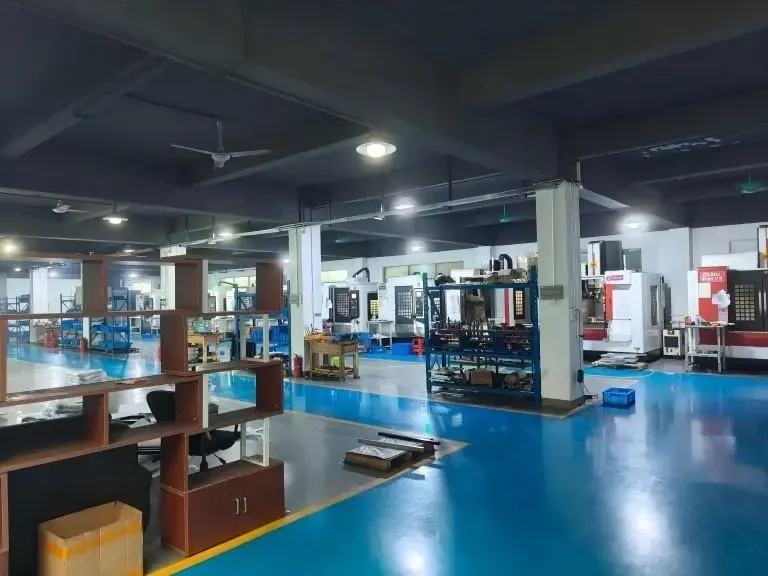
At our Dongguan and Singapore plants we hold 127 high-precision CNC machines, including 16 simultaneous 5-axis centers, 12 four-axis mills, 27 three-axis machines and 16 mill-turn centers, with a maximum processing size of 4,000 mm. That mix lets us quote the cheap route where it exists and tell you honestly when it does not.
Questions engineers ask about low-cost milling
Is a cheap CNC milling machining service always lower quality?
Not automatically. A low price can come from a simple part, standard stock, loose tolerance and a short setup. That is legitimate.
It becomes a problem when the price is low because inspection, deburring or material certification was dropped. Ask which cost lines were reduced and you will get a straight answer from a real shop.
How fast can I get a quote and parts?
We return a quotation and a free DFM analysis within 12 hours. Production can start within 24 hours after you approve.
Parts ship in 3–5 days for most milling work. Our historical late-delivery probability is below 2%.
Can I get one part without a minimum order?
Yes. There is no minimum order quantity, so you can order from one prototype to a 10,000+ part run.
The prototype will carry the full setup cost. That is the honest trade for testing geometry before volume.
What tolerance and finish can you hold?
We hold ±0.005 mm (±0.0002 in) where the drawing requires it.
Finishes run from Ra 0.2–0.8 μm for fine work, Ra 0.8–1.6 μm as a high standard, and Ra 1.6–3.2 μm as-machined for general parts.
Will you sign an NDA before I send drawings?
Yes. Uploads are secure and confidential, and we sign an NDA on request.
You can send STEP, IGES, X_T, PDF and DXF files through the quote page.
Which materials keep the price down?
Aluminium 6061 and 6061-T6, brass C36000 and stainless 303 machine quickly and hold tolerance well.
Titanium TC4, Inconel and hardened tool steel cost more in cutter wear and machine time. Budget for that instead of shopping the job around.
Send your prints and get a real number
Upload your drawings and we will return a cost breakdown, a DFM note and a lead time within 12 hours.
12-hour quote100% inspectionNo MOQNDA on request









