
CNC Machine Services Inc: How to Choose the Right Partner
This guide is for engineers and sourcing managers comparing cnc machine services inc vendors. We cover the checks that actually change part quality, cost, and delivery: tolerance capability, material range, certification fit, MOQ, and how a shop writes its quotes. Read it before you send drawings.
In this article
- 1
- 2
- 3
- 4
- 5
- 6
- 7
What matters most when comparing shops
Comparing CNC machine services inc vendors
Use this table as a checklist when you review quotes side by side.
| Criterion | What to ask | Good answer | Red flag |
|---|---|---|---|
| Tolerance | Which machine holds ±0.005 mm? | Named machine and inspection method | A number with no machine behind it |
| Material range | Can you run 7075 or 17-4PH? | Stock list with grades and forms | Only 'aluminum and steel' |
| MOQ | What is the smallest run? | One prototype to 10,000+ | Minimum 500 pieces for a prototype |
| Certifications | Which apply to my industry? | ISO 9001, IATF 16949, ISO 13485, ISO 27001 | One generic certificate for every job |
| Lead time | When does the spindle start? | Production starts within 24 hours | Vague '2–4 weeks' with no start date |
| Quote content | Is DFM included? | Free DFM analysis within 12 hours | Price only, no process notes |
| Confidentiality | Can you sign an NDA? | NDA available on request | No answer on data handling |
Match tolerance to the machine, not the brochure
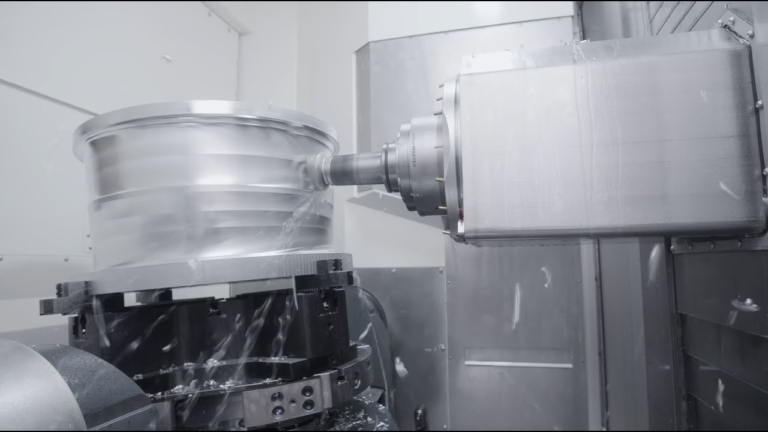
Every shop claims tight tolerance. The useful question is which machine holds it and how the shop proves it. A three-axis mill with a worn ball screw will not hold ±0.005 mm across a long part. A simultaneous five-axis center with a Ø400 mm rotary table can, if the setup is rigid and the tool path is planned for it. Ask for the machine model and the inspection method before you accept the number.
Part geometry decides the machine more than the tolerance line on the drawing. A bracket with holes on five faces needs either five-axis or several refixtures. Each refixture adds position error. On a 750 × 1,150 × 550 mm travel machine, a part that fits in one setup will hold position far better than the same part moved three times. If your part has features on four or more faces, five-axis is usually the cheaper route once you count labor.
Size matters too. GreatLight runs machines with travels from 500 × 310 × 200 mm up to 4,000 × 400 × 150 mm. A 2 m long extrusion does not belong on a compact mill. A small medical housing does not need a large gantry. Sending the wrong part to the wrong machine is a common cause of missed tolerance and slow delivery.
- 1One setup beats threeFewer refixtures means less position stack-up.
- 2Check the spindle, not the spec sheetRigidity and thermal stability drive real accuracy.
- 3Match travel to part sizeOversized parts on small machines flex or need rework.
Material range tells you how broad the shop really is
A shop that only cuts 6061 will struggle with 17-4PH stainless or Ti-6Al-4V. Titanium galls, moves under heat, and needs slower speeds and sharper tools. Inconel is worse. If your part is titanium or nickel alloy, ask how many of those jobs run per month and what tooling they keep in stock. A vague answer usually means the shop outsources it.
Plastic is a different problem. PEEK and carbon fiber need sharp cutters and controlled feed to avoid delamination and melting. POM machines cleanly but moves after cutting. ABS and PC are easy until you need a fine finish. A shop that lists these materials and can talk about feed rates has done the work before.
Finishes change fit. Hardcoat anodizing adds 0.025–0.05 mm per surface. If a bore is already at the top of tolerance, plating may push it out. Electroless nickel adds a thin, even layer; zinc and chrome vary more. Tell the shop which surfaces must stay bare and which can be coated. Laser marking needs a minimum character height of 1.5 mm to stay legible.
- 1Titanium and Inconel need experienceTool choice and speeds differ from aluminum.
- 2Plating changes dimensionsAnodize and nickel add measurable thickness.
- 3Name your critical surfacesMasking decisions should be made before finishing.
Certifications must fit your industry
ISO 9001:2015 is the baseline. It says the shop has a quality system, not that it understands your sector. For automotive and EV parts, IATF 16949:2016 adds traceability, PPAP support, and process controls that ISO 9001 does not require. For medical devices, ISO 13485:2016 covers documentation and validation practices auditors expect.
If your drawings are confidential, ISO 27001:2022 matters. It covers how the shop handles customer data, not just metal. GreatLight holds all four: ISO 9001:2015, IATF 16949:2016, ISO 13485:2016, and ISO 27001:2022. That range lets one supplier serve an automotive bracket, a surgical instrument housing, and a prototype under NDA without splitting the work.
Certificates are not a substitute for inspection. Ask what is checked, when, and whether reports come with the shipment. GreatLight inspects raw material, monitors in-process, and checks 100% before shipment. Reports are available on request. A shop that cannot describe its inspection flow has a certificate, not a process.
Read the quote, not just the price
A useful quote lists material grade, setup count, machine, tolerance verification, finish, and lead time. A price with no process notes is a number you cannot compare. Two shops can quote the same part and mean different things: one includes material certification, the other does not. Ask for the breakdown before you decide.
MOQ is a hidden cost. A shop with a 500-piece minimum forces you to buy inventory before the design is frozen. GreatLight has no minimum order quantity and runs from one prototype to 10,000+ part runs. That matters most at the prototype stage, when design changes are still cheap.
Lead time needs a start date. 'Two to four weeks' means nothing if the clock starts after material arrives. GreatLight provides a quotation and free DFM analysis within 12 hours, can start production within 24 hours, and ships parts in 3–5 days. Historical late-delivery probability is below 2%. Ask any supplier when the spindle starts, not just when parts leave.
- 1Demand itemized quotesMaterial, setup, machining, finish, inspection.
- 2Prototype without inventory riskNo MOQ keeps design changes affordable.
- 3Pin down the start date'Weeks' is not a lead time without a trigger.
Seven steps to vet a CNC machine services inc supplier
Run these in order. Each one filters out shops that cannot meet the next requirement.
- 1Send one real part, not a test couponUse a part with your tightest tolerance and at least one difficult feature. A cube proves nothing.
- 2Ask which machine will run itGet the model and travel size. Confirm it can hold ±0.005 mm on your geometry.
- 3Request the inspection planAsk what is measured, with what tool, and whether a report ships with the parts.
- 4Confirm material grade and mill certState the exact alloy, such as 7075-T6 or 17-4PH. Ask for the mill certificate.
- 5Check MOQ against your stagePrototype needs one piece. Production may need 10,000+. Make sure both are possible.
- 6Match certifications to your industryAutomotive: IATF 16949. Medical: ISO 13485. Confidential drawings: ISO 27001.
- 7Compare lead times with a start dateAsk when production begins. A 24-hour start plus 3–5 day shipping beats a vague estimate.
Questions buyers ask before ordering
What tolerance can a CNC machine services inc partner actually hold?
It depends on the machine, the setup, and the feature. GreatLight machines to ±0.005 mm (±0.0002 in) on parts that fit the machine travel and can be held rigidly.
Long, thin parts and deep bores are harder. Tell the shop which features are critical so the setup is planned around them.
Do I need a minimum order quantity for a prototype?
Not at GreatLight. There is no minimum order quantity, so a single prototype and a 10,000+ part run both go through the same process.
This keeps design changes affordable. You can revise the part without buying inventory you may never use.
How fast can a quote and first parts arrive?
Quotation and free DFM analysis come back within 12 hours. Production can start within 24 hours, and parts ship in 3–5 days.
Historical late-delivery probability is below 2%. Ask for the production start date, not just the shipping estimate.
Which certifications should I look for?
ISO 9001:2015 is the baseline for any shop. Add IATF 16949:2016 for automotive and EV work, and ISO 13485:2016 for medical devices.
If your drawings are confidential, look for ISO 27001:2022. GreatLight holds all four and can sign an NDA on request.
Will surface finishing change my dimensions?
Yes. Hardcoat anodizing adds roughly 0.025–0.05 mm per surface. Electroless nickel is thinner and more even. Zinc and chrome vary more.
Flag critical bores and sealing surfaces before finishing so they can be masked or sized to compensate.
Can one supplier handle machining, finishing, and assembly?
GreatLight covers five-axis, four-axis, and three-axis machining, CNC milling and turning, sheet metal, die casting, vacuum casting, 3D printing, and surface finishing.
Keeping those steps under one roof reduces handling, shipping, and the risk of tolerance loss between vendors.
Send drawings, get a quote in 12 hours
Upload your files and an engineer will review them, flag DFM issues, and return a detailed quote. Uploads stay secure and confidential.
12-hour quoteFree DFM analysis100% inspectionNo MOQ
More from GreatLight
We publish setup notes, tooling trials and inspection data from the factory floor.











