
CNC Machining Parts Service Quotes: What to Check Before You Approve
A quote is a technical document, not just a number. This guide breaks down what a CNC machining parts service quote should contain, how suppliers price the same drawing differently, and which items you should compare line by line. It is written for engineers and sourcing staff who have to defend the choice internally.
In this article
- 1
- 2
- 3
- 4
- 5
- 6
- 7
- 8
- 9
What matters first
Quote line items and what each one tells you
Read the left column as the question, the right columns as what a good answer looks like.
| Quote item | What to look for | Red flag |
|---|---|---|
| Material | Alloy grade and stock form stated | Only 'aluminum' or 'steel' written |
| Programming | Separate line for CAM time | Bundled into a vague 'engineering fee' |
| Cycle time | Minutes per part and machine type | No machine type mentioned |
| Setup | Number of setups and fixtures | Setup charged per part |
| Tolerance | Only tight dims flagged | One blanket tolerance note |
| Finishing | Process, spec and thickness | 'Surface treatment' with no detail |
| Inspection | Report type and sampling plan | No inspection line at all |
| Lead time | Quote, tooling, machining, finishing | Single number with no milestones |
Which service level fits your part
| Part situation | Sensible choice | Why |
|---|---|---|
| One prototype, simple geometry | 3-axis mill or 2-axis turn | Lowest setup, fast turnaround |
| Features on four faces | 4-axis with tombstone | One fixture, fewer re-clamps |
| Five-face contour or deep cavity | 5-axis simultaneous | Avoids multiple setups |
| Shaft with cross holes | Mill-turn center | Turning and milling in one pass |
| Run of 10,000+ simple parts | Near-net blank plus machining | Cuts material waste |
| Medical implant housing | ISO 13485 shop, fine finish | Traceability and Ra 0.2–0.8 μm |
| Automotive bracket, PPAP needed | IATF 16949 shop | Documentation matches program |
The cheapest quote is rarely the cheapest part
Compare on process plan, tolerance scope, finishing and inspection, not on the bottom line. Send one drawing to GreatLight and you get a breakdown plus a free DFM analysis within 12 hours, quoted by an engineer who has read the tolerances.
Why two CNC machining parts service quotes differ
The same drawing sent to three shops rarely comes back with three similar numbers. The gap is usually not greed. It is a different reading of the part. One shop plans a 3-axis setup with two fixtures, another sees a feature that needs 5-axis simultaneous motion, and a third decides to machine the part in two operations on a mill-turn center. Each plan has a different cycle time, and cycle time is the largest single driver of price.
Material is the second driver, and it is the one buyers underestimate. CNC machining is subtractive. A bracket cut from a solid 6061 block can lose most of its volume as chips, and the quote covers the whole block, not the finished weight. For large parts or runs above a few hundred pieces, a near-net-shape blank from casting or forging often makes more sense than cutting from plate.
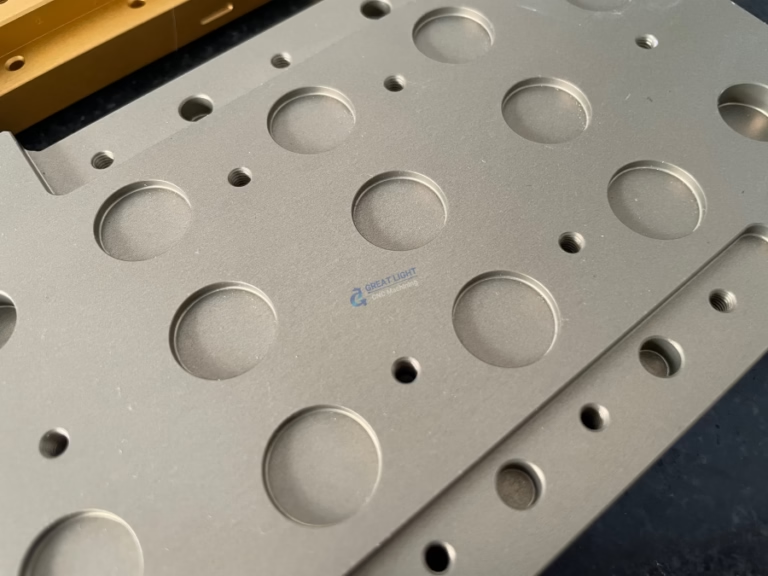
Programming effort is the third. A simple 2D milled plate with a few holes may take under an hour of CAM work. A part with blended 3D contours, thin walls, or features on five faces can take a full day of toolpath planning, plus a verification pass. If a quote does not separate programming from machining, you cannot tell which of the two is expensive.
Tolerance sits on top of all of this. A dimension held to ±0.005 mm usually requires a finishing pass, a temperature-stable setup, and a CMM check. A dimension at ±0.1 mm may not. When every dimension on a drawing carries the same tight tolerance, shops price the worst case, and you pay for precision the part does not use.
How to compare suppliers behind CNC machining parts service quotes
Start with machine list, not price. A shop running 27 three-axis machines and 12 four-axis mills handles prismatic parts efficiently. A shop with 16 simultaneous 5-axis centers and 16 mill-turn centers can hold complex geometry in fewer setups. If your part has features on five faces or needs tight true position between bores, the second shop will usually quote lower because it avoids re-fixturing.
Then check the size envelope. If the drawing is 900 mm long, a shop with a 500 mm travel cannot make it in one setup, and the quote will quietly include a second operation. Ask for the actual travel of the machine assigned to your part. Common envelopes run from 500 × 310 × 200 mm up to 4,000 × 400 × 150 mm for long parts.
Certifications should match your industry, not your ego. ISO 9001:2015 covers general quality systems. IATF 16949:2016 matters for automotive and EV work. ISO 13485:2016 matters for medical devices. ISO 27001:2022 covers information security, which matters when you upload proprietary CAD. A supplier with all four can serve mixed programs without moving your file between systems.
Finally, look at how they handle the first article. A shop that offers free DFM analysis before quoting is telling you they read the drawing. A shop that only returns a price is telling you they will read it after you place the order, when changes cost time.
- 1Machine listAsk which machine type is planned for your part.
- 2Travel limitsConfirm the part fits in one setup if the drawing allows.
- 3Certification fitMatch certs to your industry, not to a brochure.
- 4DFM before orderFree analysis at quote stage saves revisions later.
Tolerance, surface finish and what they add to a quote
Tolerance and finish are linked, and both are usually over-specified. As-machined surfaces land around Ra 1.6–3.2 μm, which is fine for most brackets, housings and fixtures. A high-finish call of Ra 0.8–1.6 μm suits sealing faces and bearing bores. Fine finish at Ra 0.2–0.8 μm is for optical, medical or sliding contact surfaces, and it adds polishing or a slower finishing pass.
On tolerance, split the drawing into three groups. Functional fits, mating features and datum references go tight, at ±0.005 mm where the design needs it. General dimensions can sit at ±0.1 mm. Cosmetic or clearance features can be looser. This reduces the number of tight dimensions the shop has to hold, and the quote reflects it.
Material choice changes both. Titanium TC4 (Ti-6Al-4V), Inconel and 17-4PH stainless cut slowly and wear tools, so cycle time goes up even at moderate tolerance. Aluminum 6061-T6 and brass C36000 machine quickly and hold tight tolerance with less effort. If a part can be redesigned in 6061 instead of 7075 without losing strength margin, the quote usually drops.
Hardness and heat treatment are separate line items. If your drawing calls for 440C at high hardness or 4140 pre-hardened, the shop has to plan tooling and feeds around it. Send the heat-treat spec with the RFQ so it is priced in the first quote instead of appearing later as a change order.
Lead time, MOQ and the hidden cost of small batches
Lead time in a CNC machining parts service quote is a chain, not a number. It includes quote turnaround, DFM review, material procurement, programming, first-article inspection, production, finishing and shipping. A shop that quotes 12 hours and starts production within 24 hours is compressing the front of that chain. A shop that quotes two weeks may be waiting on material.
MOQ reveals how the shop is set up. A supplier with no minimum order quantity can run one prototype and then a 10,000-part run on the same process plan, which means your prototype data carries into production. If a shop insists on a minimum of 500 pieces, ask what changes between the prototype and the production batch. Sometimes nothing changes, and you are just paying for their scheduling.
Small batches carry hidden costs that never appear as a line item. Setup, fixturing and programming are spread over fewer parts, so the per-part price rises even though the machine runs the same program. If you expect to scale, ask for a price at three quantities, for example 1, 100 and 1,000 pieces. The curve tells you where the setup cost stops dominating.
Shipping and finishing are the last two links. Anodizing, plating and powder coating often happen at a different facility, which adds transit time. If your schedule is tight, ask whether finishing is in-house and how it is sequenced with the machining run.
Red flags in CNC machining parts service quotes
A quote with no breakdown is the first warning. It may still be a fair price, but you cannot verify it and you cannot compare it to a second supplier. The same applies to a lead time with no milestone dates. Ask for quote, first article and ship dates separately.
The second warning is a tolerance note that contradicts the drawing. If the drawing says ±0.01 mm and the quote says 'standard tolerance', the shop is either planning to renegotiate later or has not read the drawing. Send it back.
The third is a price that is far below the others with no explanation. Sometimes it is a scheduling gap and the shop wants to fill a machine. That is a legitimate reason, but ask. If the answer is vague, the risk sits with your delivery date, not theirs.
The fourth is silence on confidentiality. If you are uploading proprietary CAD for an aerospace, automotive or medical program, ask about NDA and file handling before sending the model. A supplier who treats this as routine will have a process for it.
How to review a CNC machining parts service quote in 6 steps
- 1Check the material lineConfirm the alloy grade and stock form match your drawing. 6061-T6 and 6061 are not the same call. If the quote says only 'aluminum', ask for the grade before comparing price.
- 2Map the tolerancesMark every dimension tighter than ±0.05 mm and ask how each one is verified. If more than a handful are tight, ask whether the design truly needs them.
- 3Trace the process planAsk which machine type is assigned and how many setups are planned. A part that can run in one 5-axis setup should not be quoted as three 3-axis operations.
- 4Add up the finishingList every surface treatment, its spec and its thickness. Anodizing Type II and Type III hard coat are different processes with different costs.
- 5Read the inspection planAsk what is measured, on what equipment, and whether a report is included. A first-article report on a prototype is standard practice for tight parts.
- 6Compare at three quantitiesRequest pricing at 1, 100 and 1,000 pieces where the design allows. The slope shows you how setup and programming are being amortized.
Frequently asked questions
What file formats do I need to send for a CNC machining parts service quote?
Send a 3D model (STEP or IGES) plus a 2D drawing with tolerances, datums, surface finish and material callout. The 3D model defines geometry; the 2D drawing defines what is inspected.
If you do not have a drawing, send the model with critical dimensions marked. A supplier doing free DFM analysis can flag ambiguous features before quoting, which avoids a revision later.
How long should a quote take?
A straightforward part with a clear drawing can be quoted within 12 hours, including a free DFM analysis. Complex assemblies or parts with special material requirements can take longer, mainly because of material lead time.
If a supplier cannot give you a quote turnaround, ask what information is missing. It is usually a tolerance or finish detail.
Can I get prototypes and production from the same supplier?
Yes, and it is usually cheaper in total. Running the prototype and the production batch on the same process plan avoids a second qualification round. A supplier with no minimum order quantity is set up for this.
Ask whether the prototype process plan carries over to the production run, or whether the shop plans to change fixtures or machine type at volume.
What tolerances can a CNC shop hold on a production run?
GreatLight quotes a general tolerance capability of ±0.005 mm (approximately ±0.0002 in) on critical dimensions, verified with in-house inspection equipment. Not every dimension on a part should carry that tolerance.
Achievable tolerance depends on material, feature geometry and how the part is fixtured. A thin-wall titanium part and a solid aluminum block do not hold the same tolerance with the same effort.
How do I compare quotes when suppliers list different line items?
Normalize first. Ask each supplier to separate material, programming, setup, cycle time, finishing and inspection. Then compare the cycle time and the setup count, because those two lines explain most of the price difference.
If a supplier refuses to itemize, treat the quote as a single data point and weigh it against the ones you can read.
What should I check before uploading confidential CAD files?
Ask about NDA availability and how files are stored and accessed. GreatLight holds ISO 27001:2022 for information security and treats all uploads as confidential.
For defense, aerospace or medical programs, confirm that only the engineers assigned to your part can open the files, and ask whether the supplier shares models with subcontractors.
Send your drawing, get a quote you can defend
Upload a STEP file and a 2D drawing. An engineer reviews the tolerances and returns a line-item quote with DFM notes within 12 hours. No minimum order quantity, from one prototype to 10,000+ part runs.
12-hour quote + DFMNo MOQ±0.005 mm100% inspection before shipment
More from GreatLight
We publish setup notes, tooling trials and inspection data from the factory floor.











