
CNC Machining Service 62040: What to Check Before You Order
This guide is for engineers and sourcing staff shortlisting a cnc machining service 62040 suppliers for prototypes and small production runs. It covers the seven checks that separate a capable shop from a fast talker.
In this article
- 1
- 2
- 3
- 4
- 5
- 6
- 7
- 8
- 9
Key takeaways
Seven checks for a cnc machining service 62040 supplier
Use this table as a screening sheet. The right-hand column is what a shop should be able to answer without going away to check.
| Check | What to ask | What a good answer looks like |
|---|---|---|
| Tolerance | Which machine holds the tightest callout? | A named machine plus an inspection method |
| Material | Is the grade in stock or ordered? | Stock list with certification per heat |
| Lead time | When does the spindle actually start? | A start date, not a shipping window |
| Inspection | What is measured, and how often? | 100% before shipment, reports on request |
| Certifications | Which process does each certificate cover? | Scoped certificate with line-level detail |
| MOQ | What is the smallest run you will quote? | One piece up to 10,000+ parts |
| Confidentiality | Who sees our files? | NDA on request, restricted access |
Tolerance: what the number really costs
Every cnc machining service 62040 quote starts with a tolerance stack. A part with one or two tight bores is not the same job as a part with thirty tight features spread over 400 mm. The first can run on a three-axis mill with a good fixture. The second needs a five-axis machine and a probe routine.
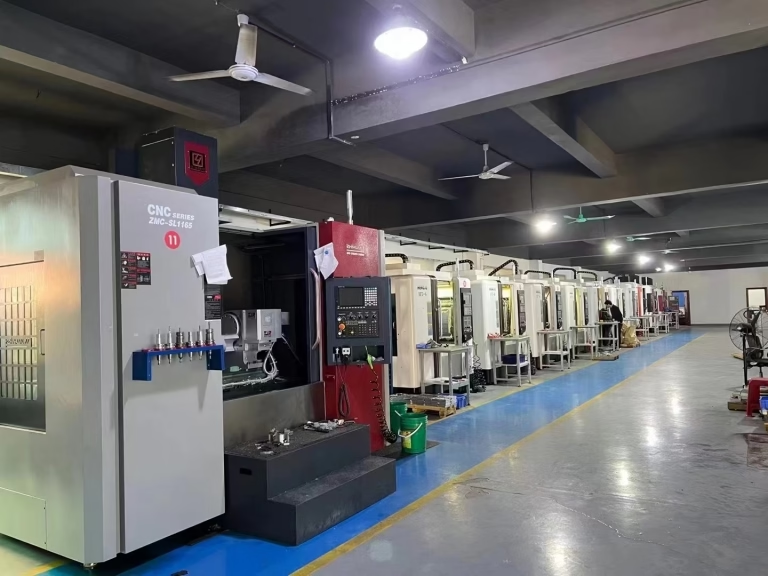
Ask which machine will run the part. A shop with 16 simultaneous 5-axis centers and 27 three-axis machines can choose honestly. A shop with only three-axis equipment will either turn the work down or quietly widen your callout.
General machining holds ±0.005 mm on a good day. Below that, the cost curve is steep because temperature, tool wear and fixture rigidity all start to matter more than the program. If your drawing says ±0.002 mm across a long part, expect to discuss material and shop temperature before price.
The practical question is not how tight a shop can hold. It is how tight it can hold repeatedly across the run. One good first article proves nothing about part 500.
- 1Send the real drawingA simplified model hides the features that drive cost.
- 2Mark critical dimensionsShops price to the tightest callout on the sheet.
- 3Ask for the machine nameVague answers usually mean the job is not planned yet.
Lead time: when the spindle actually starts
Quotes often mix two different clocks. One is the time to cut metal. The other is the queue in front of your job. A shop that answers within 12 hours with a free DFM analysis is telling you the front office is staffed. It says nothing about machine availability.
Ask for a production start date. A real answer sounds like "material arrives Tuesday, first op runs Wednesday." If the reply is a shipping window with no start date, the shop is guessing.
Fast shipping is possible when a shop keeps capacity open. Parts shipping in 3–5 days after production start is a normal rhythm for prototype quantities. It is not a promise you should expect on a 10,000-part run without a scheduled slot.
Watch for the difference between expedite fees and real capacity. Paying more does not create a free spindle. It only moves your job ahead of someone else's.
- 1Get a start dateProduction can begin within 24 hours when material is on the shelf.
- 2Ask about the queueA shop with 127 machines has more room to reshuffle than a job shop with six.
- 3Separate the clocksCutting time and queue time are different numbers.
MOQ, unit price and the setup trap
No minimum order quantity sounds generous until you see the unit price. Setup, programming and fixturing are fixed costs. On a one-piece order they land entirely on that piece. On a 5,000-piece order they spread thin. A shop that quotes both from the same number is either losing money on one or padding the other.
The honest structure is a setup cost plus a per-part cost that falls as volume rises, with the curve flattening once the fixture pays for itself. Ask where that flattening point is. For most milled parts it arrives somewhere between 50 and 500 pieces, depending on how much custom workholding is needed.
Material also changes the picture. A 6061-T6 bracket can be cut from plate stock with almost no prep. A 17-4PH or Inconel part may need a different tool path, slower feeds and more tool changes, which pushes the crossover point higher.
If you are pre-production, order one or two pieces first. A shop that will not quote a single prototype is not set up for design iteration.
- 1Ask for the curveRequest pricing at 1, 100 and 1,000 pieces.
- 2Check material stockSpecialty grades add lead time before cutting starts.
- 3Prototype firstProve the design before committing to tooling.
Certifications: read the scope, not the logo
A wall of certificates means little until you read what each one covers. ISO 9001:2015 is a quality management baseline. IATF 16949:2016 is written for automotive production and adds traceability and change-control requirements. ISO 13485:2016 applies to medical device manufacturing. ISO 27001:2022 covers information security, which matters when your files are someone else's product.
The scope statement is the part people skip. A certificate can cover one plant, one process family or one product line. If your part runs in a different building, the certificate may not apply. Ask which site and which process the certificate covers.
For medical and automotive work, ask how change control works. If a shop can swap a tool or a supplier without notifying you, the certificate is not doing much work.
Confidentiality belongs in the same conversation. Uploads should be secure, and an NDA should be available on request for intellectual-property-sensitive projects. Ask before you send files, not after.
- 1Ask for the scopeWhich site, which processes, which product families.
- 2Ask about change controlNotification rules matter more than the frame on the wall.
- 3Sort confidentiality earlyNDA on request, restricted file access.
Inspection and the report you should ask for
Inspection is where cheap quotes hide. A shop can cut a good part and still ship a bad one if nobody measures it. Ask what is checked, at which stage, and what documentation comes with the shipment.
A workable routine has three gates. Raw material is checked against the certificate. In-process checks catch drift before a batch is finished. Final inspection confirms the drawing before packing. For tight work, that final pass should cover 100% of parts, not a sample.
Ask which instruments are used. Calipers are fine for ±0.1 mm. Below that you want micrometers, bore gauges, height gauges or a CMM, and you want to know when they were last calibrated.
Reports are usually available on request. If you need first article inspection or material certificates with the shipment, say so at quote time. It is cheap then and expensive later.
- 1Three gatesMaterial, in-process, final.
- 2100% before shipmentSampling is for stable, high-volume runs.
- 3Name the instrumentsThe tool has to match the tolerance.
Finishing and secondary operations
Machining is rarely the last step. Anodizing, plating, powder coating, bead blasting and laser marking all change the part after it leaves the spindle. Each one adds a vendor, a lead time and a chance for damage.
Ask whether finishing is done in house or subcontracted. In-house control is faster and easier to trace. Subcontracted finishing can be fine, but you should know who owns the part while it is in transit.
Some finishes affect dimensions. Hardcoat anodizing builds thickness and can close a tight bore. Electroless nickel adds a uniform layer. If your part has a press fit or a seal surface, tell the shop before finishing is chosen.
Laser marking has its own limit. Minimum character height is around 1.5 mm for a clean, readable mark. Smaller text may look fine on a screen and unreadable on the part.
- 1Anodize before final sizingCoating thickness changes fits.
- 2Ask who owns the partTransit risk sits with someone.
- 3Mark lastEngraving after finishing avoids rework.
How to vet a supplier in one week
Run these steps in order. Stop as soon as a shop cannot answer clearly.
- 1Send the drawing with critical dimensions markedInclude material grade, finish, quantity and any fit that matters. A complete package gets a real quote instead of a placeholder number.
- 2Ask for the machine and the inspection methodYou want a machine name and an instrument, not "high precision". If the answer is vague, the job is not planned.
- 3Request pricing at three quantities1, 100 and 1,000 pieces. Look at where the curve flattens and whether the setup cost is stated separately.
- 4Ask for the certificate scopeWhich site and which processes each certificate covers. Match it against where your part will actually run.
- 5Confirm the production start dateSeparate queue time from cutting time. A start date plus a shipping window is a plan. A shipping window alone is a hope.
- 6Ask what ships with the partsInspection report, material certificate, first article if needed. Agree on this before the run, not after.
- 7Run a one-piece trialMeasure it yourself. A shop that passes a single-part trial with real inspection data is worth a larger order.
Frequently asked questions
How tight a tolerance can a cnc machining service 62040 supplier actually hold?
±0.005 mm is a realistic general figure for milled and turned parts on rigid setups with good fixturing. Tighter calls are possible on specific features, but they depend on material, part size and how the measurement is made.
Ask for the tolerance per feature, not one number for the whole drawing. A long part with a tight bore at each end is a different problem from a small part with one tight bore.
Does a lower unit price mean lower quality?
Not always. A shop with 127 machines and steady work can spread overhead better than a small job shop. What matters is whether the quote states setup, material and finishing separately.
A quote that is one number with no breakdown is hard to compare and easy to inflate later. Ask for the split.
What should I do if the shop has no minimum order quantity?
Order one piece first and inspect it. No minimum order only helps if the first part is right. Check the critical dimensions yourself or ask for a report.
If the prototype passes, the same shop usually becomes the cheapest path to a small production run because the setup and fixture already exist.
Are ISO certificates enough to qualify a supplier?
They are a starting filter, not a finish line. Read the scope, confirm the site and ask how change control works. A certificate that does not cover your process tells you little.
For medical and automotive parts, ask for the specific standard that applies and how traceability is maintained through finishing and shipping.
How do I compare lead times fairly?
Ask for a production start date and a shipping window as two separate numbers. Then ask whether either depends on material arriving from a supplier.
A historical late-delivery rate is useful if the shop tracks it. Ask how it is measured and over what period.
What files should I send with a request for quote?
A 3D model plus a 2D drawing with tolerances, material, finish and quantity. Mark the dimensions that actually matter for function.
Mention if the files are confidential. Uploads should be secure and an NDA should be available on request before files change hands.
Send your drawing and get a real answer
We quote and return a free DFM analysis within 12 hours, with the machine, the inspection method and the start date named in writing.
Quote in 12 hoursNo minimum order100% inspection
Follow GreatLight
We publish setup notes, tooling trials and inspection data from the factory floor.











