
CNC Machining Service Provider: How to Vet One Before You Send the PO
This guide is for engineers and sourcing teams choosing a cnc machining service provider for metal and plastic parts. It covers the checks that predict whether your first article passes: tolerance capability, inspection equipment, certifications, MOQ, quote turnaround, and how the shop handles a bad part.
In this article
- 1
- 2
- 3
- 4
- 5
- 6
- 7
- 8
What separates a capable shop from a fast talker
What to check, what a good answer looks like, and the warning sign
Use this as a scorecard when you compare two or three suppliers.
| Criterion | Strong answer | Red flag |
|---|---|---|
| Tolerance claim | A stated number with the size range it applies to | Vague claims like high precision only |
| Inspection equipment | CMM and height gauges in house, reports on request | All metrology outsourced to a third party |
| Certifications | ISO 9001:2015, IATF 16949:2016, ISO 13485:2016, ISO 27001:2022 | Certificates for a different legal entity |
| Minimum order | No MOQ, one prototype accepted | Large setup charge to start a single part |
| Quote and DFM | Quotation and free DFM analysis within 12 hours | A price with no manufacturability notes |
| Lead time | Parts ship in 3–5 days after production start | Cannot separate machining from finishing time |
| Scope of process | Machining, finishing, and assembly under one roof | Four vendors to coordinate one part number |
| Confidentiality | NDA available on request, secure uploads | CAD files sent over personal email |
1. Tolerance and machine capability: match the claim to the geometry
Tolerance is the first filter, and also the most abused number. A cnc machining service provider that states ±0.005 mm is telling you what the process can hold under normal conditions, not what every feature on every part will achieve. Ask which features that applies to. A bolt circle on a 6061-T6 plate is a different problem from a thin wall on a 316L manifold.
Geometry decides which machine you need. A 4,000 mm long extrusion with holes on five faces needs a large gantry or a long-travel mill. A compact hydraulic block with cross-drilled ports is usually a mill-turn job, because the part never has to be refixtured between operations. Refixturing is where tolerance stacks up, and it is the most common reason a second operation drifts out of spec.
Ask the shop how many setups the part will take. If the answer is three, expect three chances for positional error. A simultaneous 5-axis center that machines five faces in one setup removes two of those chances. GreatLight runs 16 simultaneous 5-axis machining centers, 12 four-axis mills, 27 three-axis machines, and 16 mill-turn centers, so the process plan is chosen by geometry rather than by whatever machine is free.
One number worth asking about is yield. A shop claiming a 99.99% qualification rate should be able to explain how it is measured and what happens to the 0.01%. That answer tells you more about the culture than the number itself.
- 1Tight features need fewer setupsPositional tolerance between faces is set by fixturing, not by spindle accuracy.
- 2Thin walls moveBelow roughly 1 mm wall thickness on aluminum, plan a finishing pass and light cuts.
- 3Surface finish is separate from toleranceRa 0.8–1.6 μm is a normal machined finish; Ra 0.2–0.8 μm needs a deliberate finishing strategy.
2. In-house inspection and the paperwork that comes with it
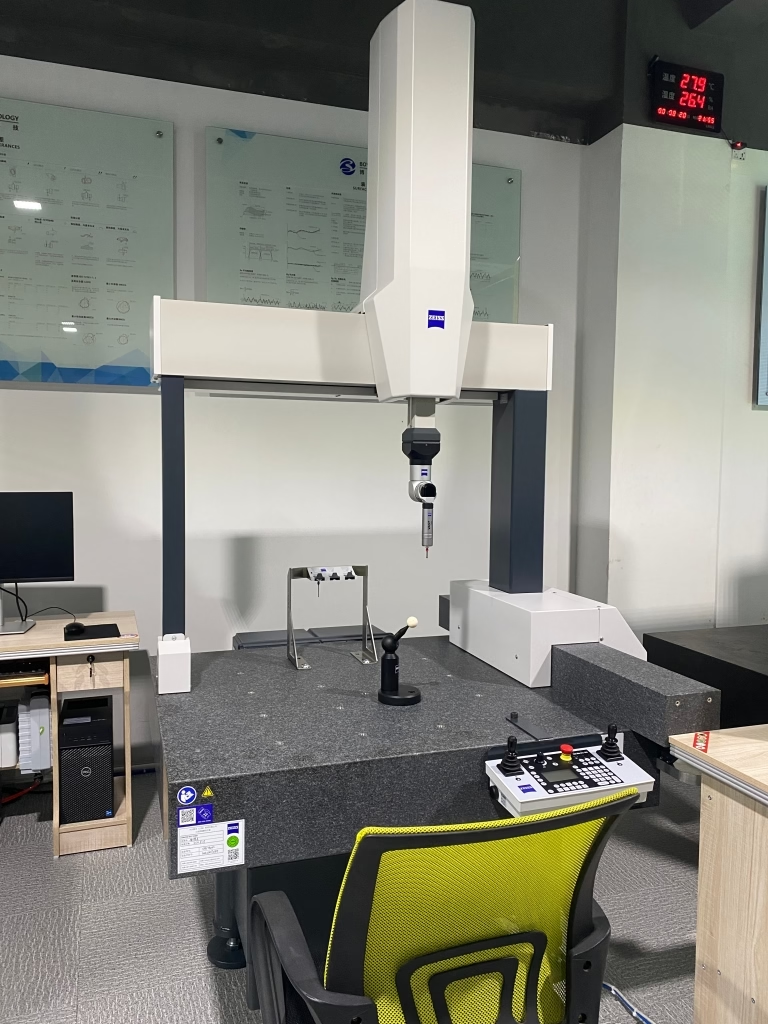
A part is only as good as the measurement behind it. When you audit a cnc machining service provider, ask what equipment sits on the floor and who runs it. In-house CMM capability matters because it keeps feedback inside the shop: the operator sees a trend before the lot is finished, not after the parts arrive at your dock.
The inspection plan should have three stages. Raw material check confirms the alloy and condition. In-process monitoring catches drift during the run, especially on long-cycle parts where thermal growth moves dimensions. Final inspection confirms the drawing before packing. Reports are available on request, and for regulated work you should request them by default.
100% inspection before shipment is a different commitment from sampling. Sampling is statistically reasonable on a mature 10,000-piece run. It is a bad idea on a five-piece prototype where every part is effectively unique. Ask which method applies to your order size.
Watch for the gap between the certificate and the entity on your quote. Certifications belong to a specific legal entity at a specific site. If your parts are machined at a different plant than the one audited, the certificate does not cover your order. GreatLight holds ISO 9001:2015, IATF 16949:2016, ISO 13485:2016, and ISO 27001:2022 across 3 wholly-owned plants, so the paperwork and the production floor match.
- 1Ask for the inspection planWhich features are measured, on what equipment, at which stage.
- 2Ask who signs the reportA named QC function, not the machine operator alone.
3. MOQ, lead time, and how the quote is structured
Minimum order quantity is a proxy for how a shop is set up. A supplier with a high MOQ is optimized for long runs and will price a single prototype to discourage you. A supplier with no minimum works from one prototype to 10,000+ part runs on the same floor. If your program starts with a prototype and scales, splitting those phases between two vendors creates a second qualification cycle you did not budget for.
Lead time needs to be broken into its parts. Machining time, finishing time, and inspection time behave differently. Anodizing runs in batches, so a small order can wait for a tank load. Heat treat and plating are often the long pole. A shop that quotes one number for everything is guessing or hiding the handoffs.
The quote itself is a technical document. It should state the material grade, the tolerance class, the finish callout, the inspection level, and any assumption about the drawing. If the shop flags a feature as hard to hold and suggests a change, that is DFM work, and it is worth more than a 5% price difference. GreatLight returns a quotation and free DFM analysis within 12 hours, and production can start within 24 hours of approval.
Be careful with suppliers who quote below material cost. They are either substituting a different alloy, skipping an operation, or planning to recover the difference later. In machined parts, the material certificate is the cheapest place to hide a problem.
- 1Separate the phases in the quoteMachining, finishing, inspection, and freight should be visible lines.
- 2Confirm the alloy grade in writing6061 and 6061-T6 are not interchangeable for strength-critical parts.
- 3Ask about finishing capacityAnodizing, plating, powder coating, and laser marking done in-house shorten the loop.
4. Certification fit, IP protection, and the rework question
Certifications are not interchangeable. IATF 16949:2016 is written around automotive production discipline: PPAP, traceability, change control. ISO 13485:2016 is about medical device quality systems and process validation. Aerospace work leans on material traceability and special-process control. Ask a supplier to show the scope statement, not just the logo.
If your drawings are the product, information security is part of the supply agreement. ISO 27001:2022 covers how design files are stored, transmitted, and accessed. A shop should offer an NDA on request and keep uploads secure. The practical test is simple: ask who inside the company can open your CAD files and whether access is logged.
The rework clause is where you learn the supplier's real attitude. A capable shop will define what counts as a quality issue, how fast it responds, and who pays for freight. Vague return policies are a signal. So is a supplier who blames the drawing after the parts fail inspection.
Materials span a wide range, and the right shop buys them often. Aluminum 6061, 7075, and 2024 behave differently under the same cutter. Stainless 303 machines freely while 316L work-hardens. Titanium Ti-6Al-4V and Inconel need lower surface speeds and more rigid setups. If the supplier treats all metals the same way, the tool life and finish numbers will show it.
- 1Match the certificate to the industryAutomotive, medical, and aerospace each have a different primary standard.
- 2Check the scope statementThe certificate should name the site that machines your parts.
5. One-stop scope versus a chain of vendors
Every handoff between vendors adds a queue, a tolerance assumption, and a place for blame to land. If machining, finishing, and assembly sit with three companies, nobody owns the final dimension. A shop that runs the whole chain keeps the datum references consistent and can inspect after finishing, which is when dimensions actually move.
Post-processing changes geometry more than most engineers expect. Anodizing builds a few micrometers of oxide on every surface. Hardcoat anodizing builds more, and it grows into the feature rather than out of it, so a tight bore can close up. Powder coating adds tens of micrometers. If the shop does not account for coating thickness in the pre-finish dimensions, the plated part will not fit.
Marking is another scope item that trips orders. Laser marking has a practical floor on character height, around 1.5 mm, and the marked area must be accessible to the lens. Engraving inside a deep pocket on a 5-axis part needs a specific tool orientation. Plan this at quoting, not after the parts are finished.
A single supplier also shortens the feedback loop on second articles. If the first run shows a trend on one feature, the machinist, the finisher, and the inspector are in the same building. That is usually worth more than a slightly lower unit price.
- 1Account for coating thicknessAnodizing and plating change dimensions; specify pre-finish sizes.
- 2Confirm marking accessCharacter height and tool clearance decide whether laser marking is possible.
Step by step: how to vet a cnc machining service provider
Run these six steps in order before you release a purchase order.
- 1Send one representative part, not a catalogPick the part with the tightest tolerance and the most faces. Include the material grade, finish callout, and any critical-to-quality feature. A shop that asks clarifying questions at this stage is engaged.
- 2Request a quote with DFM notesExpect a response within 12 hours for a normal part. Read the DFM feedback before the price. If a feature is flagged as risky, ask what the shop would change and what it would save.
- 3Ask for the process plan in three linesMachine type, number of setups, and finishing route. If the shop cannot describe it in a few lines, the plan probably does not exist yet.
- 4Confirm inspection and documentationAsk which features are measured, on what equipment, and whether a report comes with the shipment. For regulated parts, request the report by default.
- 5Verify certifications against the siteCheck the legal entity and the plant address on the certificate. Confirm it covers the process being quoted, including any outsourced finishing.
- 6Place a small order and measure the responseJudge the first delivery on dimensional report, packing, and how fast questions are answered. The behavior on a small order predicts the behavior on a large one.
Questions buyers ask before signing
What tolerance can a cnc machining service provider realistically hold?
A capable shop holds ±0.005 mm (±0.0002 in) on features it controls in a single setup, with temperature-stable conditions and sharp tooling. That number is a capability, not a promise for every dimension on every drawing.
Features that span multiple setups, thin walls, or deep bores will be looser. Tell the supplier which dimensions are critical so the process plan protects them.
Is a low price a sign of a bad supplier?
Not by itself. A shop with the right machine for your geometry can genuinely be cheaper because it takes fewer setups and less labor.
The warning sign is a price below material cost with no explanation. Ask for the material certificate and the process route, then compare.
How do I protect my design files?
Use a supplier with ISO 27001:2022 or an equivalent information security system, request an NDA, and keep uploads on a secure channel. Ask who can access the files internally.
If the supplier cannot answer that question, treat it as a no.
Do I need a different supplier for prototypes and production?
Not if the supplier runs both on the same floor with no minimum order quantity. Moving from prototype to production at a second vendor repeats the qualification work and can change the process.
Keep the same shop if the prototype passed and the process plan is documented.
What should the first article inspection report include?
Dimensional results against the drawing, the equipment used, the operator or QC sign-off, and the date. For regulated industries, add material certification and any special-process records.
Ask for it on the first order even if you do not need it later. It sets the expectation.
How fast can parts ship?
For normal machined parts, production can start within 24 hours of order approval and parts ship in 3–5 days. Finishing routes that involve plating or heat treat can extend that, so ask for the breakdown.
Rush work usually means paying for queue priority, not skipping inspection.
Send one part and see how the process plan comes back
Upload your drawing and get a quotation with free DFM analysis within 12 hours. No minimum order quantity, from one prototype to 10,000+ part runs.
12-hour quoteFree DFM analysis100% inspectionNDA on request
More from the shop floor
We publish setup notes, tooling trials and inspection data from the factory floor.











