
CNC Machining Services Arial Sc: 7 Buying Checks
This guide is for engineers and sourcing teams comparing CNC machining services Arial Sc suppliers for prototype and production parts. It covers tolerance, lead time, minimum order quantity, certification scope and what a usable quote must contain. Read it and you can screen a shop in one call.
In this article
- 1
- 2
- 3
- 4
- 5
- 6
- 7
- 8
Key takeaways
What to check before you send a drawing
Ask these five questions in the first email. Vague answers cost weeks later.
| Check | Weak answer | Strong answer | Why it matters |
|---|---|---|---|
| Tolerance | ±0.05 mm, typical | ±0.005 mm held in process | Sets your fit and function budget |
| Lead time | About two weeks | Chips cut within 24 hours | Planning and launch dates depend on it |
| MOQ | 500 pieces minimum | One prototype to 10,000+ | Prototype budget and iteration speed |
| Certification | ISO 9001 | ISO 9001, IATF 16949, ISO 13485 | Decides which markets you can serve |
| Quote detail | One lump price | Stock, setups, finish, inspection listed | Lets you compare shops fairly |
| Inspection | We check parts | 100% inspection, reports on request | Traceability for audits and recalls |
| Communication | Send files, we reply | Free DFM analysis within 12 hours | Catches design issues before cutting |
Tolerance: read the number behind the claim
Every shop writes a tolerance figure on its site. The useful question is where that number comes from. A tight number measured on one aluminum bracket does not tell you what happens on a 4,000 mm steel beam after a roughing pass. Ask which machine holds it and on which material.
Heat treatment changes the answer. Pre-hardened 4140 at 28–32 HRC cuts differently from annealed stock, and thin walls move after stress relief. A supplier who brings this up before you ask is usually the one who inspects properly.
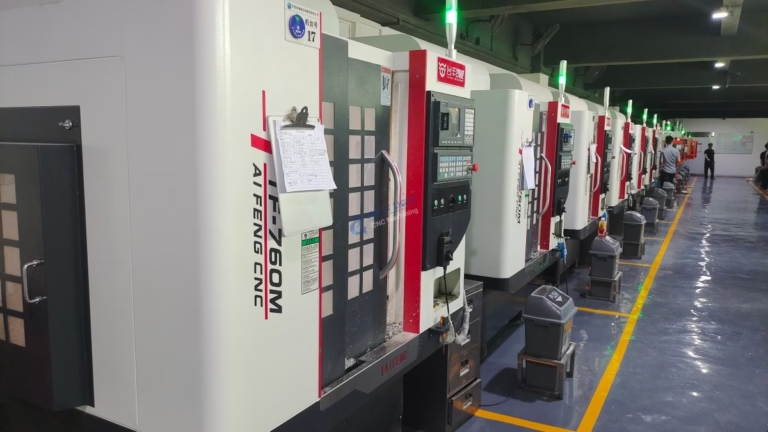
Machine count matters less than machine mix. A shop running 16 simultaneous 5-axis centers, 12 four-axis mills and 16 mill-turn centers can pick the process that fits the part instead of forcing the part onto one machine.
- 1State tolerance per featureNot one blanket number for the whole drawing.
- 2Name critical dimensionsThose get measured and reported, the rest get sampled.
- 3Mention material conditionAnnealed, pre-hardened or as-cast changes the plan.
Lead time, MOQ and what actually drives cost
Lead time splits into three parts: quoting, programming and cutting, then finishing and shipping. A shop that quotes in 12 hours and starts production within 24 hours removes most of the dead time. Parts shipping in 3–5 days is realistic for straightforward geometry.
Minimum order quantity tells you how the shop is set up. If a supplier will not run one piece, prototype iteration gets slow and expensive. No MOQ does not mean the price is the same at one piece and at 10,000 pieces, but it does mean you can test the process before committing.
Cost usually sits in setups and finishing, not in cutting time. Anodizing, electroless nickel and laser marking add days and cost. Laser marking needs a minimum character height of 1.5 mm, so tiny part numbers on small features may need a different approach.
The trap is comparing two quotes on the total price alone. One includes material certification and a first article report, the other does not. Ask what is inside the number.
- 1Quote in 12 hoursIncludes free DFM analysis on your files.
- 2Production start within 24 hoursAfter drawing release and stock confirmation.
- 3No MOQFrom one prototype to 10,000+ part runs.
Certifications: check the scope, not the logo
ISO 9001:2015 says a quality system exists and is audited. That is the floor for any serious supplier. It says nothing about automotive or medical-specific controls.
IATF 16949:2016 adds automotive requirements such as APQP, PPAP and traceability discipline. If your part goes into a vehicle program, this is the certificate that matters. ISO 13485:2016 does the same job for medical devices, with validation and record retention rules.
ISO 27001:2022 is different. It covers information security, which matters when you send proprietary CAD. Combined with an NDA on request and confidential upload handling, it gives your legal team something concrete to review.
Ask for the certificate scope statement. A shop certified for machining aluminum brackets is not automatically certified for implant-grade finishing.
- 1ISO 9001:2015Baseline quality system.
- 2IATF 16949:2016Automotive program requirements.
- 3ISO 13485:2016Medical device controls.
- 4ISO 27001:2022Information security for your files.
Match the process to the material
Material choice drives the process plan more than most buyers expect. Aluminum grades like 6061-T6 and 7075 cut fast and hold tolerance well. Stainless 316L and 17-4PH work-harden, so feeds and speeds need control or the tool wears and the surface tears.
Titanium TA2, TC4 and Inconel push the other way. They cut slowly, generate heat and need rigid setups. A shop without enough spindle torque will either refuse the job or quote it badly.
For plastics such as POM, PEEK and PC, clamping pressure is the risk. Too much and the part bows. Vacuum fixturing or soft jaws solve it, but the shop has to plan for it.
If your design allows two materials, ask for both quotes. The cheaper material is not always the cheaper part once finishing and scrap are counted.
- 1Aluminum6061, 2024, 5052, 7075, ADC12.
- 2Stainless303, 304, 316L, 17-4PH, 440C.
- 3Steel1018, 1045, 4130, 4140, 4340, tool steel.
- 4Titanium and specialTA2, TC4, Inconel, magnesium AZ31B.
What a usable quote contains
A quote you can act on lists material grade and condition, machine class, number of setups, finish specification and inspection method. It states the tolerance it will hold and the surface finish range, for example Ra 0.8–1.6 μm for a standard machined surface or Ra 0.2–0.8 μm when a sealing face needs it.
It also names what is excluded. Threads rolled versus cut, deburring level, packaging, and whether a first article report is included. These are the items that turn into change orders later.
Volume assumptions belong in writing too. A price valid at 50 pieces may not hold at 5. When the shop tells you where the price steps, you can plan tooling and inventory.
Finally, ask how files are handled. Secure upload, confidentiality terms and an NDA on request should be standard, not a favor.
- 1Material and conditionGrade plus heat-treat state.
- 2Process and setupsMachine class and fixture plan.
- 3Finish and inspectionRa range and measurement method.
- 4ExclusionsDeburring, packaging, reports.
How to screen a supplier in one week
Seven steps from first email to released PO.
- 1Send a real drawingUse a part with a tight feature and a loose feature. Skip the simplified sample file.
- 2Ask for the DFM responseA useful reply flags thin walls, deep pockets and tolerances that add cost. Expect it within 12 hours.
- 3Request the tolerance planAsk which dimensions will be reported and how. If the answer is one blanket number, keep looking.
- 4Confirm machine fitAsk which machine will run it. A 4,000 mm part needs different capacity than a 50 mm fitting.
- 5Check certification scopeRequest the certificate and read the scope, not just the standard number.
- 6Run a small order firstOrder one to five parts. Check dimensions, finish and paperwork before scaling to 10,000+.
- 7Lock the paperworkConfirm NDA, inspection reports and packaging before the production PO is released.
Questions buyers ask before ordering
Can a shop hold ±0.005 mm on every feature?
No, and you should be suspicious of anyone who says yes. ±0.005 mm is achievable on specific features with the right machine, material and setup.
Put the tight tolerance on the dimensions that matter for function. Everything else can sit at a looser band, which lowers cost and reduces scrap risk.
Is no minimum order quantity real?
It means the shop will quote and run a single prototype. It does not mean the unit price at one piece equals the price at 10,000 pieces.
Setup, programming and fixturing get spread over the batch. At low volume you pay for those once; at high volume they disappear into the piece price.
Which certification do I actually need?
ISO 9001:2015 for general industrial work. IATF 16949:2016 if the part goes into a vehicle program. ISO 13485:2016 for medical devices.
ISO 27001:2022 matters if your CAD files are sensitive. Ask for the scope statement, because a certificate only covers what is written on it.
How fast can parts ship?
Quotation and free DFM analysis within 12 hours, production start within 24 hours after release, and parts shipping in 3–5 days for straightforward geometry.
Complex finishing, exotic material or a first article report adds time. Ask for the schedule in writing before you commit.
What should I send with the RFQ?
A 3D model, a 2D drawing with tolerances and datums, material grade and condition, finish specification, quantity and target date.
Note which dimensions are critical. That single note saves a round of questions and often a revision.
How do I compare two quotes fairly?
Put material, machine class, setups, finish, inspection and exclusions side by side. A lower number that omits a first article report or material certification is not cheaper.
Ask both shops to quote the same revision of the same drawing with the same quantity.
Send your drawing, get a usable answer
Quotation and free DFM analysis within 12 hours. Production can start within 24 hours after release.
12-hour quote100% inspectionNo MOQNDA on request
More from the shop floor
We publish setup notes, tooling trials and inspection data from the factory floor.











