
CNC Machining Services Cambridgeshire: How to Pick the Right Supplier
A working checklist for engineers and buyers comparing CNC machining services Cambridgeshire suppliers quote on. It covers tolerance, lead time, MOQ, certification and quoting, so you can judge a local machine shop and an offshore partner on facts rather than sales copy.
In this article
- 1
- 2
- 3
- 4
- 5
- 6
- 7
- 8
Key takeaways
Cambridgeshire machine shop vs offshore CNC partner
Use this to match the sourcing route to the part, not to the brochure.
| Factor | Local Cambridgeshire shop | Offshore CNC partner |
|---|---|---|
| Best for | Repairs, jigs, one-off fixtures | Runs from 1 to 10,000+ parts |
| Tolerance floor | ±0.01 mm typical | ±0.005 mm on 5-axis centers |
| Lead time | Days, driven by queue | Quote in 12 hours, ship in 3–5 days |
| Setup and MOQ | Often a minimum batch | No MOQ, prototype to production |
| Certification | Varies by shop | ISO 9001, IATF 16949, ISO 13485, ISO 27001 |
| Engineering help | Walk-in, limited hours | DFM feedback with every quote |
| Cost per part | Higher at volume | Lower at volume, shipping added |
| Risk to manage | Capacity and queue jumps | Freight, customs, time zone |
Verdict: match the supplier to the part, not the price list
Keep one-off tooling and urgent repairs local. Move repeat parts and complex 5-axis geometry to a partner with the machines, metrology and certifications to hold ±0.005 mm at volume. Ask for the machine, the measurement method and the certificate scope before you release a PO.
What tolerance can the shop actually hold?
Every supplier will quote ±0.005 mm if you ask. Fewer can hold it across a full batch. The difference is not operator skill. It is spindle condition, thermal stability, workholding rigidity and how often the machine is checked with a ballbar or laser interferometer. A shop that cannot show calibration records for its CMM is quoting a hope, not a capability.
Ask a direct question: which machine will run my part, and what is its repeatability? A 5-axis center with a Ø400 mm rotary table holds tighter position than a 3-axis mill with a long tool and a thin wall. If the answer is vague, the tolerance is vague.
Also ask how they measure. A ±0.005 mm callout on a bore needs an air gauge or a CMM probe, not calipers. GreatLight inspects 100% before shipment with raw material checks, in-process monitoring and a final report, and shares those reports on request.
- 1Below ±0.01 mmDemand a metrology method and a calibration date.
- 2Thin walls and deep pocketsAsk about tool reach and support, not just machine brand.
- 3Surface finishRa 0.8–1.6 μm is standard; Ra 0.2–0.8 μm needs a second operation.
How CNC machining services Cambridgeshire suppliers handle lead time
Lead time is where most sourcing plans break. A local shop with a packed queue can sit on your job for two weeks before the first cut. An offshore partner adds freight and customs, but the machining itself may start sooner. Compare the full chain, not the machining window alone.
Ask what happens between the PO and the first chip. A shop that quotes and returns DFM analysis within 12 hours and can start production within 24 hours keeps your schedule predictable. Parts shipping in 3–5 days is a reasonable target for standard materials like 6061 aluminium or 304 stainless.
Then ask about the tail risk. What is their historical late-delivery rate? Anything under 2% across a year is a signal that the schedule is real. Anything above 5% means you should add buffer or split the order.
- 1Quote turnaround12 hours with DFM feedback is a fair benchmark.
- 2Production start24 hours from PO release is achievable on standard materials.
- 3Freight timeAdd it to the machining window before you promise a date.
MOQ, certification and the paperwork that matters
Minimum order quantity is a proxy for how the shop schedules work. If a supplier only runs batches of 500, your 20-part build will sit at the back of the queue. Ask whether one prototype and a 10,000-part run use the same process. If yes, the shop is set up for mixed volume work.
Certification is the second filter. ISO 9001:2015 covers general quality systems. IATF 16949:2016 is the automotive standard and matters if your part ends up on a vehicle. ISO 13485:2016 applies to medical devices. ISO 27001:2022 covers information security, which matters when you send CAD files to an external partner.
Read the scope statement inside each certificate. A supplier can hold a certificate for one plant and one process while your part runs somewhere else. Ask which site will machine your parts and confirm that site is on the certificate.
- 1Prototype to productionNo MOQ means one part and 10,000 parts share the same route.
- 2Automotive workIATF 16949:2016, not just ISO 9001.
- 3Medical workISO 13485:2016 plus traceable material lots.
- 4File securityISO 27001:2022 and an NDA on request.
Materials, finishing and where the hidden cost sits
The machining cost is usually the easy number. The hidden cost sits in material availability and post-processing. A supplier that stocks 6061, 7075, 304, 316L, 17-4PH and Ti-6Al-4V can start sooner than one ordering each grade per job. Inconel and magnesium AZ31B need extra care on tool wear and chip control, so expect a longer quote.
Finishing often adds more calendar time than the cut. Anodizing, electroless nickel, zinc plating, powder coating and black oxide each run on their own schedule. If your drawing calls for hardcoat anodizing plus laser marking, ask whether both run in-house or go out to a subcontractor.
Laser marking has a hard limit worth knowing before design freeze. Minimum character height is 1.5 mm. Below that, the mark becomes unreadable and the part fails inspection for the wrong reason.
- 1Standard alloys6061, 304, 316L usually ship fastest.
- 2Exotic alloysInconel, Ti-6Al-4V and magnesium need longer quotes.
- 3Finishing chainAsk in-house or subcontracted, and add the difference to lead time.
When to keep the work local and when to send it out
Keep the job local when the part is a fixture, a repair, or something you need to hold in your hand this week. Local shops win on access. You can drive over, look at the setup, and change a dimension on the spot. For one-off tooling and urgent breakdowns, that access is worth the higher hourly rate.
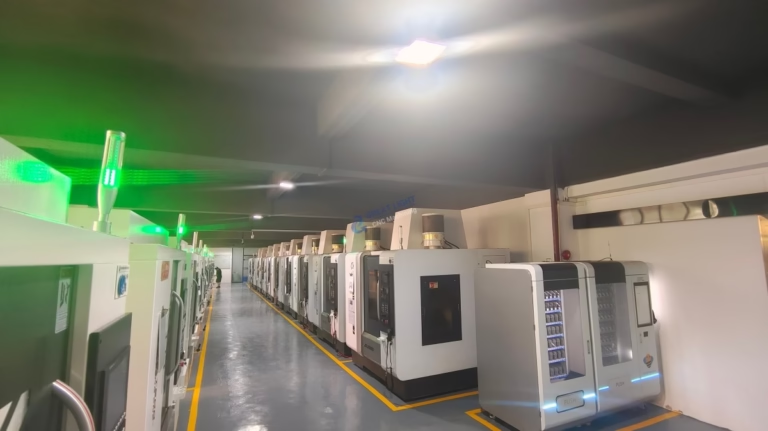
Send it out when the part repeats. Once you have a proven drawing and a stable process, the cost per part drops sharply at volume, and a partner with 127 CNC machines has capacity your local shop cannot match. The trade is freight and coordination, which you manage with clear drawings and a named contact.
The worst option is the middle. A complex 5-axis part quoted by a shop that mostly does 3-axis work will run late and out of tolerance. Match the geometry to the machine. If the part needs five faces in one setup, send it to a shop with simultaneous 5-axis centers.
- 1Keep localRepairs, jigs, prototypes you must inspect in person.
- 2Send outRepeat parts, complex geometry, volume runs.
- 3Split the orderLocal for the first article, offshore for the production run.
A 6-step process for vetting a CNC supplier
Run these in order. Each step removes suppliers that cannot support your part.
- 1Send the drawing with tolerances markedHighlight the critical dimensions and the datum scheme. A supplier who quotes without asking about datums is quoting a different part.
- 2Ask for the machine and the metrology methodGet the specific machine model and the inspection tool. For ±0.005 mm, expect a CMM or air gauge, not calipers.
- 3Request DFM feedback with the quoteLook for notes on wall thickness, tool reach and tolerance stack. Good feedback arrives within 12 hours.
- 4Confirm MOQ, material stock and finishing routeCheck whether your alloy is stocked and whether anodizing or plating runs in-house. Both change lead time.
- 5Verify the certificate scope for your siteMatch ISO 9001, IATF 16949, ISO 13485 or ISO 27001 to the plant that will run the job.
- 6Run a first article before the full releaseInspect the first part against the drawing, then release the batch. This catches setup errors while they are still cheap.
Frequently asked questions
What tolerance should I expect from a good CNC shop?
A capable shop holds ±0.005 mm on critical features when the machine, workholding and metrology all support it. Standard features usually sit at ±0.01 mm.
Ask which machine runs your part and how the feature is measured. Tolerance without a measurement method is a guess.
Is there a minimum order quantity?
It depends on the supplier. Some set a batch minimum to protect their schedule. Others run from a single prototype to a 10,000+ part run on the same process.
If a supplier cannot start with one part, ask how they handle design changes after the first article.
How fast can parts ship?
Quotation with DFM analysis can come back within 12 hours, and production can start within 24 hours of PO release. Standard material parts often ship in 3–5 days.
Add freight and customs time if the shop is outside the UK before you promise a date to your own customer.
Which certifications matter for my industry?
ISO 9001:2015 for general quality, IATF 16949:2016 for automotive, ISO 13485:2016 for medical devices, and ISO 27001:2022 for information security.
Check the scope statement. A certificate held by one plant does not automatically cover another.
How do I protect my design files?
Ask for an NDA before you upload CAD, and confirm how files are stored and who can access them. ISO 27001:2022 is the relevant standard for information security.
Uploads should be secure and confidential, with access limited to the engineering and programming team.
What surface finishes are available after machining?
Common options include anodizing in clear, colour, hardcoat and conductive types, electroless nickel, zinc, silver and gold plating, powder coating, black oxide, bead blasting, tumbling, brushing and polishing.
Laser marking is also available with a minimum character height of 1.5 mm.
Get a quote and DFM feedback within 12 hours
Send your drawing and tolerances. We return a quote with DFM notes, name the machine that will run the part, and confirm the certification scope for the site.
12-hour quote100% inspectionNo MOQNDA on request
More machining notes
We publish setup notes, tooling trials and inspection data from the factory floor.











