
CNC Machining Services Canada: What to Check Before You Order
A practical guide for Canadian engineers and buyers sourcing CNC machining services Canada suppliers. We cover the checks that decide whether your parts arrive on spec: tolerance, lead time, minimum order, certifications, and how a supplier quotes.
In this article
- 1
- 2
- 3
- 4
- 5
- 6
- 7
- 8
- 9
Key takeaways
CNC Machining Services Canada: Comparison Criteria
What each check tells you before you send a PO.
| Check | What to ask | Why it matters | Red flag |
|---|---|---|---|
| Tolerance | Which instrument verifies ±0.005 mm? | Decides fit on mating parts | No inspection report offered |
| Lead time | Is material in stock this week? | 3–5 day ship dates depend on it | Vague dates, no DFM note |
| MOQ | Can you run one prototype first? | Lets you test before 10,000 parts | High MOQ on a first sample |
| Certifications | ISO 9001, IATF 16949, ISO 13485? | Gate for medical and automotive | Certificate not shown on request |
| Quote detail | Itemized price plus DFM notes? | Tells you the shop read the drawing | Price only, no questions asked |
| Material range | Aluminum, stainless, titanium, PEEK? | Decides which jobs they take | Says yes to everything |
| Finishing | Anodizing, plating, bead blasting in house? | Fewer vendors, fewer handoffs | Sends finishing to unknown shops |
The Short Version
Pick a supplier who quotes with a DFM note, names the inspection method, and will run one part before the full order. Everything else is a brochure.
Why Tolerance Claims Need a Measurement Method
Every CNC machining services Canada supplier lists a tolerance number. The useful question is how that number gets verified. ±0.005 mm on a 50 mm aluminum bracket is routine for a well-kept machining center. The same callout on a thin-wall titanium housing is a different job, because the part moves as it is cut.
Ask what instrument confirms the callout: a CMM, a micrometer, or a pin gauge. A shop that inspects 100% of parts before shipment and can send reports on request is giving you a traceable answer. A shop that says 'we hold tight tolerances' is giving you a slogan.
Material selection also sets the floor. Aluminum 6061 and 7075 cut cleanly and hold ±0.005 mm well. Stainless 316L work-hardens, so heavy finishing passes need sharp tooling and conservative feed rates. Titanium TC4 (Ti-6Al-4V) heats the cutting edge and demands coolant and patience.
One more factor: feature size. A Ø2 mm hole with a ±0.005 mm tolerance is harder than a Ø20 mm bore with the same callout, because the tool deflects more relative to its diameter. Send the drawing and ask which features are the real risk.
- 1Ask for the instrumentCMM, micrometer, or pin gauge, named in the quote.
- 2Match material to toleranceAluminum holds tight limits more easily than titanium or 316L.
- 3Flag small featuresHoles under Ø3 mm with tight limits drive cost and scrap.
Lead Time: What 3–5 Days Actually Requires
A 3–5 day ship date is real, but it depends on three things lining up: stock material, a drawing that needs no back-and-forth, and a machine slot that exists this week. If any of the three is missing, the date moves.
Quotation and free DFM analysis within 12 hours is the first signal. If the quote comes back with a note about a thin wall, an unreachable corner, or a tolerance that will cost more than it needs to, the shop read your file. That is the shop you want on a short deadline.
Production can start within 24 hours once the drawing and material are settled. That is not the same as shipping in 24 hours. Machining time, finishing, and inspection still run their course.
For planning, treat the quote as the schedule. Historical late-delivery probability below 2% sounds good on a page, but your project's date comes from the specific quote you receive, not from an average.
- 1Stock material firstAsk whether the alloy and size are on the shelf today.
- 2DFM note in the quoteA note means the drawing was reviewed, not just priced.
- 3Separate start from shipProduction start in 24 hours is not a 24-hour delivery.
Certifications: Match Them to Your Industry
ISO 9001:2015 covers general quality management and is the baseline for most industrial work. If your part goes into a car or a medical device, the baseline is not enough. IATF 16949:2016 is the automotive standard, and ISO 13485:2016 is the medical device standard.
ISO 27001:2022 is less common in machine shops. It covers information security, which matters when you upload CAD files and BOMs. A shop with this certificate has a documented process for handling your data, not just a promise in an email.
Ask for the certificate scope, not just the logo. A certificate that covers machining but not surface finishing means the finishing step sits outside the audited system. If your part is critical, that gap is worth knowing about.
For defense or aerospace work, ask which standards apply and what inspection records ship with the parts. We list AS9100D as pending, so we do not claim it. Buyers should treat pending certifications as not yet in place.
- 1ISO 9001:2015General industrial baseline.
- 2IATF 16949:2016Required for automotive production parts.
- 3ISO 13485:2016Required for medical device components.
- 4ISO 27001:2022Covers how your uploaded files are protected.
MOQ, Prototypes, and the Cost of Being Wrong
No minimum order quantity means you can order one part. That matters more than it sounds. A single prototype proves the geometry, the fit, and the finish before you commit tooling or a 10,000-part run.
The catch is setup cost. On a one-off part, programming and fixturing are spread across a single unit, so the per-part price is high. That is normal, not a markup. Ask for the setup line separately so you can see what changes when quantity rises.
For bridge production, a run of 50 to 500 parts is often the sweet spot. You get a lower unit price, but you are not yet locked into a hard tool. Mill-turn centers and 5-axis machines handle this range without dedicated fixtures.
If a supplier refuses a one-piece order on a new design, ask why. Sometimes the answer is honest: the part needs a fixture that only makes sense at volume. Sometimes it means the shop only wants easy work.
- 1One part is a risk checkCheaper than discovering a design error at volume.
- 2Separate setup from unit priceShows you what volume actually saves.
- 350–500 partsBridge range before hard tooling.
Five-Axis and Mill-Turn: When They Are Worth It
Five-axis machining cuts angled faces, undercuts, and contoured pockets in one setup. That removes the misalignment risk that comes from flipping a part across three or four setups on a 3-axis machine. For a housing with ports on five sides, the difference shows up in the inspection report.
Five-axis is not automatically faster. On a simple plate with holes on one face, a 3-axis machine with a good fixture wins on cycle time and price. The right question is how many setups your part needs, not how many axes the shop owns.
Mill-turn centers combine turning and milling in one cycle. Parts like shafts with cross-holes, or fittings with milled flats, avoid a second operation and a second tolerance stack. If your drawing has turned diameters plus off-axis features, ask about mill-turn.
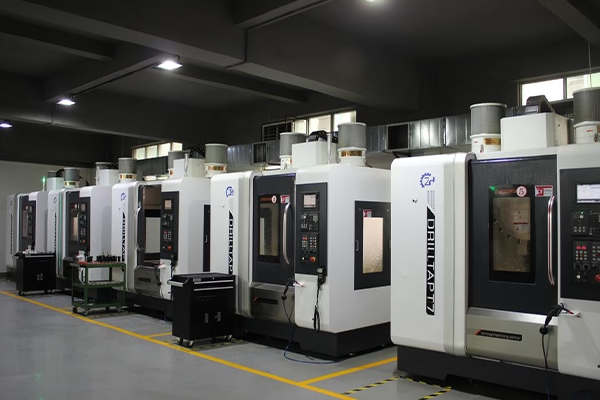
Capacity matters here. We run 16 simultaneous 5-axis machining centers, 16 mill-turn centers, 12 four-axis mills, and 27 three-axis machines, with a maximum processing size of 4,000 mm and travels up to 4,000 × 400 × 150 mm. The point is matching the machine to the part, not selling the biggest one.
- 1Count the setupsFive-axis pays off when a part needs three or more faces.
- 2Simple parts stay on 3-axisBetter cycle time and lower price.
- 3Mill-turn for mixed featuresTurned diameters plus cross-holes in one cycle.
Quote Details and Data Handling in Canada
Canadian buyers often work across a border and a time zone. Two things make that easier: a quote that answers questions before you ask them, and a clear data policy for your CAD files.
A useful quote lists material, machining, finishing, and inspection as separate lines. It names the alloy grade, the finish spec (for example Ra 0.8–1.6 μm), and whether reports ship with the parts. If finishing is subcontracted, say so.
On data, uploads should be secure and confidential, with an NDA available on request. Ask whether files are stored on access-controlled systems and who inside the shop can open them. For medical and defense work, this is part of the audit trail, not an extra.
Shipping and customs are the buyer's side of the border. Duties, brokerage, and cross-border paperwork sit with your freight setup. A supplier who understands the documents you need saves days at the border.
- 1Itemized quoteMaterial, machining, finishing, inspection on separate lines.
- 2Name the finish specRa value and process, not just 'smooth'.
- 3NDA on requestCovers CAD, BOM, and drawing files.
7 Steps to Qualify a Supplier
Run this before you send a purchase order.
- 1Send the drawing with a tolerance calloutInclude GD&T if you have it. A shop that quotes without asking about datum structure is guessing.
- 2Ask which instrument verifies the tightest calloutCMM, micrometer, or pin gauge. If the answer is vague, the tolerance claim is vague.
- 3Request a DFM note with the priceLook for at least one specific comment about your part. Generic notes mean the file was not reviewed.
- 4Confirm material stock for your alloy6061-T6 and 304 are usually on the shelf. 17-4PH, Inconel, and PEEK may add wait time.
- 5Check certification scope against your industryISO 9001 for industrial, IATF 16949 for automotive, ISO 13485 for medical. Ask what the certificate covers.
- 6Order one piece before the full runNo MOQ makes this cheap. Inspect the finish, the fit, and the report before committing to volume.
- 7Settle data handling and shipping termsSign the NDA if needed, and confirm who handles customs and brokerage at your border.
Frequently Asked Questions
What tolerance can a Canadian buyer expect from an overseas shop?
±0.005 mm is achievable on rigid parts in aluminum, brass, and most steels when the shop inspects for it. Thin walls, deep pockets, and small holes push the practical limit wider.
Ask for the measurement method before you accept the callout. A tolerance without an inspection method is a claim, not a capability.
How fast can parts ship after I approve the quote?
Quotation and free DFM analysis come back within 12 hours. Production can start within 24 hours once the drawing and material are settled, and parts typically ship in 3–5 days.
Finishing and inspection run inside that window. If your part needs anodizing or plating, confirm the finishing step is included in the date.
Is there a minimum order quantity?
No minimum order quantity. You can order a single prototype or a run of 10,000+ parts. Setup cost dominates the price on low quantities, so ask for the setup line separately.
For bridge production, 50 to 500 parts usually gives a better unit price without dedicated tooling.
Which certifications apply to medical and automotive parts?
ISO 13485:2016 covers medical device manufacturing, and IATF 16949:2016 covers automotive. ISO 9001:2015 is the general baseline, and ISO 27001:2022 covers information security for uploaded files.
Check the certificate scope. If finishing is subcontracted and outside the audited system, the part leaves the certified process at that step.
How do you handle confidentiality for CAD files?
Uploads are secure and confidential, and an NDA is available on request. Files sit on access-controlled systems, and internal access is limited to the people working on your job.
For medical and defense programs, ask for the document control process as part of the supplier qualification.
What materials and finishes do you machine most often?
Aluminum 6061, 6061-T6, 7075, and 6082; stainless 303, 304, 316L, and 17-4PH; steels 1018, 1045, 4130, and 4140; plus titanium TC4, Inconel, and plastics such as POM and PEEK.
Common finishes include anodizing, electroless nickel, zinc plating, powder coating, black oxide, bead blasting, and laser marking with a minimum character height of 1.5 mm.
Send Your Drawing, Get a Real Answer
Quotation and free DFM analysis within 12 hours. Uploads are secure and confidential, NDA available on request.
12-hour quoteNo MOQ100% inspection
More from the shop floor
We publish setup notes, tooling trials and inspection data from the factory floor.











