
CNC Machining Services Coventry: How to Choose a Supplier
A practical guide for Coventry-area engineers and buyers sourcing turned and milled parts. We cover the criteria that decide whether a supplier can hold your tolerance, hit your build date, and survive an audit — and where a local shop stops making sense.
In this article
- 1
- 2
- 3
- 4
- 5
- 6
- 7
- 8
- 9
Key takeaways
CNC Machining Services Coventry: What to Check
Use this as a scoring sheet. Any supplier that cannot answer a row in one sentence is a risk on that row.
| Criterion | What good looks like | What to avoid |
|---|---|---|
| Achievable tolerance | ±0.005 mm stated with machine and method | Tolerance quoted without naming the process |
| Inspection | 100% inspection before shipment, reports on request | Sample-only checks, no paperwork |
| Certifications | ISO 9001:2015, IATF 16949:2016, ISO 13485:2016 | Certificates with expired dates |
| Minimum order | No MOQ, 1 piece to 10,000+ | Large MOQ forced on prototype work |
| Quote speed | Quotation and DFM feedback within 12 hours | Days of silence after RFQ |
| Production start | Can start within 24 hours of PO | Vague start dates |
| Delivery | Parts ship in 3–5 days | No tracking or ship confirmation |
| Size range | Up to 4,000 mm maximum processing size | Small envelope only |
| Materials | Aluminum, stainless, steel, titanium, PEEK | One or two alloys only |
| Finishing | Anodizing, plating, powder coat, laser marking | Finishing outsourced with no control |
Why CNC Machining Services Coventry Buyers Face a Wide Field
Coventry has a deep engineering base. Automotive work sits alongside aerospace, medical and machinery builders, and each of those sectors pushes a different requirement onto the machine shop. A transmission housing and a surgical instrument bracket may both be milled from aluminum, but they are judged against different standards.
That range is why the supplier list looks long. Local job shops, regional subcontractors and overseas factories all compete for the same RFQ, and the quotes that come back often look similar on the first page. The differences sit further down: how tolerance is verified, who signs the inspection report, and what happens when a feature comes out of spec.
The practical question is not which supplier is cheapest. It is which supplier can prove, before you place the order, that they will still be the cheapest option once scrap, rework and late parts are counted. That is what the rest of this page covers.
Tolerance: What ±0.005 mm Actually Requires
A tolerance of ±0.005 mm is not a marketing line. It needs a machine that can hold it, a fixture that does not let the part move, and a metrology step that can confirm it. On a 3-axis mill with a vise and a drill chuck, that number is unreachable. On a simultaneous 5-axis center with a dedicated fixture and a temperature-stable room, it is routine work.
Ask which machine will run your part and how many setups it needs. Every additional setup adds a datum shift. For tight work, a single-setup 5-axis process removes that error source entirely, at the cost of a longer programming cycle. For a flat bracket with three holes, a 3-axis machine is faster and cheaper, and the tolerance is not in question.
Material also moves the target. Aluminum 6061 and 7075 machine cleanly and hold ±0.005 mm without drama. Titanium Ti-6Al-4V and Inconel cut hotter, spring more, and need slower feeds and more tool changes. If a supplier quotes the same cycle time for 7075 and Inconel, they have not quoted Inconel.
Surface finish is a separate clause. As-machined at Ra 1.6–3.2 μm suits most brackets. Sealing faces and bearing bores often want Ra 0.8–1.6 μm, and optical or vacuum parts can need Ra 0.2–0.8 μm. Finish drives tool choice and cycle time, so it belongs on the drawing, not in a side email.
- 1±0.005 mmAchievable, but only on the right machine with the right fixture.
- 2±0.0002 inThe same figure in imperial units, if your drawing is in inches.
- 3Ra 0.8–1.6 μmTypical sealing and bearing surface target.
Inspection, Documentation and the Audit Trail
The inspection clause is where cheap quotes quietly save money. A shop that checks one part per batch and ships the rest is not doing the same job as one that inspects 100% before shipment. For a bracket on a shelf, that may not matter. For a part that goes into a braking system or a ventilator, it decides whether the lot is usable.
Ask for the sequence, not the promise. A sound flow is: raw material certificate on arrival, in-process monitoring at each critical feature, and a final dimensional report before the box is sealed. Reports should be available on request, with the inspection method named. Calipers alone will not confirm ±0.005 mm on a bore; that needs a CMM or a bore gauge with a known calibration date.
Certifications are the second half of the audit trail. ISO 9001:2015 covers general quality management and is the baseline. IATF 16949:2016 is what automotive OEMs expect from a tier supplier. ISO 13485:2016 applies to medical device work. ISO 27001:2022 covers information security, which matters if you are sending CAD files for an unreleased product.
Check the scope on the certificate, not just the logo. A certificate that covers assembly but not machining does not cover your part. Expiry dates matter too. An expired certificate is the same as no certificate when your customer audits you.
Lead Time, MOQ and the Cost of Small Batches
Lead time has two halves that buyers often merge. The first is quote turnaround: how long before you get a price and any DFM feedback. The second is floor time: how long from purchase order to shipped parts. A supplier can be fast on one and slow on the other.
For prototype and bridge production, the setup cost dominates the unit price. A shop that charges a full fixture build for a single part will quote a number that looks absurd next to a production run. A shop set up for mixed low-volume work amortizes that setup differently, which is why no minimum order quantity changes the economics so much for Coventry buyers running one-off test rigs or pre-production builds.
Delivery risk is worth asking about directly. Any supplier can quote three days. Ask what share of recent orders shipped late. A rate below 2% indicates a shop that plans capacity rather than one that promises and hopes.
There is a limit to speed. Parts that need heat treatment, hard anodizing or a plating step sit in a queue at the finisher, and no machine shop controls that queue. If your schedule depends on a coating, ask which finishing house is used and how many days it adds.
Local Shop or Overseas Partner?
The honest answer is that both work, for different parts. A Coventry-area shop wins when you need a face-to-face fixture review, when the part is too heavy to ship economically, or when the design is still moving and you want to stand at the machine. For a 40 kg casting that needs three iterations this week, local is correct.
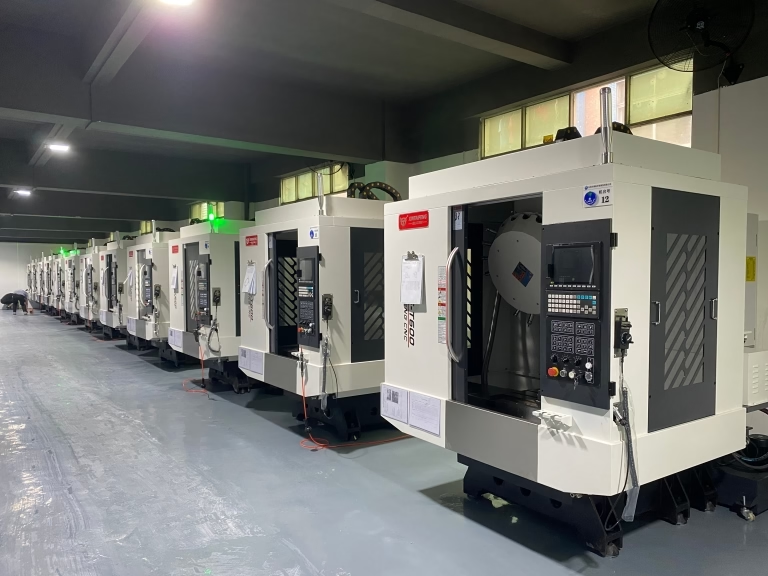
An overseas partner wins on envelope, alloy range and cost at volume. A factory with 127 high-precision CNC machines, 16 simultaneous 5-axis centers and a 4,000 mm maximum processing size can take work that a small local shop must decline. The trade-off is shipping time and a time-zone gap, which is manageable when the quote and DFM loop is fast.
The deciding factor is usually how the part will be inspected and who carries the risk of a bad feature. A supplier that inspects 100% before shipment and provides reports on request takes that risk off your desk. A supplier that ships on trust puts it back on you.
For Coventry buyers, the practical split looks like this: local for heavy, urgent, still-changing parts; a capable overseas partner for tight-tolerance, complex, or higher-volume work where the tolerance and documentation can be verified remotely.
Red Flags in a Quote for CNC Machining Services Coventry
A quote that arrives without questions is a warning. A serious shop will ask about datum strategy, thread callouts, surface finish and whether the part is cosmetic. If none of that comes back, the price is a guess.
Watch for a tolerance claim that is not tied to a process. If a supplier says they hold ±0.005 mm but cannot name the machine or the inspection method, the claim is untested. The same applies to a finish callout that is quoted without a measurement method.
A price that undercuts the field by a wide margin usually means one of three things: the material grade was silently downgraded, the finishing step was left out, or the inspection step was skipped. All three surface later as scrap or a failed audit.
Finally, check what happens after a bad part. A supplier that offers rework or a refund on a genuine quality failure is standing behind the process. One that argues about the drawing is not.
Step by Step: Vetting a Supplier
Work through these in order. Each step should take one email or one call.
- 1Send a real drawing, not a sample partInclude tolerance, finish callouts and the material grade. A supplier who quotes a simplified drawing will quote a simplified part.
- 2Ask for the process planWhich machine, how many setups, which fixture. For ±0.005 mm work, a single-setup 5-axis plan is a good sign.
- 3Request the inspection flowRaw material check, in-process monitoring, final report. Name the instrument for each critical feature.
- 4Confirm certification scope and datesISO 9001:2015 as a baseline, plus IATF 16949:2016 or ISO 13485:2016 if your sector needs it.
- 5Nail down quote and floor time separatelyAsk for hours to quote and days to ship. Anything beyond 12 hours of quote time should be explained.
- 6Check the MOQ policy against your forecastIf the first build is 5 parts and the second is 5,000, the supplier must handle both on one process.
- 7Ask about late delivery historyA stated rate below 2% tells you the shop tracks it. A blank answer tells you they do not.
- 8Sign the NDA before sending CADIf the design is unreleased, get confidentiality in writing before the first file transfer.
Questions Buyers Ask About CNC Machining Services Coventry
Can an overseas supplier realistically support a Coventry build schedule?
Yes, if the quote and DFM loop is fast. A 12-hour quotation and DFM analysis window keeps the design iteration from stalling, and production can start within 24 hours of a purchase order.
Parts then ship in 3–5 days. Add shipping and customs to your schedule, and treat the overseas route as a planned lead time rather than a rush option.
What material grades should I expect a supplier to stock?
At minimum: aluminum 6061, 6061-T6, 2024, 5052, 5083, 6063, 6082, 7075 and ADC12; stainless 303, 304, 316, 316L, 420, 430, 431, 440C and 17-4PH; steel 1018, 1045, 4130, 4140, 4340 and A36.
For higher-demand work, titanium TA1, TA2, TC4 (Ti-6Al-4V), Inconel, magnesium AZ31B and AZ91D, plus plastics such as POM, PEEK, PA and carbon fibre.
How do I verify a tolerance claim without visiting the factory?
Ask for the inspection method on the critical features and request the dimensional report with the shipment. The report should name the instrument and the calibration status.
A supplier that can produce that on the first order can produce it on every order.
Does a low MOQ mean higher unit prices?
Not necessarily. Setup cost is spread across the batch, so a one-off part always carries more setup per unit than a 10,000-part run.
What matters is whether the supplier can run both on the same process without rebuilding the fixture. A no-MOQ policy only helps if the shop is set up for mixed low and high volume.
Which finishing steps add the most lead time?
Anodizing, plating and powder coating are the usual bottlenecks because they are batch processes run at a separate facility.
Bead blasting, tumbling, brushing and laser marking are faster and often done in-house. If your schedule is tight, keep the finish to as-machined or a single in-house step.
What should be in an NDA for machined parts?
It should cover the CAD files, the drawings, any fixture designs, and the existence of the project. Uploads should be handled as secure and confidential from the first transfer.
Get it signed before the first file goes out, not after the order is placed.
Get a Quote You Can Audit
Send your drawing and we will return a quotation with DFM notes within 12 hours. No minimum order quantity, inspection reports on request.
12-hour quote100% inspectionNo MOQNDA on request
More from GreatLight
We publish setup notes, tooling trials and inspection data from the factory floor.











