
CNC machining services in Baltimore MD: how to choose a supplier
This page is for engineers and purchasing teams in Maryland who need machined parts and want to compare suppliers on facts, not slogans. It lists the six checks that decide whether a shop can actually hold your print: tolerance, geometry, material, lead time, order size and documentation. Read it before you send an RFQ.
In this article
- 1
- 2
- 3
- 4
- 5
- 6
- 7
Key takeaways
What to compare before choosing CNC machining services in Baltimore MD
Use this table as an RFQ checklist. Each row is a question you can ask any shop, local or overseas.
| Criterion | What to ask | Good answer | Red flag |
|---|---|---|---|
| Tolerance | Can you hold ±0.005 mm on bores? | Stated per feature, with metrology method | One blanket tolerance for the whole print |
| Geometry | Do you have simultaneous 5-axis? | Yes, with rotary table size given | 3-axis only, part re-fixtured 4 times |
| Max part size | What is your largest travel? | 4,000 × 400 × 150 mm or similar | No answer, or 'depends' |
| Order size | Is there a minimum order quantity? | No MOQ, 1 to 10,000+ parts | Setup fee hidden until invoice |
| Lead time | When do parts ship? | Quote in 12 h, ship in 3–5 days | Vague '2–3 weeks' with no start date |
| Certifications | Which ISO certificates are current? | ISO 9001, IATF 16949, ISO 13485 | 'We follow ISO procedures' |
| Confidentiality | Will you sign an NDA? | NDA on request, secure uploads | Refuses NDA for prototypes |
| Inspection | Do you inspect 100% before shipping? | 100% inspection, reports on request | Sample check only |
Pick the supplier whose machine list and certificates match your part
Local is right for emergency spares and simple fixtures. For 5-axis contours, ±0.005 mm features and runs from one part to 10,000+, pick a plant with the machines and the certificates already in place. Send the STEP file and get a quote with DFM feedback in 12 hours.
Tolerance and geometry: what the print actually demands
Most RFQs fail on one line: the tolerance block. A drawing marked ±0.005 mm across every dimension will be quoted high by any honest shop, because holding that on a 300 mm aluminum plate means temperature control and multiple finishing passes. Holding it on a Ø12 mm bore is routine. Before you send the file, mark which features are functional. Bearing seats, seal grooves and mating faces usually need the tight number. Cosmetic edges and clearance holes do not.
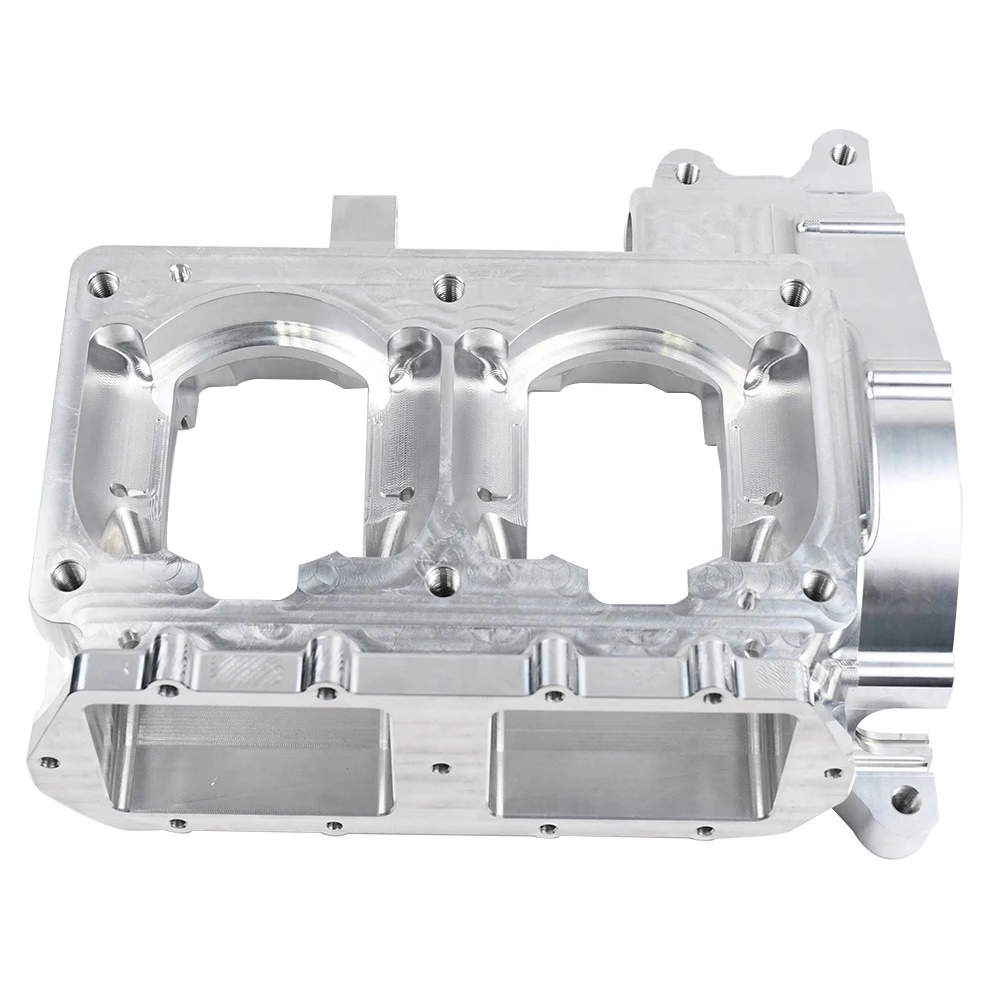
The second question is geometry. A part with undercuts, deep pockets on five faces, or a curved surface that must stay continuous cannot be made on a 3-axis mill without re-fixturing. Each re-fixture adds setup error. A simultaneous 5-axis center with a Ø400 mm rotary table cuts those faces in one setup, so the datum relationships stay intact. If your part is prismatic with holes on two faces, 3-axis work is faster and cheaper.
Material changes the answer again. Aluminum 6061 and 7075 cut freely, so ±0.005 mm is realistic on most features. Stainless 316L and 17-4PH work-harden, so thin walls below 1 mm tend to move after clamping. Titanium TC4 and Inconel need slower feeds, more tool changes and a longer cycle. When you compare quotes for CNC machining services in Baltimore MD or anywhere else, ask for the assumed material condition. A quote based on 6061 will not survive a switch to Inconel.
One practical test: send the same STEP file to three shops and ask each to list the features they consider critical. If two shops name the same three features and the third names none, the third is not reading the print.
- 1Tighten only what movesBearing bores, seal faces and datums. Leave clearance holes at ±0.1 mm.
- 2Count the setupsEach re-fixture adds stack-up error. One 5-axis setup beats four 3-axis setups.
- 3Name the material grade6061-T6 and 6061-O machine differently and price differently.
Lead time, order size and the quote you should expect
Lead time is not one number. It splits into quoting, programming, machining and finishing. A shop that answers in 12 hours with a DFM note is telling you the engineering team is staffed. A shop that takes a week to confirm receipt is telling you something else. Ask when production starts after PO, not just when parts ship. Production start within 24 hours is achievable when the DFM issues are closed before the PO.
Order size is the next filter. Many machine shops set a minimum order quantity of 10 or 50 pieces because a single prototype does not cover programming time. That is a legitimate business choice, but it rules out validation builds. If you are at the prototype stage, ask directly whether the shop accepts one part. A shop with no MOQ can run one piece for fit check and then 10,000 pieces on the same program.
Read the quote structure, not just the total. A quote with separate lines for material, machining, finishing and inspection lets you remove a step you do not need. A single lump sum hides where the cost sits, so you cannot negotiate. Post-processing is often the surprise line: anodizing, electroless nickel, powder coating, bead blasting and laser marking all add days and cost. Laser marking needs a minimum character height of 1.5 mm, so tiny logos on small parts may not be feasible.
Finally, ask what happens if a dimension is out. A shop that inspects 100% before shipment and can send reports will catch it before the box leaves. That is cheaper than a return from Maryland.
- 1Separate the quote linesMaterial, machining, finishing, inspection. Then you can delete what you do not need.
- 2Ask about first articleFor a new program, request a first-article report before the full run.
- 3Plan finishing earlyAnodizing and plating add calendar days after machining ends.
Certifications, documentation and confidentiality
Certificates are not decoration. They map to industries. ISO 9001:2015 is the baseline for general industrial work and tells you the shop has a documented quality system. IATF 16949:2016 is written for automotive production, so it covers PPAP-style documentation and traceability. ISO 13485:2016 is the medical device standard, which adds process validation and clean handling expectations. ISO 27001:2022 covers information security, which matters when you upload proprietary CAD files.
Match the certificate to your end use before you shortlist. A shop with only ISO 9001 can still make excellent brackets and housings. It is the wrong choice for an implant component or a safety-critical automotive part where your own auditor will ask for the supplier's certificate scope. Ask for the certificate number and the scope statement, not a logo on a webpage.
Documentation travels with the parts. For each order you can request material certificates, dimensional reports and finish certificates. On a first article, an inspection report with the measured values against the print is the fastest way to confirm the process before you commit to volume.
Confidentiality is part of the same conversation. Prototype geometry is the most valuable file you will send. Ask whether uploads are handled on a secure channel and whether the shop will sign an NDA before you share the STEP file. A shop that hesitates on an NDA for a pre-launch part is a risk you do not need to take.
- 1ISO 9001:2015Baseline quality system for general industrial parts.
- 2IATF 16949:2016Automotive production, traceability and PPAP-style records.
- 3ISO 13485:2016Medical devices; adds validation and handling controls.
- 4ISO 27001:2022Information security for uploaded CAD and drawings.
When a Baltimore supplier is the right call, and when it is not
Local sourcing wins on three things: physical proximity for urgent rework, same-day courier for a single replacement part, and face-to-face engineering reviews. If your line is down and you need two parts by tomorrow morning, a shop inside the Beltway is worth a premium. That is a real advantage and it should be priced as one.
Local sourcing loses on capacity and on cost for anything beyond simple geometry. A regional job shop may have two or three mills and no 5-axis center. Your contoured part then goes out to a subcontractor, and you lose visibility on the schedule. For runs above a few hundred parts, the per-piece price gap between a small local shop and a high-volume plant is usually larger than the freight.
The practical answer is a split. Keep a local shop for emergency spares and simple fixtures. Send complex geometry, tight tolerance work and volume runs to a plant with the machine list to match. What matters is that both suppliers are measured the same way: tolerance capability, lead time from PO to ship, MOQ, certificate scope and inspection records.
If you outsource overseas, close the distance with process. Freeze the drawing revision before PO. Get the DFM feedback in writing. Ask for the inspection report with the shipment. Those three steps remove most of the risk that people associate with offshore machining. GreatLight runs 127 high-precision CNC machines across three plants, including 16 simultaneous 5-axis centers, so the machine list is not the constraint.
- 1Choose local forEmergency spares, same-day rework, in-person design reviews.
- 2Choose a larger plant for5-axis contours, tight tolerance volume, multi-material programs.
- 3Measure both the same wayTolerance, lead time, MOQ, certificates, inspection records.
Six steps to vet a supplier and place a clean order
Run these in order. Each step produces a document you can hold the supplier to.
- 11. Freeze the drawing revisionAssign a revision letter and lock the file before any quote. Send STEP plus a 2D PDF with the tolerance block and datum callouts. Quotes against a moving drawing are worthless.
- 22. Mark critical featuresHighlight every dimension that needs ±0.005 mm and every surface that needs Ra 0.8–1.6 μm. Leave the rest at general tolerance. This one step often cuts quoted cost by 15–30%.
- 33. Request the DFM note with the quoteAsk for thin-wall warnings, tool reach limits and suggested datum changes. A useful DFM note names specific features, not generic advice. Expect it within 12 hours from a staffed engineering team.
- 44. Confirm machine fit and order sizeGive the bounding box and the tightest tolerance. Ask which machine will run it and whether one piece is accepted. Check the largest travel against your part: 4,000 × 400 × 150 mm covers long parts, 500 × 500 × 450 mm covers compact ones.
- 55. Agree on finishing and inspectionList the finish by name: clear anodize, hardcoat, electroless nickel, black oxide, bead blast. State the inspection level. For a new program, request a first-article report. Confirm laser marking character height is at least 1.5 mm if you need a logo.
- 66. Sign the NDA, then release the POSign the NDA before uploading production files. Put the drawing revision, finish spec, inspection level and ship date on the PO. Ask for the ship confirmation with tracking and the inspection report attached.
Questions buyers ask about CNC machining services in Baltimore MD
What tolerance can I realistically ask for?
±0.005 mm is achievable on critical features such as bearing bores and seal grooves in aluminum and brass. On stainless and titanium, expect ±0.01 mm on the same feature unless the shop controls temperature and uses finishing passes.
Put the tight tolerance only on the features that need it. A blanket ±0.005 mm across a large part raises cost and adds inspection time without improving function.
Is there a minimum order quantity?
It depends on the shop. Many regional job shops set a minimum because programming time has to be covered. Others accept a single prototype and then run 10,000+ pieces on the same program.
Ask before you send the file. Also ask whether the setup charge is a separate line or built into the piece price. That determines what happens when your quantity changes.
How fast can parts ship?
A staffed engineering team can return a quote and a DFM note within 12 hours, start production within 24 hours of PO, and ship parts in 3–5 days for standard geometry.
Complex 5-axis parts, multi-stage finishing or first-article inspection add calendar days. Get the ship date in writing on the PO rather than assuming the standard window.
Which materials are available?
Aluminum grades 6061, 6061-T6, 2024, 5052, 5083, 6063, 6082, 7075 and ADC12. Stainless 303, 304, 316, 316L, 420, 430, 431, 440C and 17-4PH. Steel 1018, 1045, 4130, 4140, 4340 and A36.
Also copper and brass C101, C110, C27400, C28000, C36000, titanium TA1, TA2 and TC4, Inconel, magnesium AZ31B and AZ91D, and plastics including ABS, PC, POM, PEEK, PA and carbon fibre.
Do you sign an NDA before I send CAD files?
Yes. An NDA is available on request, and uploads are handled on a secure and confidential channel. Sign the NDA before you share production geometry.
For early concepts, send a simplified model or a 2D section first. That gives the shop enough to quote tooling and cycle time without exposing the full design.
What inspection documentation comes with the parts?
Every order gets raw material check, in-process monitoring and 100% inspection before shipment. Reports are available on request.
For a new program, ask for a first-article inspection report with measured values against the drawing. That is the fastest way to confirm the process before you release a volume order.
Send your drawing, get a quote and a DFM note in 12 hours
Upload the STEP file and 2D PDF. We return pricing, a DFM note and a ship date. No MOQ, one part or 10,000+.
12-hour quoteNo MOQ100% inspectionNDA on request
More machining notes
We publish setup notes, tooling trials and inspection data from the factory floor.











