
CNC Machining Services in UAE: What Engineers Should Check Before Ordering
This guide is for UAE design engineers and sourcing teams who need machined parts but are unsure how to compare suppliers. It covers the checks that decide part quality, paperwork, and schedule risk.
In this article
- 1
- 2
- 3
- 4
- 5
- 6
- 7
- 8
Key takeaways
How to compare CNC machining suppliers for UAE projects
Use the left column as your question list during any supplier call.
| Check | What good looks like | Why it matters |
|---|---|---|
| Achievable tolerance | ±0.005 mm on critical features | Bearing bores and seal faces fail outside this band |
| Axis count on the floor | 5-axis and mill-turn in house | Fewer setups means tighter position control |
| Certifications | ISO 9001, IATF 16949, ISO 13485, ISO 27001 | Regulated buyers audit the paperwork, not the pitch |
| Minimum order quantity | No MOQ, one part to 10,000+ | Prototype and volume run stay on one process |
| Quote turnaround | Quote and DFM analysis in 12 hours | Late quotes stall your own build schedule |
| Production start | Within 24 hours after approval | Keeps pilot builds and trade shows on track |
| Shipping time | Parts ship in 3–5 days | Air freight to Dubai or Abu Dhabi adds its own days |
| Confidentiality | Secure upload, NDA on request | R&D drawings leak from weak file handling |
What UAE buyers actually need from CNC machining services in UAE supply chains
UAE industrial work clusters around a few demanding sectors. Dubai and Abu Dhabi aerospace MRO groups rework brackets, housings and fixtures that must fit back onto certified assemblies. Medical device teams in the same cities need small runs of ISO-compliant prototypes before clinical trials. Automotive and EV programs in Sharjah and the northern emirates push toward production volumes with traceable paperwork.
Each of those sectors sets a different bar. A machined aluminium bracket for a ground support fixture tolerates general machining tolerance. A titanium implant trial part does not. The mistake we see most often is treating all three as the same purchase and choosing a supplier on price alone.
Local capacity in the UAE has grown, but the mix is uneven. Plenty of shops run 3-axis milling and turning well. Far fewer hold simultaneous 5-axis centers, in-house finishing, and the material range that aerospace and medical work requires. That gap is what sends a lot of drawings overseas, especially for tight-tolerance parts and short runs.
The practical question is not local versus overseas. It is which supplier can hold the tolerance, provide the certificate your customer asks for, and start cutting quickly enough. Those three things are measurable before you place an order.
Tolerance, machine mix and part size: the first filter
Start with the tightest feature on your drawing. If a bore, slot or mating face carries ±0.005 mm (±0.0002 in), the supplier needs the right machine and the right fixturing. A 3-axis mill can hit that on one face. A part with angular features on five sides usually cannot, because each re-fixturing step adds position error.
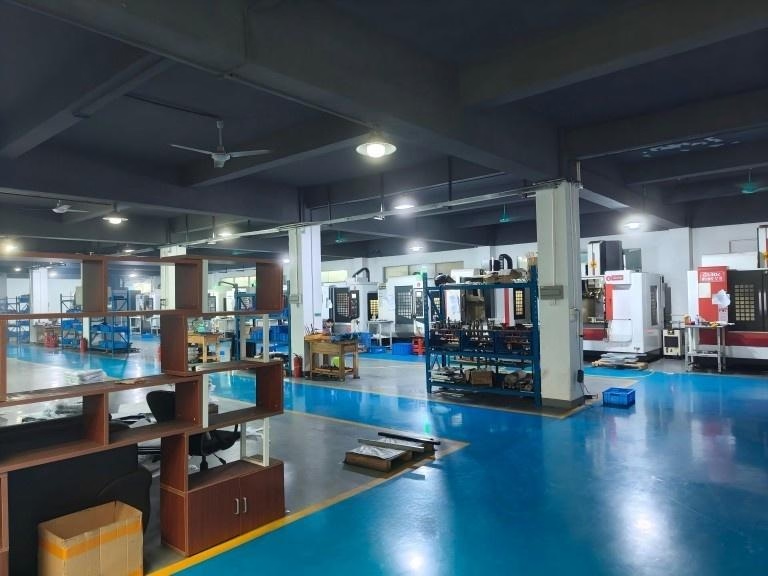
Ask how many axes are available and what the shop does for one-setup work. Our own floor runs 127 high-precision CNC machines: 16 simultaneous 5-axis centers, 12 four-axis mills, 27 three-axis machines and 16 mill-turn centers. Mill-turn matters for parts that are turned and milled, like valve bodies and shaft collars, because it removes a second setup.
Part size sets the second filter. Small parts fit almost anywhere. Long housings and frame rails need travel that many job shops do not have. Our largest travel is 4,000 × 400 × 150 mm, with medium platforms at 750 × 1,150 × 550 mm and 600 × 600 × 600 mm, and compact platforms at 500 × 500 × 450 mm and 500 × 310 × 200 mm. A Ø400 mm rotary table handles round work that needs indexed features.
Surface finish is part of the same conversation. As-machined surfaces land around Ra 1.6–3.2 μm. Fine finishes reach Ra 0.2–0.8 μm when the geometry and material allow it. If your drawing calls for a fine finish on a deep pocket, expect a longer cycle and a higher price, and ask whether that finish is truly functional.
- 1One setup beats threePosition error comes from re-fixturing, not from the spindle.
- 2Check travel against your largest partA 4,000 mm envelope covers most frame and rail work.
- 3Specify finish where it mattersFine finish on a non-critical face only adds cost.
Material range and finishing: where quotes quietly diverge
Two suppliers can quote the same drawing and return numbers 40 percent apart. The difference is usually material grade and finishing scope, not machining time. Aluminium 6061 and 7075 machine easily. 17-4PH stainless and Ti-6Al-4V (TC4) do not. Inconel is slower again, and tool wear shows up in the price.
Ask which grades the shop stocks or buys regularly. A supplier who runs aluminium 6061, 6061-T6, 2024, 5052, 5083, 6063, 6082, 7075 and ADC12 every week will quote faster and machine more predictably than one ordering a single bar for your job. The same applies to stainless 303, 304, 316, 316L, 420, 430, 431, 440C and 17-4PH, and to steels such as 1018, 1045, 4130, 4140 and 4340.
Finishing is the second hidden variable. Anodizing in clear, colour, hardcoat or conductive form changes dimension slightly and changes cost clearly. Electroless nickel, zinc, silver and gold plating, powder coating, black oxide, bead blasting, tumbling, brushing and polishing all sit on top of the machining price. Laser marking and engraving need a minimum character height of 1.5 mm, so plan label space before you finalize the drawing.
The clean approach is to list every operation on the purchase order, including masking areas for anodizing and thread protection for plating. Suppliers who finish in house control the sequence. Suppliers who subcontract finishing add days and a second handling step where parts can be damaged.
- 1Name the grade, not just the alloy6061-T6 and 6061 behave differently under load.
- 2Plan masking before anodizingThreads and mating faces usually need protection.
- 3In-house finishing shortens the chainFewer handoffs means fewer damaged parts.
Certifications and confidentiality for regulated UAE sectors
If your part ends up in a car, an aircraft or a patient, the certificate matters more than the price. IATF 16949:2016 covers automotive quality management. ISO 13485:2016 covers medical devices. ISO 9001:2015 is the general baseline. ISO 27001:2022 covers information security, which is the one buyers forget until a customer audit asks how drawings are stored.
Ask for the certificate scope, not just the logo. A supplier can hold ISO 9001 for one process and send your part elsewhere. Confirm that machining, inspection and finishing for your part type fall inside the audited scope. Then ask what the inspection record looks like, because that is the document your customer will request.
Our standard flow is a raw material check, in-process monitoring, and final inspection, with 100 percent inspection before shipment and reports on request. For a first article, ask for dimensional results on the critical features with the measurement method named. A CMM report on a bore is useful. A caliper reading on a complex profile is not.
Confidentiality runs on the same logic. Uploads are kept secure and confidential, and we sign an NDA on request. If your drawings carry export-controlled or unreleased product data, agree on file handling before you send anything: who can open the files, how long they are stored, and how they are destroyed.
Lead time, MOQ and how to read a quote
Lead time has three parts: quoting, production, and shipping. Ask for all three. We return a quotation and a free DFM analysis within 12 hours, start production within 24 hours after approval, and ship parts in 3–5 days. Our historical late-delivery probability is below 2 percent. Air freight to Dubai or Abu Dhabi then adds its own transit days, which you should plan separately.
MOQ is the clearest signal of who a supplier wants to serve. A shop with a high minimum is built for volume. One with no minimum order quantity can take a single prototype and then run the same part at 10,000+ pieces without changing process or inspection plan. For UAE teams moving from a trade-show sample to a pilot build, that continuity saves a full re-qualification.
Read the quote line by line. Material grade and size, machine time, finishing, inspection reports, packaging, and shipping terms all move the total. A low number often excludes finishing or assumes a loose tolerance on features you marked tight. Ask what tolerance the price covers and whether the tight features are quoted separately.
DFM feedback is worth reading closely. A supplier who suggests a wider corner radius, a different alloy, or a small geometry change is telling you where the cost sits. Free DFM analysis before production is cheaper than a redesign after the first article fails.
- 1Split the lead timeQuote, production and freight are three separate clocks.
- 2Confirm the tolerance the price coversLow quotes often assume general machining tolerance.
- 3Ask for DFM before you approveSmall geometry changes can cut cycle time.
Step by step: qualifying a CNC machining partner for a UAE project
Run these steps in order. Each one filters suppliers before you spend time on detailed quotes.
- 1Mark the critical featuresOn your drawing, flag every dimension that carries ±0.005 mm or a specific Ra value. Send the marked version, not the full assembly.
- 2Ask for the machine mixRequest axis count, travel sizes and whether 5-axis and mill-turn work stays in house. Compare against your largest part and tightest angle.
- 3Confirm the certificate scopeAsk for ISO 9001, IATF 16949, ISO 13485 or ISO 27001 documents and check that your process is inside the audited scope.
- 4Request a quote with DFM notesA useful quote arrives with material grade, tolerance coverage, finishing steps and DFM comments. Ours comes back within 12 hours.
- 5Agree the inspection planState which features need first article reports and whether final reports are required. Name the measurement method for each critical feature.
- 6Set confidentiality termsSign an NDA before releasing sensitive files. Confirm storage, access and destruction rules in writing.
- 7Run a small first orderOrder one to five parts before a full run. Inspect them against the drawing and check the paperwork matches the parts.
- 8Lock the production slotOnce the sample passes, confirm the run quantity and shipping method. Production can start within 24 hours after approval.
Questions UAE buyers ask before ordering
Can you hold ±0.005 mm on parts shipped to the UAE?
Yes, when the geometry and material allow it. We hold ±0.005 mm (±0.0002 in) on critical features using 5-axis and mill-turn capacity that keeps most parts in one or two setups.
Send the marked drawing with your critical features. We will confirm which ones reach that band and which need a different approach.
Do you have a minimum order quantity?
No minimum order quantity. We run from one prototype to 10,000+ part runs on the same process and inspection plan.
That matters for UAE teams who need a clinical trial sample or a trade-show unit first, then a pilot build six weeks later.
Which certifications cover automotive, medical and data security?
IATF 16949:2016 for automotive, ISO 13485:2016 for medical devices, ISO 9001:2015 as the general baseline, and ISO 27001:2022 for information security.
Ask for the scope document. A certificate only helps if your part type and process fall inside the audited scope.
How fast can parts reach Dubai or Abu Dhabi?
Quotation and free DFM analysis come back within 12 hours. Production can start within 24 hours after approval, and parts ship in 3–5 days.
Freight transit from China to the UAE is separate and varies by carrier and customs clearance. We quote shipping terms on the order, not a guaranteed delivery date.
Can you machine titanium, Inconel and engineering plastics?
We machine TA1, TA2, TC4 (Ti-6Al-4V), Inconel, and magnesium AZ31B or AZ91D, along with plastics including ABS, PC, PMMA, POM, PA, PEEK, PP, HDPE and carbon fibre.
Titanium and Inconel cut slowly and wear tooling, so expect longer cycles and a higher price than the same part in aluminium.
How are my drawings protected?
Uploads are secure and confidential, and we sign an NDA on request.
For unreleased or export-controlled designs, agree on file access, storage period and destruction before you send anything.
Send your drawing and get a quote with DFM notes
Upload your files and an engineer reviews tolerance, material and finishing before pricing. Quotation and free DFM analysis within 12 hours.
12-hour quoteNo MOQ100% inspection before shipmentNDA on request
More from GreatLight
We publish setup notes, tooling trials and inspection data from the factory floor.











