
CNC Machining Services in Vietnam: What Engineers Must Check
Sourcing managers compare Vietnam against China, Singapore and local shops on price, but the real questions are tolerance capability, certification coverage and who signs the inspection report. This guide gives you seven checks to run before you release a purchase order, and shows where a Vietnamese supplier is a good fit and where it is not.
In this article
- 1
- 2
- 3
- 4
- 5
- 6
- 7
What to know before you send an RFQ
CNC machining services in Vietnam: how the options compare
Typical capability bands, not quotes. Confirm each line with the supplier's own documents.
| Criterion | Local Vietnamese job shop | Vietnam contract manufacturer | Established export hub shop |
|---|---|---|---|
| Typical tolerance | ±0.05 mm | ±0.02 mm | ±0.005 mm |
| 5-axis availability | Rare, often subcontracted | Limited, 1–3 machines | 16 simultaneous 5-axis centers |
| Max part size | Often under 800 mm | Around 1,500 mm | Up to 4,000 mm |
| Automotive certification | Usually none | Sometimes IATF 16949 | IATF 16949:2016 |
| Medical certification | None | Rarely ISO 13485 | ISO 13485:2016 |
| Quote turnaround | 3–7 days | 2–5 days | Within 12 hours |
| Minimum order quantity | Varies, often 50+ | Varies by program | No minimum, 1 to 10,000+ |
| Inspection paperwork | On request, basic | Partial reports | 100% inspection, reports on request |
When Vietnam is the right choice, and when it is not
Vietnam works well for 3-axis and 4-axis parts at ±0.02 to ±0.05 mm with standard materials and finishes. For tolerances below ±0.01 mm, 5-axis contoured geometry, titanium or Inconel, or programs that need IATF 16949 and ISO 13485 under one roof, an established export hub with 16 simultaneous 5-axis centers, four quality certifications and no minimum order quantity is the lower-risk call. Send the drawing and we will tell you which side of that line your part falls on.
Why buyers look at CNC machining services in Vietnam
Vietnam built its manufacturing base on textiles, consumer electronics assembly and basic metalworking. CNC capacity followed that growth. Today a buyer can find 3-axis mills, CNC lathes and basic surface finishing inside most industrial zones near Ho Chi Minh City, Hanoi and Da Nang. For brackets, housings, shafts and fixtures held at ±0.02 to ±0.05 mm, that supply is real and the pricing is competitive.
The limit shows up when tolerances tighten. A shop running older VMCs without temperature control will struggle to hold ±0.005 mm across a batch, especially on long parts where thermal drift accumulates. The machine is only part of it. Probing, tool wear tracking and a documented in-process check are what keep a tight tolerance stable from part 1 to part 500.
So the question is not whether Vietnam can machine parts. It clearly can. The question is which band of work you are buying, and whether the supplier has the equipment and the inspection discipline to match your drawing. That is what the seven checks below are for.
One more thing worth stating early. Price per part is a weak signal on its own. Two quotes 30% apart usually differ in machine class, inspection depth or material certification, not in labor rate.
- 1Good fit3-axis and 4-axis parts, ±0.02 to ±0.05 mm, aluminum and mild steel, runs from 10 to 10,000 pieces.
- 2Needs checking5-axis contoured surfaces, thin-wall parts, titanium and Inconel, tolerances below ±0.01 mm.
- 3Poor fitAerospace flight hardware and implantable devices without a certified quality system in place.
Check 1 to 3: tolerance, machine list and materials
Start with the tolerance band you actually need, then ask for the machine list. A supplier holding ±0.005 mm will name specific machines, spindle hours and how they compensate for thermal growth. If the answer is vague, the tolerance on the quote is aspirational. Ask what percentage of their parts are inspected with a CMM versus calipers and pin gauges. For tight work, 100% inspection before shipment should be the default, not an upsell.
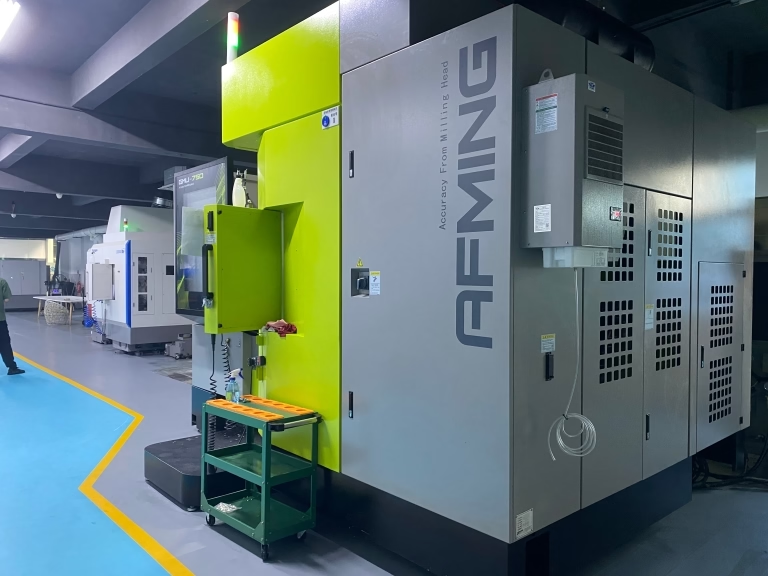
Machine count matters less than machine mix. A shop with 127 high-precision CNC machines, 16 simultaneous 5-axis centers and 16 mill-turn centers can route a part to the right spindle instead of forcing it onto a 3-axis machine with multiple setups. Every extra setup adds a datum shift. On a part with a true position callout of 0.02 mm, three setups can eat the whole tolerance budget.
Material availability is the third check. Common aluminum grades (6061, 7075), stainless (303, 304, 316L, 17-4PH) and plastics (POM, PEEK, PA) are usually stocked. Titanium TC4, Inconel and beryllium copper are not. If your part needs one of those, ask whether the supplier buys certified stock with mill certificates or sources from a local trader. The difference shows up at incoming inspection, not on the quote.
Size also filters the list quickly. If the part is 1,200 mm long, only shops with a 4,000 mm travel machine can hold it in one setup. Anything smaller means repositioning, which changes how you should read the flatness and parallelism callouts.
- 1Ask forMachine make and model, spindle hours, CMM availability, and a sample inspection report.
- 2Ask aboutMill certificate traceability for titanium, Inconel and copper alloys.
- 3Red flagA ±0.005 mm claim with no CMM and no thermal compensation plan.
Check 4 to 5: certifications and industry coverage
Certifications are a gate, not a nice-to-have. ISO 9001:2015 shows a basic quality system. IATF 16949:2016 is what automotive and EV programs require, and it forces traceability, PPAP discipline and change control. ISO 13485:2016 is the equivalent gate for medical devices. ISO 27001:2022 matters when you send CAD files and drawings, because it covers how those files are stored and who can open them.
The useful question is not which certificates hang on the wall. It is which certifications the supplier actually operates under for the parts they ship. Ask for the certificate scope and the issuing body. A certificate covering a trading office is not the same as one covering the machine shop floor.
Industry coverage follows from that. Aerospace, automotive, medical, robotics, electronics and new energy each carry their own documentation habits. A supplier who has shipped automotive parts will already have a control plan format and know what a deviation request looks like. A general job shop will not, and you will spend weeks teaching them your process.
If your program needs an NDA before drawings leave your building, settle that before the RFQ, not after. It is a normal step and a supplier who resists it is telling you something.
- 1General industrialISO 9001:2015 is usually enough.
- 2Automotive and EVIATF 16949:2016 plus PPAP capability.
- 3Medical devicesISO 13485:2016 and documented process validation.
- 4IP-sensitive programsISO 27001:2022 and a signed NDA before files move.
Check 6 to 7: lead time, MOQ and surface finishing
Lead time is where offshore sourcing breaks down. Ask for three numbers: how fast the quote and DFM analysis come back, how fast production starts after you approve, and how long the parts take to ship. A supplier who quotes in 12 hours and starts production within 24 hours is set up for repeat work. One who quotes in a week will not hold a 3–5 day shipping window when your line is waiting.
Minimum order quantity is the other half. If a supplier will not run one prototype, you cannot validate the process before committing to a large order. No minimum order quantity, from one part to a 10,000+ run, removes that risk. It also lets you check the finish and the fit on a real part instead of arguing over a drawing.
Surface finishing is the last check and the most often skipped. Anodizing, electroless nickel, zinc and gold plating, powder coating, black oxide, bead blasting, tumbling, brushing and polishing each add a step and a lead time. If the finish is outsourced, the supplier loses control of the schedule and the quality. Ask who runs the finishing line and how they mask critical surfaces.
Laser marking has its own constraint. Minimum character height is 1.5 mm on most setups. If your part number needs to be smaller than that, plan for a different marking method or accept that readability will suffer.
- 1Quote and DFM12 hours is a reasonable benchmark for a complete RFQ package.
- 2Production startWithin 24 hours after approval keeps a short program on schedule.
- 3Shipping3–5 days for standard parts; finishing adds time.
How to qualify a supplier in seven steps
Run these in order. Each step can end the conversation early, which saves you weeks.
- 11. Write the tolerance band firstSplit your drawing into critical and non-critical features. Send the critical list with the RFQ. A supplier who only quotes a single blanket tolerance has not read the drawing.
- 22. Request the machine listAsk for machine model, axis count and spindle hours. For 5-axis contoured work, confirm simultaneous 5-axis, not 3+2 positioning. Those are different processes.
- 33. Ask for a sample inspection reportLook for CMM data with datum references, not just pass/fail stamps. Check that the report covers the features you flagged as critical.
- 44. Verify certification scopeRequest the ISO 9001, IATF 16949, ISO 13485 or ISO 27001 certificate and read the scope line. Confirm it covers the manufacturing site that will run your parts.
- 55. Test the quote turnaroundSend a complete RFQ with 3D files, 2D drawings, material, finish and quantity. Time the response. A 12-hour reply with DFM notes is a good signal.
- 66. Run one prototypeOrder a single part before a production run. Measure it against your critical list. No minimum order quantity makes this cheap and fast.
- 77. Agree the finishing and paperworkConfirm who runs anodizing or plating, how critical surfaces are masked, and what documents ship with the parts. Settle NDA terms before files move.
Questions buyers ask about CNC machining services in Vietnam
Can Vietnamese shops hold ±0.005 mm?
Some can, but it is not the norm. The capability depends on machine class, temperature control in the shop, probing and tool wear tracking.
Ask for the machine list and a CMM report on a comparable part. If the supplier cannot show both, treat the tolerance on the quote as unverified.
Is Vietnam cheaper than China for CNC parts?
Labor rates are lower, but labor is a small share of a machined part's cost. Material, machine time, finishing and inspection dominate.
A 30% gap between two quotes usually means a different machine class or a lighter inspection routine, not a cheaper country.
What certifications should I require?
ISO 9001:2015 for general industrial work. IATF 16949:2016 for automotive and EV. ISO 13485:2016 for medical devices. ISO 27001:2022 when CAD files and drawings need controlled handling.
Always read the certificate scope and confirm it covers the site that machines your parts.
How small an order will a supplier accept?
It varies widely. Some shops set a minimum around 50 pieces to cover setup. Others, including GreatLight, run no minimum order quantity and accept a single prototype up to a 10,000+ part run.
A single-part trial is the cheapest way to test a supplier before a production commitment.
How long should a quote take?
A complete RFQ package with 3D files, 2D drawings, material, finish and quantity should come back with pricing and DFM notes within a working day.
If it takes a week, the supplier is likely re-quoting the work to a subcontractor, which adds risk to your schedule.
What finishes are usually available locally?
Bead blasting, tumbling, brushing, black oxide and basic anodizing are common. Hardcoat anodizing, electroless nickel and precious metal plating are less so.
Ask whether the finishing line is in-house. Outsourced finishing is the most common cause of a missed ship date.
Send your drawing, get a DFM answer in 12 hours
Upload your 3D files and 2D drawings. We reply with pricing and free DFM analysis within 12 hours, start production within 24 hours of approval, and inspect 100% of parts before shipment. Uploads are secure and confidential, with an NDA available on request.
12-hour quoteFree DFM analysis100% inspectionNo minimum order quantity
More machining notes
We publish setup notes, tooling trials and inspection data from the factory floor.











