
CNC Machining Services Lakeville: How to Pick a Supplier Without Rework
This guide is for engineers and purchasing teams in Lakeville who need machined parts and want a supplier they can audit, not just a quote. We cover the checks that actually predict part quality: tolerance capability, material stock, inspection reports, MOQ, and lead time. Read it before you send an RFQ.
In this article
- 1
- 2
- 3
- 4
- 5
- 6
- 7
- 8
Key takeaways
What to compare on CNC machining services Lakeville quotes
Use this table to score two or three suppliers side by side before you commit a PO.
| Check | What good looks like | Red flag |
|---|---|---|
| Tolerance capability | ±0.005 mm stated with machine model | Quote says 'precision' with no number |
| Material stock | Aluminium, stainless, titanium listed | Specialty alloy sourced per order, no date |
| Minimum order | One prototype to 10,000+ parts | Setup fee that kills small builds |
| Inspection | 100% inspection, reports on request | Sample check only, no data shipped |
| Certifications | ISO 9001, IATF 16949, ISO 13485 | Certificate expired or not named |
| Quote turnaround | DFM analysis within 12 hours | Days of silence after upload |
| Lead time | Parts ship in 3–5 days | Vague 'subject to capacity' |
| Confidentiality | Secure upload, NDA on request | Email-only file handling |
Tolerance is the first filter for CNC machining services Lakeville buyers
Every supplier will say they hold tight tolerance. Few will tell you which machine does it and on what geometry. A 3-axis mill can hit ±0.005 mm on a flat face, but the same callout on a deep pocket wall or a compound angle is a different problem. Ask for the machine model and the setup plan before you accept the number.
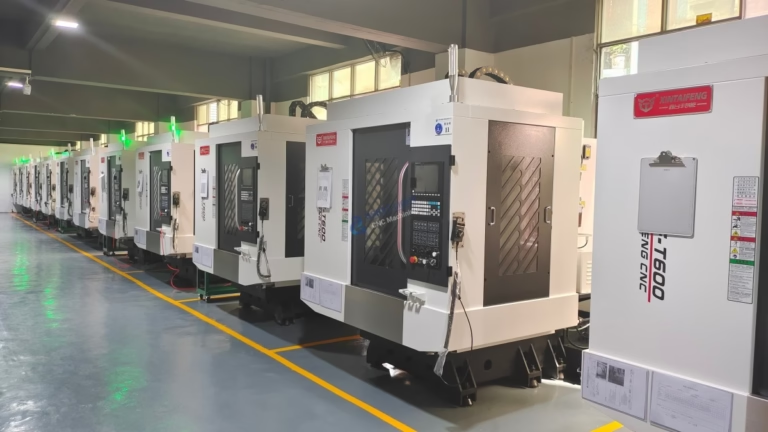
For parts with features on five faces, a simultaneous 5-axis center removes the part once and finishes it in one setup. That matters because every re-fixture adds stack-up error. GreatLight runs 16 simultaneous 5-axis machining centers alongside 12 four-axis mills, 27 three-axis machines, and 16 mill-turn centers. The right machine depends on your geometry, not on the shop's favorite spindle.
Tolerance also drives cost. A part quoted at ±0.05 mm and then tightened to ±0.005 mm after the first article can double the cycle time. Send the real drawing on the first RFQ. If a feature truly needs ±0.005 mm, say so. If it does not, loosen it and save money.
- 1Flat and prismatic parts3-axis or 4-axis is usually enough and cheaper.
- 2Multi-face and contoured parts5-axis cuts setups and stack-up error.
- 3Shafts and turned featuresMill-turn centers finish both in one cycle.
Material stock tells you what the shop really machines
A supplier who stocks 6061 and 304 will quote anything, then scramble when your drawing calls for 17-4PH or Ti-6Al-4V. Ask what is on the rack. Aluminum grades such as 6061-T6, 7075, and 2024 behave differently in chip control and finish. Titanium and Inconel need slower feeds, more coolant, and tooling that many small shops do not keep on the shelf.
Material choice also sets the finish you can reach. As-machined aluminum lands around Ra 1.6–3.2 μm. With the right toolpath and finishing pass, fine surfaces reach Ra 0.2–0.8 μm. If your drawing calls for a mirror finish on a soft plastic, the process is polishing, not machining, and it should be quoted as a separate operation.
Ask how the shop verifies incoming stock. A raw material check before the first cut catches the wrong grade or a bad heat lot. That check is part of the quality plan at GreatLight, along with in-process monitoring and final inspection. If a supplier cannot describe their incoming inspection, assume there isn't one.
One more question worth asking: can they run the same material for the prototype and the production lot? Switching from a bar-stock prototype to a die-cast production part changes dimensions and surface. Keep the process consistent until the design is frozen.
Match certifications to your industry, not to a logo wall
Certificates are not decoration. Each one covers a specific risk. ISO 9001:2015 is the baseline quality system. IATF 16949:2016 is what automotive and EV programs expect. ISO 13485:2016 applies to medical devices. ISO 27001:2022 covers information security, which matters when your CAD files are the product.
Ask for the certificate number and the scope. A certificate that covers a trading office but not the machine shop is not the same thing. If your program is in aerospace, medical, or automotive, the audit trail from raw material to final inspection is part of the deliverable, not an extra.
For Lakeville buyers sourcing overseas, the data question is separate from the part question. Files move across time zones and email accounts. A shop with a documented upload path and an NDA on request removes a real risk. GreatLight offers both, and the NDA page is linked from the quote flow.
- 1Automotive and EVLook for IATF 16949:2016 plus PPAP-style documentation.
- 2Medical devicesISO 13485:2016 and traceable inspection records.
- 3Any IP-sensitive designSecure upload and ISO 27001:2022 scope.
MOQ, unit cost, and where the money actually goes
CNC machining has almost no tooling cost compared with molding or casting. That is why a shop with no minimum order quantity can run one prototype and a 10,000 part order on the same equipment. If a supplier quotes a large setup fee for a single part, you are paying for their scheduling, not for the work.
Unit price falls with quantity because programming and setup are spread across more parts. The drop is steep from one to fifty, gentler from five hundred to five thousand. If your forecast is uncertain, ask for a price at three quantities and check where the curve flattens. That tells you the economic batch size better than any sales claim.
Do not shop on unit price alone. A quote that excludes deburring, anodizing, or inspection is not comparable. Ask what is included: material, machining, surface finish, inspection report, and packaging. A complete quote at a higher number is often cheaper than a bare number plus change orders.
Lead time: separate the quote clock from the shipping clock
Ask two questions. How fast is the quote, and how fast is the part? They are different clocks and suppliers often blur them. A useful benchmark: quotation and free DFM analysis within 12 hours, production start within 24 hours, and parts shipping in 3–5 days.
For a first article, the DFM feedback is worth more than the speed. A supplier who flags a thin wall, an unreachable feature, or a tolerance that will not hold saves you a scrapped lot. Read that feedback before you approve production, even if it costs a day.
Shipping method changes the total time more than shop speed for Lakeville buyers working with an overseas supplier. Air freight compresses transit; ocean freight compresses cost. Decide which one your schedule needs before the quote, because the answer changes the price you should compare.
Keep a buffer for finishing. Anodizing, plating, and powder coating are outside processes with their own queues. If your parts need color anodizing or laser marking, add that to the timeline from the start.
Step by step: vetting a supplier in one week
- 1Send the real drawing with GD&TInclude material, tolerance, finish, and quantity. A vague RFQ gets a vague quote that you cannot compare.
- 2Ask which machine holds the tightest calloutRequest the machine model and setup count. For ±0.005 mm on multiple faces, expect a 5-axis or mill-turn answer.
- 3Request a DFM response before pricingLook for specific notes on wall thickness, tool reach, and tolerance. Generic replies mean no one read the file.
- 4Confirm material availabilityAsk for the grade and the stock form. If it is not on the rack, ask for the mill lead time in writing.
- 5Order one piece firstNo MOQ means this is cheap. Measure the critical features yourself before releasing a larger run.
- 6Review the inspection reportCheck that the reported dimensions match your drawing callouts. 100% inspection with data beats a verbal OK.
- 7Test the finishing pathSend one part through anodizing or plating. Color and thickness consistency varies between vendors more than machining does.
- 8Lock the process before scalingKeep material, machine class, and finish the same from prototype to production so dimensions do not shift.
Frequently asked questions
How do I know a supplier can actually hold ±0.005 mm?
Ask which machine and how many setups. Tight tolerance on one flat face is easy; the same callout across five faces needs a 5-axis or mill-turn process.
Then ask for the inspection data on the first article. The report is the evidence, not the quote.
Is a local Lakeville shop always faster than an overseas supplier?
For a one-off repair, often yes. For a defined production run, shipping method dominates. Air freight plus a 3–5 day build can beat a local queue.
Compare total time to your dock, not the day the part leaves the machine.
What does no minimum order quantity actually mean?
It means the shop will run a single prototype without a setup surcharge that makes one part uneconomic.
The same process should scale to 10,000+ parts. If the prototype and production use different methods, expect dimensional drift.
Which certifications should I require?
ISO 9001:2015 is the baseline for any supplier. Add IATF 16949:2016 for automotive, ISO 13485:2016 for medical, and ISO 27001:2022 when your files are confidential.
Check the scope on the certificate. It should cover the site doing the machining.
How should I compare quotes from different shops?
Normalize the scope first: material, machining, deburring, finish, inspection, and packaging. Then compare price and lead time.
A low quote that excludes finishing is not a lower quote.
What surface finish can I expect as-machined?
Typical as-machined surfaces land at Ra 1.6–3.2 μm. A controlled finishing pass reaches Ra 0.8–1.6 μm, and fine finishing reaches Ra 0.2–0.8 μm.
Specify the finish on the drawing. If you leave it open, you get whatever the toolpath produces.
Send your drawing and get a DFM review with the quote
Upload your CAD files and we return a quotation plus free DFM analysis within 12 hours. Uploads are secure and confidential, and an NDA is available on request.
12-hour quoteNo MOQ100% inspectionNDA on request
More from the shop floor
We publish setup notes, tooling trials and inspection data from the factory floor.











