
CNC Machining Services Melaka: How to Pick the Right Supplier
This guide is for engineers and sourcing staff in Melaka who need machined parts. It covers the checks that actually decide whether a supplier can hold your tolerances, meet your schedule and survive an audit. Read it before you send an RFQ.
In this article
- 1
- 2
- 3
- 4
- 5
- 6
- 7
- 8
What matters most when you compare suppliers
Which type of CNC machining services Melaka buyers should choose
Three common sourcing routes, and where each one stops working.
| Supplier type | Best for | Watch out for | Typical fit |
|---|---|---|---|
| Local job shop | Simple milling and turning, repair parts | Limited 5-axis capacity, thin inspection records | Brackets, fixtures, one-off spares |
| Regional contract shop | Mid-volume runs, repeat orders | Tolerance ceiling near ±0.02 mm | Enclosures, housings, shafts |
| Specialized export supplier | Tight tolerances, complex geometry, audits | Longer shipping leg, needs clear drawings | Medical, automotive, aerospace parts |
| Hybrid: local plus export | Fast iterations plus volume production | Two sets of paperwork to keep aligned | Prototype to 10,000+ part runs |
How to read a tolerance claim from cnc machining services melaka suppliers
A tolerance number on a website tells you what a shop has hit at least once, not what it holds across a batch. Ask which machine produced that number. A ±0.005 mm callout on a small aluminum bracket is routine on a 5-axis center with a controlled shop floor. The same callout on a 400 mm long steel shaft is a different problem, because thermal growth and tool deflection scale with length.
Size limits matter as much as tolerance. GreatLight runs a 4,000 mm maximum processing size, with a 4,000 × 400 × 150 mm travel envelope on the large machines and 750 × 1,150 × 550 mm on the medium ones. If your part sits outside the envelope, the supplier will either tilt it across setups or turn it down. Both answers are useful, but you want them before you commit to a design freeze.
Surface finish travels with tolerance. A ±0.005 mm bore usually needs Ra 0.8–1.6 μm or better to stay functional, and Ra 0.2–0.8 μm when a seal or bearing runs against it. As-machined Ra 1.6–3.2 μm is fine for brackets and covers. If a quote lists a tight tolerance and a rough finish, one of the two numbers is wrong.
One more check: ask how the shop verifies the tolerance. Raw material check, in-process monitoring and final inspection are the three points where a good shop catches drift. Reports on request should be normal practice, not a paid extra.
- 1Ask for the machine, not just the number5-axis centers, mill-turn centers and 3-axis mills each hold different limits.
- 2Check the work envelope against your largest feature
- 3Pair tolerance with finishTight bore plus rough surface equals a rework ticket.
Certifications and audits: what each one actually buys you
Certifications are a shortcut for judging process control. ISO 9001:2015 says the shop documents how it works and corrects problems. IATF 16949:2016 adds automotive-specific discipline: change control, traceability, and a structured approach to process capability. Medical work runs on ISO 13485:2016, which pushes validation and record keeping further. ISO 27001:2022 covers information security, which matters when you send proprietary CAD files.
GreatLight holds all four: ISO 9001:2015, IATF 16949:2016, ISO 13485:2016 and ISO 27001:2022. For a Melaka buyer in electronics or medical devices, that combination removes a large part of the supplier qualification work. You still audit the process, but you start from a documented baseline.
Certificates are not the whole story. Ask for the scope statement. A shop can hold ISO 9001 for a warehouse and machine parts in a different building. The scope should name the machining activity and the site where it happens.
Confidentiality sits next to certification. Uploads should be secure, and an NDA should be available on request rather than something you have to negotiate. If a supplier hesitates on an NDA for a simple bracket, they will hesitate on your production drawings too.
- 1Read the scope, not the logoThe certificate should cover the machining site, not a head office.
- 2Match the standard to your industryISO 13485 for medical, IATF 16949 for automotive, ISO 27001 for file security.
- 3Ask for an NDA earlyA supplier that agrees in one email is easier to work with for years.
Lead time, MOQ and quote quality in cnc machining services melaka sourcing
Lead time has three parts: quote, production start and shipping. A single number hides the one that hurts. GreatLight quotes and returns a free DFM analysis within 12 hours, starts production within 24 hours, and ships parts in 3–5 days. The DFM note is the useful part, because it tells you which features will drive cost before you cut metal.
MOQ is the second trap. No minimum order quantity means one prototype and a 10,000+ part run use the same process and the same inspection. That removes the awkward gap where a prototype is made one way and production another. For a Melaka team doing design iterations, this keeps the first article representative.
Quote format matters more than quote speed. A useful quote lists material grade, machine type, tolerance, finish, inspection scope and the assumptions behind the price. A single lump sum tells you nothing when the design changes in week three.
Ask what happens when a drawing is ambiguous. A shop that flags the ambiguity in the DFM note is cheaper to work with than one that machines to its own guess and ships.
- 1Separate quote, start and ship dates12 hours to quote, 24 hours to start, 3–5 days to ship.
- 2Treat no MOQ as a design toolYou can iterate without tooling commitments.
- 3Demand itemized assumptionsMaterial, machine, finish and inspection should be visible.
Matching material and geometry to the right machine
Material choice drives machine choice. Aluminum grades such as 6061-T6, 7075 and 6082 cut fast and hold tight tolerances well, which makes them the default for prototype housings and brackets. Stainless 303 and 304 machine cleanly; 316L and 17-4PH are tougher on tooling and need slower feeds, so they cost more per part. Titanium TC4 (Ti-6Al-4V) and Inconel are a different category: heat at the cutting edge, short tool life, and a real risk of distortion on thin walls.
Geometry decides how many setups a part needs. A part with features on five faces is a natural fit for simultaneous 5-axis work, where one setup removes the stack-up error of four separate fixtures. A turned part with cross-holes suits a mill-turn center. Simple prismatic parts belong on a 3-axis mill, and putting them on a 5-axis machine just adds hourly cost.
Thin walls and deep pockets are where quotes go wrong. A 1 mm wall on a 100 mm aluminum part will move after clamping, no matter how good the machine is. If you can thicken the wall or add a rib, do it before the RFQ.
Prototypes deserve the same process as production. If the prototype runs on a 5-axis center and production runs on a 3-axis mill, the first article is not representative and your validation data is worth less than you think.
- 1Aluminum first for prototypes6061-T6 and 7075 balance cost, strength and machinability.
- 2Count the faces before you count the costEach extra setup adds tolerance stack-up.
- 3Fix thin walls at the design stageClamping distortion cannot be machined away.
Red flags in a quote for cnc machining services melaka projects
The first red flag is a tolerance promise with no machine list. If a shop claims ±0.005 mm but cannot name the equipment, the number came from a marketing page. The second is a missing inspection scope. Parts should be inspected before shipment, with reports available, and the quote should say so in writing.
The third is a finish that does not match the function. Anodizing, electroless nickel, black oxide and bead blasting all change dimensions by small amounts. Hardcoat anodizing can add 0.02–0.05 mm on a surface, which matters on a bore. A supplier who ignores this will ship parts that fit on the bench and not in the assembly.
The fourth is silence on change control. When you revise a drawing, the supplier should confirm which revision they are cutting and keep the old program archived. That is standard under IATF 16949:2016 and good practice everywhere else.
The fifth is a shipping date with no production start date. Late delivery below 2% over past projects is a useful track record, but only if the clock starts at a defined point.
- 1No machine list, no tolerance creditAsk which model and how many axes.
- 2Finish changes dimensionsHardcoat anodizing adds 0.02–0.05 mm; plan the bore accordingly.
- 3Confirm the drawing revisionEvery order should name the revision being machined.
How to qualify a supplier in seven steps
Run these in order. Each step filters out suppliers before you spend engineering time.
- 11. Write down your real toleranceSeparate the critical dimensions from the cosmetic ones. A part with three tight features and fifty loose ones costs less than a drawing that calls everything ±0.01 mm.
- 22. Confirm the work envelopeCheck your largest part against the supplier's travel. GreatLight covers up to 4,000 mm overall and 4,000 × 400 × 150 mm on the large machines.
- 33. Match certification to industryMedical needs ISO 13485:2016. Automotive needs IATF 16949:2016. File security needs ISO 27001:2022. Check the scope statement covers the machining site.
- 44. Send the RFQ with a material specName the grade, for example 6061-T6 or 316L, not just aluminum or stainless. Grade changes the price more than geometry does.
- 55. Read the DFM note before the priceA 12-hour quote with a free DFM analysis should tell you which features cost money. If there is no DFM note, ask for one.
- 66. Fix the inspection scope in writingRaw material check, in-process monitoring and final inspection, with reports on request. Confirm who pays for a CMM report if you need one.
- 77. Run a small order firstNo MOQ lets you order one part. Check dimensions, finish and paperwork before you release a 10,000-part run.
Questions buyers ask about cnc machining services melaka
Can a supplier outside Melaka hold tighter tolerances than a local shop?
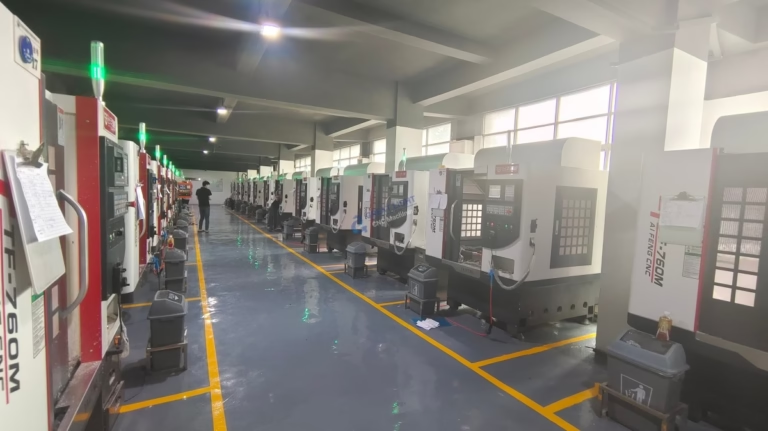
Usually yes, but not because of distance. It comes down to machine type and shop floor control. A supplier running 16 simultaneous 5-axis centers and 16 mill-turn centers can hold ±0.005 mm on small features where a general-purpose shop stops near ±0.02 mm.
The trade-off is shipping time and communication lag. For simple parts and repair work, a local shop is often the faster answer. For complex geometry and audit-ready paperwork, an export supplier is usually the better fit.
What does no minimum order quantity actually mean?
It means the supplier will run one part and a 10,000+ part order on the same machines, with the same inspection steps. You are not paying for tooling or a setup that only makes sense at volume.
For design teams this removes the gap between prototype and production. The first article you validate is made the same way as the parts you ship.
How do I judge a quote if the price looks low?
Check what is missing. A low quote often leaves out surface finish, inspection reports, or the material grade. Ask for the assumptions in writing: machine type, tolerance, finish, inspection scope and packaging.
A quote that names all five is comparable to another quote. A lump sum is not.
Do finishes change part dimensions?
Yes. Hardcoat anodizing can add 0.02–0.05 mm on a surface. Electroless nickel and plating also add material. Bead blasting removes a small amount and rounds edges.
On a bore or a press fit, tell the supplier which surfaces are functional and which are cosmetic. The finish plan should protect the functional ones.
How should I send confidential drawings?
Use a supplier with an information security process in place. ISO 27001:2022 covers how files are stored, who can open them, and how they are deleted after a project.
Ask for an NDA before the first RFQ rather than after the design is frozen. It is a short step and it removes a long argument later.
What is a realistic first-order schedule?
With a complete drawing and material spec, expect a quotation and DFM analysis within 12 hours, production start within 24 hours, and parts shipping in 3–5 days. Add shipping time to Melaka on top of that.
Schedules slip when drawings are ambiguous or material is out of stock. A DFM note in the quote stage catches both early.
Send your drawing and get a machinable answer
Upload your CAD files and we will return a quotation with a free DFM analysis within 12 hours, plus a clear statement of tolerance, finish and inspection scope.
12-hour quote100% inspectionNo MOQNDA on request
More from the shop floor
We publish setup notes, tooling trials and inspection data from the factory floor.











