
CNC Machining Services Midlands: What to Check Before You Order
A buying guide for engineering and procurement teams in Birmingham, Coventry, Derby and Leicester. It covers the checks that decide whether a supplier can hold ±0.005 mm, quote in 12 hours and keep your drawings confidential. Read it before you send an RFQ.
In this article
- 1
- 2
- 3
- 4
- 5
- 6
- 7
- 8
Key takeaways
Midlands supplier checklist: what to verify and why
Use this as an RFQ scorecard. A supplier that fails two rows is a schedule risk.
| Check | What to ask for | Why it decides the order |
|---|---|---|
| Tolerance | ±0.005 mm with CMM report | Fits bearing bores and mating faces |
| Part size | 4,000 × 400 × 150 mm travel | Covers large frames without splitting |
| 5-axis capacity | 16 simultaneous 5-axis centers | Fewer setups, tighter position control |
| Lead time | Quote in 12 h, ship in 3–5 days | Keeps line trials on schedule |
| MOQ | One prototype to 10,000+ parts | No dead stock at design stage |
| Certifications | ISO 9001, IATF 16949, ISO 13485, ISO 27001 | Matches your audit and IP rules |
| Inspection | 100% before shipment, reports on request | Catches a bad batch before freight |
| Materials | Aluminium, stainless, steel, titanium, plastics | Avoids sourcing a second vendor |
Match the machine to the part, not to the map
The Midlands has a dense supplier base, from Birmingham and Coventry automotive toolrooms to Derby and Leicester subcontractors. Proximity helps with a same-day fixture change. It does not help when a part needs a 4,000 mm bed or a five-sided cut in one setup. Start the shortlist with geometry, then filter by location.
For prismatic parts up to 750 × 1,150 × 550 mm, a three-axis or four-axis mill handles most faces. Parts with undercuts, deep pockets or angled ports usually need simultaneous 5-axis work. That removes two or three setups and the stacked position error that comes with them. On a housing with six true-position bores, that difference shows up at final assembly.
Size is the other hard limit. A 4,000 × 400 × 150 mm travel machine takes long extrusions and frame rails in one pass. A Ø400 mm rotary table covers round flanges and valve bodies that would otherwise need a second operation on a lathe.
Material choice also shapes the quote. Aluminium 6061-T6 and 7075 cut fast and hold ±0.005 mm well. Stainless 316L and 17-4PH move more under heat, so the shop needs to plan roughing, stress relief and finishing. Inconel and TC4 (Ti-6Al-4V) need slower feeds and sharp tooling. If a supplier cannot name the material grade they machine most often, ask again.
- 1Prismatic, tight position5-axis with in-process probing
- 2Long frame rails4,000 mm travel, one setup
- 3Round flangesMill-turn or 4-axis with Ø400 mm table
- 4Heat-sensitive alloysRough, relieve, finish in separate steps
Precision is a measurement claim, not a slogan
Any shop can print ±0.005 mm on a website. Fewer can show a CMM report for the actual part you ordered. When you ask for CNC machining services Midlands suppliers, ask what happens between the last cut and the shipping box. The answer should include raw material check, in-process monitoring and final inspection.
Tolerance also depends on feature type. A bored hole in aluminium can hold ±0.005 mm with a good reamer and a stable setup. The same callout on a thin 316L wall may need two passes and a temperature soak. Surface finish follows the same logic: Ra 0.2–0.8 μm needs a finishing pass and sometimes polishing, while Ra 1.6–3.2 μm comes off a normal milling cut.
First article inspection is the cheap insurance. One CMM report on part number one costs far less than scrapping a 200-part run. If the drawing has GD&T, the report should list the measured values against each datum, not a single pass or fail line.
Ask where the machine sits too. A shop with its own metrology lab can recheck a disputed feature the same day. One that ships parts to a third-party lab adds days to every question.
How to read a quotation and a delivery date
A quotation is a design review in disguise. A useful one comes back within 12 hours with a DFM note: a wall too thin to hold, a corner radius smaller than the cutter, a tolerance that costs more than it adds. A price with no comment means nobody read the drawing closely.
Lead time has three separate clocks. First, the quote and DFM window. Second, production start, which can begin within 24 hours once the drawing and material are released. Third, the shipping window, typically 3–5 days for machined parts. When a supplier quotes a single number, ask which clock it refers to.
Material availability is the usual hidden delay. A shop that stocks 6061, 304 and 1045 will start faster than one ordering each grade per job. For titanium and Inconel, expect a longer raw material lead time and plan the trial build around it.
Late delivery risk is measurable. A historical late-delivery probability below 2% is a figure a supplier should be able to discuss. If the answer is a story about a busy quarter, treat the date as soft.
Which certificate actually applies to your part
Certifications are scope documents. ISO 9001:2015 covers the general quality system. IATF 16949:2016 adds automotive traceability and change control, which matters for production parts and PPAP-style submissions. ISO 13485:2016 applies to medical device work, where process validation and records carry more weight. ISO 27001:2022 covers information security.
Read the scope, not the logo. A certificate may cover one plant or one process. If your part runs on a five-axis cell in another building, confirm that the site is inside the audit scope. For regulated programmes, ask for the certificate number and expiry date and check the issuing body.
Confidentiality is a separate question. Uploads should be secure and confidential by default, and an NDA should be available on request. For defence, medical or EV battery work, that should be arranged before the first drawing transfer, not after the order.
None of this replaces a sample. A certification tells you the system exists. A first article tells you the system works on your part.
MOQ, finishing and the real cost of a part
No minimum order quantity changes how a project starts. You can approve one prototype, test the fit, then release a 10,000+ part run against the same process. That removes the usual guesswork of buying a batch to reach a threshold.
Finishing is where quotes diverge. Anodizing, electroless nickel, zinc, silver and gold plating, powder coating and black oxide each add a step and a handling risk. Bead blasting and tumbling change surface texture and can move a tight edge. Laser marking needs a minimum character height of 1.5 mm, so a 0.8 mm logo will not read.
Ask how parts move between machining and finishing. A shop that runs both in-house keeps the tolerance chain under one document. Outsourced finishing adds a packing and unpacking cycle, and small dents appear there.
The cheapest per-part price is rarely the lowest total cost. Add the cost of a rejected batch, a re-quote, and a delayed line trial. On a prototype, the engineering hours you spend chasing a supplier usually cost more than the price gap.
Seven steps to qualify a supplier
Each step produces one document or answer you can compare across suppliers.
- 1Send a 3D model and a 2D drawingInclude STEP plus a PDF with GD&T, material grade, finish and critical features marked. A model alone leaves tolerance open to interpretation.
- 2State the annual volume and the first batchOne prototype and 10,000 parts are different processes. Say both so the quote covers tooling, fixtures and inspection.
- 3Ask for the tolerance and finish calloutConfirm ±0.005 mm and the Ra range you need. If a feature is tighter than Ra 0.2 μm, expect a polishing step and a longer window.
- 4Request the DFM note with the priceA 12-hour quote should flag thin walls, deep slots and radii under the cutter diameter. Read it before comparing prices.
- 5Verify the certificate scope and siteMatch ISO 9001, IATF 16949, ISO 13485 or ISO 27001 to your industry, and check the plant named on the certificate.
- 6Agree the inspection packageRaw material check, in-process monitoring, 100% inspection before shipment, plus a CMM or FAI report on request.
- 7Sign the NDA before sending drawingsFor IP-sensitive parts, have the agreement in place first. Secure and confidential upload is the default, an NDA is available on request.
Questions buyers ask before the first order
Can a supplier outside the Midlands hold the same tolerances?
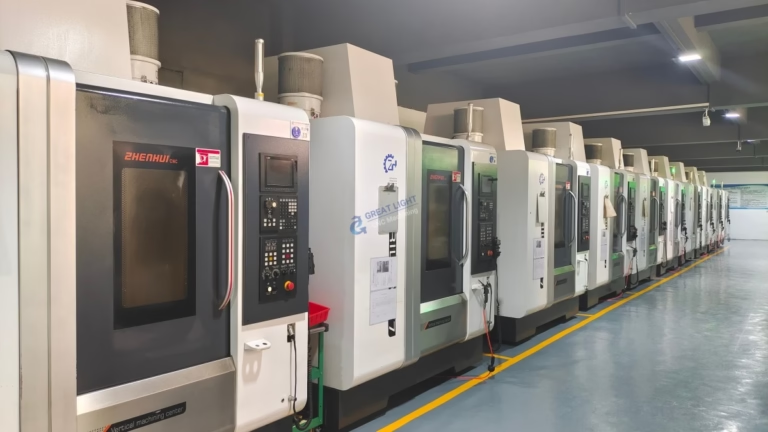
Tolerance comes from the machine, the fixture and the metrology, not the postcode. A shop with 127 high-precision CNC machines, 16 simultaneous 5-axis centers and in-house CMM inspection can hold ±0.005 mm for a Midlands buyer as easily as for a local one.
What you lose is the same-day site visit. What you gain is capacity for large parts and a wider material stock. Many teams keep one local supplier for urgent fixtures and one larger partner for production runs.
What lead time should we plan for?
Plan three numbers: quotation and free DFM analysis within 12 hours, production start within 24 hours after release, and parts shipping in 3–5 days. Add raw material time for titanium, Inconel or special stainless grades.
Historical late-delivery probability below 2% is the benchmark to ask about. If a supplier cannot give a figure, treat the promised date as an estimate rather than a commitment.
Is one prototype really possible with no MOQ?
Yes. No minimum order quantity means a single part can go through the same process as a production run, so the first article tells you something real about the second order.
Expect the unit price to be higher on one part because programming, fixturing and inspection are spread across the quantity. That cost is usually lower than committing to a batch before the design is frozen.
Which materials are stocked and which need ordering?
Aluminium 6061, 6061-T6, 2024, 5052, 5083, 6063, 6082, 7075 and ADC12, stainless 303, 304, 316, 316L, 420, 430, 431, 440C and 17-4PH, steel 1018, 1045, 4130, 4140, 4340, A36 and tool steel, plus copper, brass, titanium TA1, TA2 and TC4, Inconel and magnesium AZ31B and AZ91D.
Plastics include ABS, PC, PMMA, POM, PA, PEEK, PP, HDPE and carbon fibre. Special grades may need a purchase lead time, so flag them early.
How do we keep design data confidential?
Uploads are secure and confidential, and a non-disclosure agreement is available on request. For medical, automotive or defence work, sign the NDA before the first drawing transfer.
ISO 27001:2022 covers information security management, which is the certificate to look for when your customer audits your supply chain.
What does the quote include and what is extra?
The quote should state the machining process, material, finish, inspection level and delivery window. Finishing steps such as anodizing, plating, powder coating or laser marking are usually listed separately because they add handling.
Laser marking has a minimum character height of 1.5 mm. If your part number is smaller than that, say so at quoting stage so the marking method can change.
Send a drawing and get a DFM answer in 12 hours
Upload your model and drawing. We return a price, a lead time and a manufacturability note. No minimum order quantity, NDA on request.
12-hour quote±0.005 mm100% inspectionNo MOQ
More from GreatLight
We publish setup notes, tooling trials and inspection data from the factory floor.











