
CNC Machining Services Quotes: How Engineers Should Compare Them
A quote is a set of assumptions written in numbers. This guide shows which numbers matter on CNC machining services quotes, which ones hide risk, and how to compare two suppliers fairly before you release a PO.
In this article
- 1
- 2
- 3
- 4
- 5
- 6
- 7
- 8
What decides a CNC machining quote
CNC machining services quotes: what to compare line by line
Read the quote as a set of commitments, not a single number. Each row below is a place where two quotes on the same drawing can mean different things.
| Item on the quote | What to look for | Red flag |
|---|---|---|
| Tolerance statement | Value stated per feature, e.g. ±0.005 mm | One blanket tolerance for the whole part |
| Setup and fixturing | Number of setups named | No setup line at all |
| Lead time basis | Days from approved drawing and material | Days from inquiry only |
| MOQ | Prototype to 10,000+ runs accepted | Minimum charge with no tooling credit |
| Inspection scope | 100% inspection, reports on request | 'Samples checked' only |
| Certificates | ISO 9001, IATF 16949, ISO 13485, ISO 27001 | Certificate claimed, scope not given |
| Finishing | Anodize, plating, powder coat, laser mark | Finish quoted as 'standard' |
| Confidentiality | NDA available, secure uploads | CAD sent as plain email attachment |
The short version
Compare quotes on tolerance scope, setup count, lead time basis and inspection, not on the bottom line. If a quote names none of those, it is a placeholder, not a price.
What actually moves the number on CNC machining services quotes
Price on a machined part is built from four things: material, setup, cutting time and inspection. Material is the easiest to see and the least negotiable. A 6061-T6 aluminium bracket and the same bracket in 17-4PH stainless differ by a wide margin before anyone touches a machine. Ask for the material grade in writing, not just 'aluminium' or 'stainless'.
Setup is where most of the surprise lives. A part with features on five faces needs five orientations unless the shop has a machine that reaches them in one clamping. That is the practical difference between a 3-axis quote and a 5-axis quote: not speed, but how many times someone opens the door and re-dials the part.
Cutting time scales with how much metal you remove and how hard the material is. Deep pockets, thin floors and long tools all slow the feed rate down. So does a surface finish callout below Ra 0.8 μm, because that usually means a finishing pass or a separate polishing step. If the drawing says Ra 0.2–0.8 μm over a large area, expect that on the quote.
Inspection closes the loop. A tolerance of ±0.005 mm is not a promise the machine holds it by itself. It means someone measures and records it. Shops that inspect 100% before shipment price that labour in. Shops that do not, price it out. Both numbers are real; only one tells you what you are buying.
Matching tolerance and finish callouts to the real function
Most drawings carry tighter tolerances than the part needs. A mounting hole that locates a bracket needs position accuracy, not a ±0.005 mm diameter. When every dimension is drawn to the same tight band, the shop has two options: quote high, or quote low and hope. Neither helps you.
Sort the callouts by function before you send the RFQ. Bearing bores, sealing faces, mating pilots and shaft journals usually earn the tight band. Clearance holes, cosmetic edges and non-critical depths rarely do. Marking which is which on the drawing is the single fastest way to get a realistic quote.
Surface finish follows the same logic. Ra 1.6–3.2 μm is a normal as-machined result and costs nothing extra. Ra 0.8–1.6 μm is fine machining and needs a controlled finishing pass. Ra 0.2–0.8 μm is a lapping or polishing operation on most geometries, and it applies to specific faces, not the whole part.
Titanium and Inconel change the arithmetic again. TC4 (Ti-6Al-4V) and Inconel cut slowly, heat the tool and work-harden if the feed is wrong. A tolerance that is routine in 6061 can double the cycle time in Inconel. Say which faces are critical so the shop can plan the sequence instead of guessing.
Quantity: where a prototype quote stops being useful
A quote for one part and a quote for 5,000 parts are not the same quote at different volumes. They are different processes. At low volume the part is milled from billet, and the cost is mostly programming and setup. At high volume the same geometry may be die cast or vacuum cast, then machined only on the critical faces.
That is why a supplier who only mills will look expensive at 10,000 pieces, and a supplier who only casts will look slow at 10. Ask what process the price assumes, and ask what happens at the next volume break. A useful quote names the crossover point.
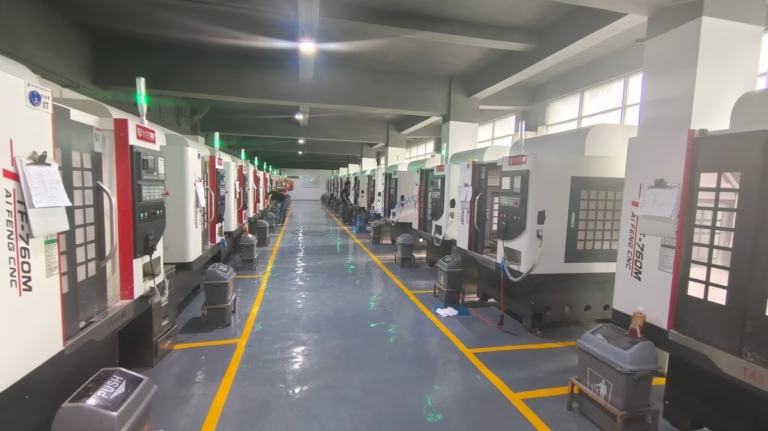
GreatLight runs no minimum order quantity, from one prototype to 10,000+ part runs, and holds 127 high-precision CNC machines across three wholly-owned plants in Dongguan plus a Singapore factory. That mix matters when a program starts at five pieces and ends at a production run: the same shop can carry both ends.
If your volumes are uncertain, submit two quantities in the same RFQ. The gap between them tells you how much of the price is fixed setup and how much is variable. That ratio is more useful than either number alone.
Lead time claims and what to verify behind them
Lead time is the easiest line on a quote to write and the hardest to verify. 'Two weeks' means nothing until you know the clock starts when. From inquiry, from PO, from approved drawing, or from material arrival? Those four starting points can be a week apart on a part that needs a specific bar stock.
Ask for the sequence, not the total. If the quote says quotation and free DFM analysis within 12 hours, production can start within 24 hours, and parts ship in 3–5 days, you can check each stage against your own schedule. A single total hides which stage is the constraint.
Material availability is the usual hidden delay. 7075 aluminium, 17-4PH stainless and Ti-6Al-4V are not always on the shelf in the size you need. If the shop lists material as a separate lead item, that is a good sign. If it does not, ask.
Historical late-delivery probability below 2% is a useful figure only if you know what it counts. Ask how it is measured and over what period. A supplier who can explain the metric is a supplier who tracks it.
Pitfalls that show up three weeks after the quote
The lowest number is often the least informed one. A shop that quotes without reading the tolerance block is not cheaper; it is quoting a different part. The gap appears later as a deviation request or a rejected lot.
Vague certification claims are the second trap. ISO 9001:2015 covers quality management. IATF 16949:2016 covers automotive production. ISO 13485:2016 covers medical devices. ISO 27001:2022 covers information security, which is what protects your CAD files. Each answers a different question. Ask which one applies to the work you are placing.
Watch for a quote that never mentions inspection, fixturing or material source. Those are not optional steps. They are simply unpriced, which means either the shop absorbs them and cuts elsewhere, or you find out at receiving.
One more check: who answers your technical questions? If the reply comes from a sales inbox with no engineering detail, the DFM feedback you were promised probably will not arrive. An engineer who asks about the datum scheme before quoting is a good sign.
How to request CNC machining services quotes that come back comparable
- 1Send a complete 3D model and a 2D drawingSTEP or IGES for geometry, PDF for tolerances, datums and finish callouts. A model alone leaves every tolerance open, and the shop has to assume the tightest one to protect itself.
- 2Mark critical features explicitlyFlag bearing bores, sealing faces and mating pilots. State the tolerance on those faces, for example ±0.005 mm, and let the rest sit at general tolerance. This alone can cut a quote by a visible margin.
- 3State the material grade and temper6061-T6, 304, 17-4PH (SUS630), TC4 (Ti-6Al-4V). Grade changes machinability, finish and price. 'Aluminium' is not a specification.
- 4Give two quantitiesOne prototype quantity and one production quantity, for example 5 and 2,000. The price gap shows the fixed setup cost and the volume crossover.
- 5Name the finish and the faces it applies toClear anodize on all over, hardcoat on the wear face only, laser marking with minimum character height 1.5 mm. Finish scope is a common source of rework.
- 6Ask for DFM feedback with the priceA thin wall, a deep pocket, a sharp internal corner with no tool radius, or a hole too deep for the drill. If the quote comes back with no comments, send it back and ask.
- 7Confirm inspection and documentationState whether you need dimensional reports, material certificates or first article inspection. 100% inspection before shipment and reports on request is a standard starting point.
- 8Put confidentiality in place before you uploadSecure uploads and an NDA on request protect the design. If a supplier cannot sign one, that is a decision point, not a detail.
Questions engineers ask before sending a PO
How fast can I get CNC machining services quotes?
A quotation with free DFM analysis comes back within 12 hours for a complete RFQ: 3D model, 2D drawing with tolerances, material grade, quantity and finish.
Incomplete submissions take longer because the shop has to ask questions first. Sending the tolerance and finish callouts up front is the fastest way to shorten the round trip.
What is the minimum order quantity?
There is no minimum order quantity. Parts run from a single prototype to 10,000+ piece production, and the same shop can carry the program as volumes grow.
For high volumes, casting plus finish machining is often cheaper than milling from billet. Ask for both routes if the quantity is uncertain.
Can you hold ±0.005 mm on every feature?
±0.005 mm is achievable, but applying it to every dimension on a part raises cost and cycle time without adding function.
Send the critical faces at ±0.005 mm and keep general features at a wider band. That gives a lower quote and a more predictable result.
Which materials and finishes are available?
Aluminium 6061, 6061-T6, 2024, 5052, 5083, 6063, 6082, 7075 and ADC12; stainless 303, 304, 316, 316L, 420, 430, 431, 440C and 17-4PH; steel 1018, 1045, 4130, 4140, 4340 and A36; copper and brass including C36000; titanium TA1, TA2, TC4, Inconel and magnesium AZ31B / AZ91D; plastics from ABS and POM to PEEK and carbon fibre.
Finishes include anodizing, electroless nickel, zinc, silver and gold plating, powder coating, black oxide, bead blasting, polishing, and laser marking down to 1.5 mm character height.
How is my design kept confidential?
Uploads are secure and confidential, and an NDA is available on request before any file transfer.
If your program requires it, sign the NDA first and then send the model through the same channel. Do not send CAD as a plain email attachment.
What inspection documentation can I get?
Every order is inspected 100% before shipment, with raw material checks, in-process monitoring and a final inspection.
Dimensional reports, material certificates and first article inspection are available on request. Say which ones you need in the RFQ so they are quoted, not added later.
Send your drawing, get a quote with DFM notes
Upload the model and drawing, and an engineer reviews the tolerances before pricing. Quotation and free DFM analysis come back within 12 hours.
12-hour quoteNo MOQ100% inspectionNDA on request
More machining notes
We publish setup notes, tooling trials and inspection data from the factory floor.











