
CNC Machining Services Rio Rancho NM: A 7-Point Buyer Guide
A selection checklist for engineers and purchasing teams in Rio Rancho who need machined parts built to print. Read it and you can rank suppliers on tolerance, lead time, MOQ, certifications and quoting scope before you send a drawing anywhere.
In this article
- 1
- 2
- 3
- 4
- 5
- 6
- 7
Key takeaways
What to check before you award a machining job
Use the left column as your filter order. Drop any supplier that cannot answer the first three rows.
| Check | What good looks like | Red flag | Why it matters |
|---|---|---|---|
| Tolerance | ±0.005 mm stated with the machine type | One number for every feature | A 5-axis center holds what a 3-axis cannot |
| Inspection | 100% inspection, reports on request | Sample check only | Escape risk lands on your assembly line |
| Lead time | Quote in 12 h, ship in 3–5 days | Vague '2–3 weeks' | Late parts stall your build schedule |
| MOQ | No minimum, 1 to 10,000+ parts | Tooling fee at prototype stage | Kills low-volume and pilot runs |
| Certifications | ISO 9001, IATF 16949, ISO 13485, ISO 27001 | PDF with no scope or expiry | Audit trail for auto, medical, data |
| Finishing | Anodizing, plating, coating in house | Outsourced with no handoff plan | Adds days and hides surface defects |
| Confidentiality | Secure uploads, NDA on request | Drawings sent by plain email | Your IP leaves the building unmanaged |
Pick the supplier that answers the drawing, not the one with the biggest number
Tolerance, inspection and lead time are process facts you can check before you award the job. If a shop cannot explain which machine holds your critical feature, keep looking.
Match the machine to the feature, not the part name
A Rio Rancho design house sends a bracket with three true-position holes, one deep pocket and a cosmetic face. That is not one machining problem. The holes want a 4-axis mill with a rotary table so two faces are cut in one setup. The pocket wants a 3-axis machine with a long reach tool and light radial engagement. The cosmetic face wants a fine finish pass and a bead blast, not a heavier cut at the same stepover.
This is why 'we hold ±0.005 mm' is only half an answer. The number has to attach to a feature, a setup count and a measuring method. A shop that moves a part between three vises will stack three position errors before the cutter touches metal. A shop that cuts five faces in one 5-axis setup has fewer datum shifts to defend.
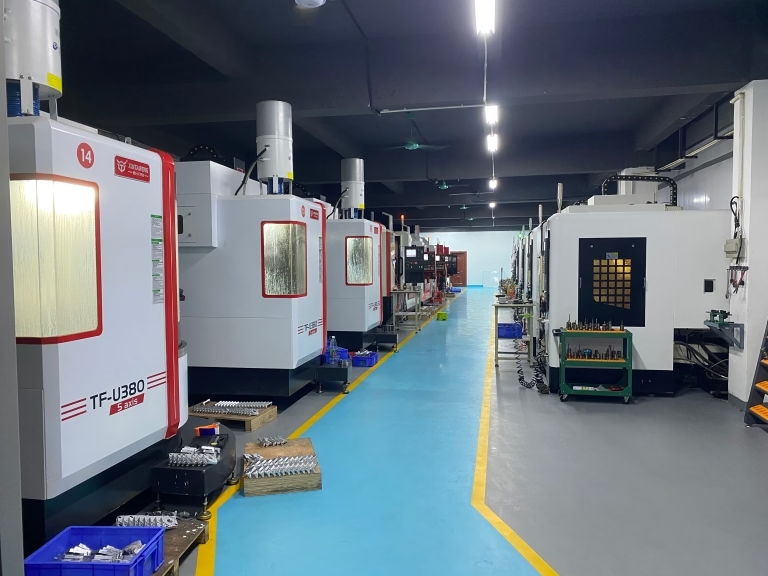
Ask what the machine travels are. GreatLight runs 16 simultaneous 5-axis centers, 12 four-axis mills, 27 three-axis machines and 16 mill-turn centers. Travel envelopes run from 500 × 500 × 450 mm up to 4,000 × 400 × 150 mm, with a Ø400 mm rotary table for round work. If your part is 900 mm long, the compact machines are already out of the conversation.
- 1Count the setupsEach setup adds a datum shift. Fewer setups means a shorter tolerance stack.
- 2Name the critical featureOne or two callouts usually drive the process. Machine the rest to general tolerance.
- 3Check the measuring planA CMM report on the critical feature beats a promise on the whole drawing.
Material choice and surface finish drive cost more than cycle time
Aluminum 6061-T6 cuts fast and holds a good finish, which makes it the default for housings, plates and fixtures. Switch to 7075 and the same part becomes stiffer but more prone to chatter, so the shop needs lighter radial cuts and a rigid setup. Stainless 316L and 17-4PH hold up in medical and marine service but work-harden, which means constant feed and no dwelling in the cut.
Titanium TC4 (Ti-6Al-4V), Inconel and magnesium AZ31B sit at the hard end. They are machinable, but heat management and tool wear change the setup, the fixture and sometimes the machine. If a supplier quotes titanium at the same rate as 6061, the quote is not built on a process plan.
Finishing is the second cost lever. As-machined surfaces land at Ra 1.6–3.2 μm. A high-quality finish runs Ra 0.8–1.6 μm, and a fine finish reaches Ra 0.2–0.8 μm. Anodizing, electroless nickel, powder coating and black oxide all add handling steps, and each one can hide or expose a defect. Spec the finish on the drawing and keep it in the quote line.
- 1Pick the alloy for the load6061 for general work, 7075 for strength, 316L for corrosion, TC4 for weight.
- 2Set finish by functionSealing faces and bearing bores need the tight callout. Cosmetic panels do not.
Lead time, MOQ and the quoting conversation
A supplier that answers in 12 hours with a DFM note is showing you its engineering bench. That note should flag thin walls, deep pockets, tool reach and any feature that will need a second setup. It should also say what the shop needs from you: a STEP file, a 2D drawing with datums, material, finish and quantity.
Production start within 24 hours is realistic when the material is in stock and the drawing is released. Parts ship in 3–5 days on that basis. Treat those numbers as a process description, not a delivery promise. The useful question is what happens when a feature is out of tolerance on the first article: does the shop stop and call you, or ship and explain later?
MOQ is where small hardware teams get squeezed. A tooling fee or a 500-piece minimum kills a 20-piece pilot run. GreatLight quotes from one prototype to 10,000+ part runs with no minimum order quantity, so the first article and the production batch come off the same process.
- 1Send a complete RFQ packSTEP plus a 2D drawing with datums, material, finish and quantity gets a usable quote.
- 2Ask about first-article flowWho signs off, what is measured, and how changes are documented.
- 3Keep one shop for prototype and runProcess continuity removes a second qualification cycle.
Which certificates actually matter for your program
ISO 9001:2015 is the baseline. It says the shop has a documented quality system, calibration records and corrective action. Without it, you are relying on one person's habits rather than a process. IATF 16949:2016 is what automotive and EV buyers ask for, because it adds traceability and change control on top of the baseline.
ISO 13485:2016 applies to medical device work. It is the certificate that tells a regulatory reviewer the shop understands device documentation. ISO 27001:2022 covers information security, which matters when your drawings and CAD data sit on a supplier's server. Four certificates do not make a shop better at cutting metal, but they answer four different audit questions.
Confidentiality is the other filter. Uploads should land in a controlled system, and an NDA should be available before you send a full assembly. Ask where the files live, who can open them, and how long they stay after the job closes.
- 1Check scope and expiryA certificate PDF without a scope or valid dates is a marketing page.
- 2Match the cert to the industryIATF for auto, ISO 13485 for medical, ISO 27001 for data handling.
- 3Paper the NDA earlySign it before the first STEP file moves, not after the PO.
Step by step: shortlist and qualify a machining supplier
Run these in order. Stop at any step where the answer is vague.
- 1Write the feature listList every critical callout, the datum scheme and the measuring method. Mark which two features really drive the part. This one page becomes your scoring sheet.
- 2Send the RFQ packSTEP file, 2D drawing with GD&T, material grade, finish callout and quantity range. Note whether you need material certs and a first-article report.
- 3Time the responseA quotation with DFM feedback inside 12 hours is the benchmark. Read the DFM note first; the price second. The note tells you if the shop read the drawing.
- 4Verify the machinesAsk which machine will run the part and what its travel is. Confirm the shop can reach the 5-axis or mill-turn capacity the geometry needs.
- 5Check the certificatesRequest ISO 9001:2015, and IATF 16949:2016 or ISO 13485:2016 if your industry needs them. Confirm scope and expiry dates.
- 6Agree the inspection planRaw material check, in-process monitoring and final inspection before shipment. Ask for reports on the critical features and for 100% inspection on the run.
- 7Set the change rulesWrite down what happens when a dimension drifts, who approves a deviation, and how revision control works between first article and production.
- 8Place a small first orderStart with the prototype or a low-volume lot, then scale to the full run once the first article passes. No minimum order quantity makes this step cheap to run.
Questions buyers in Rio Rancho ask
Can a supplier in Dongguan serve a Rio Rancho program?
Yes, and the deciding factor is the data flow, not the distance. Quotes come back in 12 hours, production can start within 24 hours and parts ship in 3–5 days once the first article is approved.
The practical setup is a clear RFQ pack, an agreed inspection report and a named engineer on both sides. Shipping and customs are logistics; they are managed with a schedule, not with hope.
What tolerance should I put on the drawing?
Put the tight callout only where the function needs it. GreatLight machines to ±0.005 mm (±0.0002 in) on critical features, but applying that to every dimension raises cost without adding value.
Use general tolerance for non-critical features, and name the two or three features that must be measured and reported.
How do you handle a low-volume or one-off part?
There is no minimum order quantity. A single prototype and a 10,000+ part run use the same quoting path, which means the first article already reflects the production process.
For one-offs, expect the setup and programming to dominate the price. That is normal. The useful comparison is total cost across the pilot plus the run, not the unit price of one piece.
Which materials do you machine most often?
Aluminum 6061-T6, 7075 and 6082 lead the volume, followed by stainless 303, 304, 316L and 17-4PH. Steel grades 1018, 1045, 4140 and 4340 cover most structural parts.
Titanium TA1, TA2 and TC4, Inconel and magnesium AZ31B are available for weight or temperature-driven designs. Plastics include POM, PEEK, PC, ABS and carbon fibre.
How is my design data protected?
Uploads are handled as secure and confidential. ISO 27001:2022 covers the information security system behind that, and an NDA is available on request before files move.
Ask for the NDA at the quoting stage. It costs nothing and removes the awkward conversation later.
What does the quote include?
A usable quote names material, machining, finishing, inspection and packaging as separate lines, plus the lead time and the quantity breaks. Vague single-line pricing hides where the cost sits.
If you need material certificates or a dimensional report, say so in the RFQ. Those items change the price and the schedule.
Send a drawing, get a quote and a DFM note
Quotation and free DFM analysis within 12 hours, production start within 24 hours, parts shipping in 3–5 days. No minimum order quantity, from one prototype to 10,000+ parts.
12-hour quote100% inspectionNo MOQNDA on request
More machining notes
We publish setup notes, tooling trials and inspection data from the factory floor.











