
CNC Plastics Machining Services: How to Pick the Right Shop
Cutting plastic is not cutting aluminum with a different feed rate. Heat moves the part, soft walls deflect, and chips weld to the tool. This guide is for design engineers and sourcing staff who need to judge whether a supplier can actually hold their drawing. You will get the checks that matter, the numbers to ask for, and the jobs that should never be quoted as plastic machining.
In this article
- 1
- 2
- 3
- 4
- 5
- 6
- 7
- 8
Key takeaways
Which plastic suits which job
Match the part to the material before you ask for a price.
| Plastic | Typical use | Machining note | Watch out for |
|---|---|---|---|
| POM (acetal) | Gears, bushings, sliding parts | Cuts clean, holds ±0.005 mm well | Internal stress; anneal before finishing |
| PC (polycarbonate) | Enclosures, guards, lenses | Sharp tools, low feed to avoid melting | Stress cracking near solvents |
| PEEK | Medical and high-temperature parts | Rigid, dimensionally stable when dry | Cost per kg; needs dry stock |
| PA (nylon) | Gears, wear strips, rollers | Machines well but absorbs moisture | Grows 0.2–0.5% after machining |
| PMMA (acrylic) | Optical windows, display covers | Polishes to Ra 0.2–0.8 μm | Chips easily at high feed |
| UHMWPE | Wear pads, liners, guides | Soft, needs light cuts and support | Frays; hard to hold tight tolerance |
| ABS | Housings, brackets, prototypes | Forgiving, good for first articles | Low stiffness; avoid thin ribs |
Pick the shop that questions the drawing
A supplier who quotes your plastic part without asking about heat, moisture and clamping is quoting a shape. The right one pushes back on material and tolerance before cutting.
What CNC plastics machining services should tell you before quoting
A shop that quotes your part without asking about load, temperature and chemical exposure is quoting a shape, not a part. Plastic selection is the first engineering decision, and it changes the price more than any machining parameter. PEEK costs many times more per kilogram than POM, and it machines slower. If the application does not need continuous heat above 150 °C or steam sterilization, POM or PA will usually do the job at a fraction of the cost.
Ask the supplier to justify the material in writing. A useful answer names the service temperature, the chemical it sees, and the wear mode. A weak answer names the color and the cheapest option. We assign material engineers to review the drawing against the stated environment, and we push back when the requested plastic is overkill. That conversation saves money before the first chip is cut.
Moisture is the quiet problem. Nylon and POM absorb water from the air and grow. A PA gear machined to size on a dry day can measure oversize two weeks later. The fix is to condition the stock in the shop environment before the final pass, or to specify a moisture-stable grade. Neither step shows up on a quotation, which is why buyers should ask about it directly.
- 1Ask for the service temperatureContinuous, not peak. Many plastics fail slowly above their rated range.
- 2Ask about chemical contactSolvents and lubricants attack PC and some grades of ABS.
- 3Ask whether stock is conditionedNylon and POM move after machining if it is not.
- 4Ask for a material substitution noteA good shop offers a cheaper equivalent when it exists.
What precision is realistic on plastic parts
Metal buyers carry a habit into plastic work: they write ±0.005 mm on every dimension. On a rigid PEEK block with thick walls, that is achievable. On a 1.5 mm polycarbonate cover, it is not, and chasing it wastes money. The part will move when the vise opens. Thermal expansion alone on a 200 mm PC part is roughly 0.13 mm over a 20 °C shop swing.
The practical rule is to tolerance the features that matter and leave the rest open. Datum faces and bearing bores need tight limits. Cosmetic edges and clearance holes do not. Marking a drawing this way tells the machinist where to spend time. It also prevents a supplier from rejecting a good part because a non-critical slot drifted 0.02 mm.
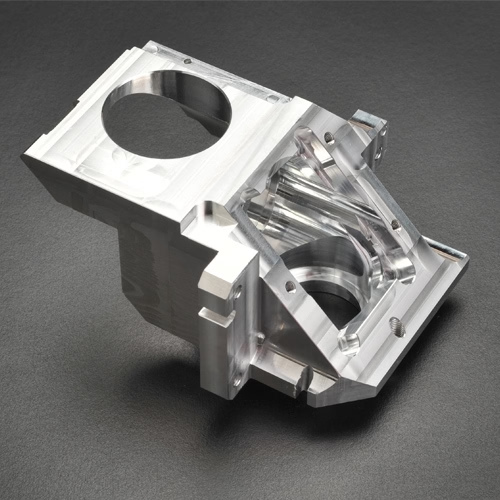
Geometry matters as much as tolerance. Undercuts, curved internal channels and angled ports need multi-axis access. A 3-axis machine can reach them only through extra setups, and each setup adds a locating error. On a plastic part, where clamping pressure already distorts the walls, those errors compound. If your design has features on five faces, quote it on a 5-axis center from the start.
- 1Tight limits on datums onlyBearing bores, sealing faces, mating surfaces.
- 2Open limits elsewhereCosmetic edges and clearance holes rarely need ±0.005 mm.
- 3Count the setupsEach additional setup adds locating error and cost.
- 4Check the wall thicknessBelow 1.5 mm, support the part or expect deflection.
How heat, clamping and chips decide the result
Plastic conducts heat poorly. Friction at the cutting edge stays in the chip and the part instead of flowing into the tool. If the feed is too low, the edge rubs and the surface melts. If the feed is too high, the tool grabs and chips the edge. The window is narrow, and it differs for every grade. Shops that machine a lot of plastic keep parameter sets per material rather than guessing at the machine.
Clamping is the second failure point. A vise tightened to metal standards will bow a plastic wall before the first cut. Light pressure, soft jaws and support underneath are standard practice. Vacuum fixtures work well on flat covers. For thin-walled boxes, we often machine a sacrificial backing plate that the part is bonded to, then release it after the profile is finished.
Chip evacuation gets overlooked. Long stringy chips from POM wrap around the tool and mark the finished surface on the next pass. Air blast beats flood coolant for most plastics because it clears chips without thermal shock. Coolant still has a place on PEEK and other heat-resistant grades where the cut generates more heat than air can carry away.
- 1Air blast over flood coolantMost plastics prefer chip clearing without thermal shock.
- 2Soft jaws and light pressureMetal-grade clamping bows thin plastic walls.
- 3Support under thin floorsBacking plates stop chatter on shallow pockets.
- 4Sharper tools than metal workRubbing, not cutting, is what melts the edge.
Post-processing that plastic parts usually need
Most plastic parts leave the machine with a matte, slightly visible tool path. If the part is internal, that is fine. If it is a front panel or a lens housing, it needs more. Vapor polishing and flame polishing bring PMMA and PC to an optical finish, but both are manual and both can distort thin sections. Bead blasting gives an even matte that hides tool marks and is much cheaper.
Annealing is the step buyers forget. Machining leaves residual stress in the skin of the part. Over weeks, that stress pulls the geometry. A controlled heat cycle after machining relaxes it. PEEK and POM benefit most. The trade-off is time: an annealing cycle adds a day to the schedule, and it can slightly change dimensions, so the final inspection must happen after the cycle, not before.
Marking and assembly follow. Laser marking works on most dark plastics and on light grades with a suitable additive. Minimum character height is 1.5 mm for a clean read. Inserts, threads and bonded joints should be specified on the drawing, because a shop that presses a brass insert into a PC boss without heating the insert will crack the boss.
- 1Bead blasting for an even matteCheapest way to hide tool marks on internal and external faces.
- 2Vapor polishing for clarityPMMA and PC only; risky on thin walls.
- 3Anneal before final inspectionStress relief changes dimensions slightly.
- 4Heat inserts, do not press them coldCold pressing cracks polycarbonate bosses.
How to judge a supplier of CNC plastics machining services
Start with the machines. Plastic parts with features on five faces need 5-axis access. GreatLight runs 16 simultaneous 5-axis machining centers, 12 four-axis mills, 27 three-axis machines and 16 mill-turn centers across three plants, with a maximum processing size of 4,000 mm. That range matters if your program includes both a small connector body and a long structural panel.
Then ask about inspection. A tolerance claim means nothing without a measurement plan. We inspect 100% of parts before shipment and can supply reports covering raw material check, in-process monitoring and final inspection. For medical and automotive work, the certificates that count are ISO 9001:2015, IATF 16949:2016, ISO 13485:2016 and ISO 27001:2022. Ask which one applies to your part, not which ones the shop holds.
Finally, test the commercial terms. No minimum order quantity matters when you are at the prototype stage. Quotation and free DFM analysis within 12 hours matters when the design is still moving. Production start within 24 hours and shipping in 3–5 days matter when the schedule is tight. If a supplier cannot state these numbers plainly, the schedule risk sits with you.
- 1Match machine count to geometryFive-face features need 5-axis, not three setups on a 3-axis mill.
- 2Ask for the inspection planWhat is measured, how often, and reported to whom.
- 3Confirm the relevant certificateISO 13485 for medical, IATF 16949 for automotive.
- 4Get MOQ and lead time in writingVerbal promises do not survive a schedule slip.
Seven steps from drawing to shipped plastic parts
This is the sequence we follow on a typical plastics job.
- 1Send the 3D model and 2D drawingInclude the material, the service environment and any cosmetic callouts. A STEP file plus a PDF drawing is enough to start.
- 2Receive DFM feedback within 12 hoursWe flag wall thickness below 1.5 mm, unsupported floors, sharp internal corners and features that need a fifth axis.
- 3Confirm material and stock conditionNylon and POM are conditioned before the final pass. PEEK is checked for moisture and kept dry.
- 4Fix the setup and clamping planSoft jaws, vacuum fixtures or a sacrificial backing plate. Clamping pressure is set light, and the part is supported under thin floors.
- 5Cut with material-specific parametersFeeds and speeds are taken from per-grade sets, with air blast for chip clearing and coolant only where the cut runs hot.
- 6Anneal and finishStress relief, then bead blasting, polishing or laser marking. Marking characters stay at 1.5 mm minimum height.
- 7Inspect 100% and shipFinal inspection happens after annealing. Reports are available on request. Parts ship in 3–5 days from production start.
Questions buyers ask about plastic machining
Can you machine one prototype and then the production run?
Yes. There is no minimum order quantity, so the same shop can cut one part and later run 10,000 or more. Keeping both stages with one supplier avoids a second setup plan and a second set of tolerances.
The parameters used on the prototype are recorded, so the production parts repeat the same surface finish and dimensions.
Why is my nylon part measuring oversize a week after delivery?
Nylon absorbs moisture from the air and grows, typically 0.2–0.5% depending on grade and section. If the stock was not conditioned before the final pass, the part grows after it leaves the machine.
The fix is to condition the stock in the shop environment first, or to specify a moisture-stable grade. Ask your supplier which approach they used.
Is ±0.005 mm achievable on every plastic feature?
No. It is realistic on rigid sections of PEEK, POM or PC with adequate wall thickness. On thin walls, long unsupported spans and parts that see a wide temperature swing, the part moves after clamping is released.
Give tight limits only to the features that function, such as bearing bores and sealing faces, and leave the rest open.
Do you machine carbon fiber and other filled plastics?
Carbon fiber and glass-filled grades are machinable, but the abrasive filler wears tools quickly and the dust needs extraction. Tool changes are more frequent, which shows up in the price.
Send the exact grade with the filler percentage. A 30% glass-filled PA cuts very differently from unfilled PA.
How do you protect a new plastic part design?
Uploads are secure and confidential. A non-disclosure agreement is available on request before any file is shared.
ISO 27001:2022 covers our information security management, which is the certificate buyers usually ask for on sensitive programs.
What should be on the drawing for a plastic part?
Material and grade, service temperature, chemical contact, critical tolerances, surface finish callouts and any assembly features such as inserts or threads.
Also mark which faces are cosmetic. It tells the machinist where to slow down and where a tool mark is acceptable.
Send your plastic part drawing today
Upload the model and drawing, and you get a quotation with free DFM analysis within 12 hours. No minimum order quantity, from one prototype to 10,000+ parts.
12-hour quote100% inspectionNDA on request
More from GreatLight
We publish setup notes, tooling trials and inspection data from the factory floor.











