
CNC Sub Contract Machining Service: What to Check Before You Award the Job
This guide is for engineers and procurement staff who need to outsource machined parts instead of adding machine time in house. It covers the checks that decide whether a CNC sub contract machining service can hold your tolerance, hit your window and keep your drawings confidential.
In this article
- 1
- 2
- 3
- 4
- 5
- 6
- 7
Key takeaways
What to Verify on a CNC Sub Contract Machining Service
Each row is a claim a supplier can make. The middle column is how you verify it, and the last column says when the claim stops mattering.
| Claim | How to verify | When it matters most |
|---|---|---|
| ±0.005 mm tolerance | Ask for a first-article report with instrument names | Mating bores, bearing seats, seal grooves |
| Ra 0.8–1.6 μm finish | Request a surface roughness trace on the same alloy | Sliding seals and optical mounts |
| Material range | Ask which grades sit in stock, not in a catalog | Titanium, Inconel, PEEK jobs |
| No minimum order | Confirm setup cost is quoted separately | Single prototypes and bridge builds |
| 3–5 day shipping | Ask when the clock starts: PO or drawing release | Line-down recovery |
| ISO 9001 / IATF 16949 | Check the certificate scope covers your process | Automotive and EV programs |
| ISO 13485 / ISO 27001 | Check scope covers machining and data handling | Medical devices, defense drawings |
Why the Machine Mix Decides Whether the Job Is Accepted
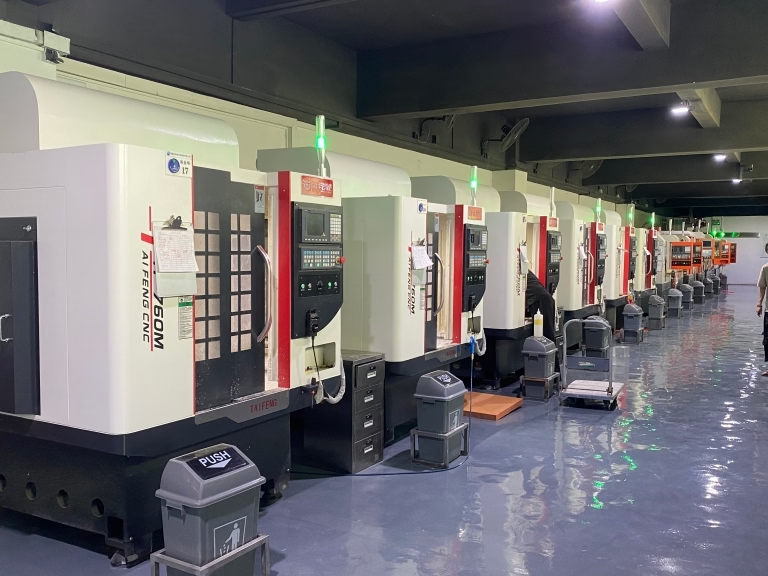
A CNC sub contract machining service is judged on the work it can take without splitting the part across three suppliers. A shop with 5-axis, mill-turn and 3-axis capacity in the same building can move a job between machines when a fixture is awkward or a deadline moves. That flexibility is worth more than a single high-end spindle.
GreatLight runs 127 high-precision CNC machines across three wholly-owned plants: 16 simultaneous 5-axis machining centers, 12 four-axis mills, 27 three-axis machines and 16 mill-turn centers. Maximum processing size is 4,000 mm, with travels of 4,000 × 400 × 150 mm on the large frames and 750 × 1,150 × 550 mm on the medium ones. A Ø400 mm rotary table covers most turned-and-milled work.
The limit is not always the envelope. Thin walls, deep pockets and features on five faces push a part toward 5-axis or mill-turn, because fewer setups means fewer datum shifts. If a supplier quotes a five-face part as three separate 3-axis operations, ask how the datums are transferred. That answer usually predicts the tolerance you will see on the third batch.
Parts that fit a 3-axis envelope and have one or two critical features do not need the expensive route. Sending simple brackets to a 5-axis cell adds cost without adding capability. Match the process to the geometry, not to the machine list.
- 15-axis and mill-turnFewer setups, tighter position between features
- 23-axisRight call for flat parts with one critical face
- 3Large framesUp to 4,000 mm for long bases and rails
- 4Rotary tableØ400 mm for turned features with milled flats
Material Range and What It Costs You in Lead Time
Aluminium and stainless are the easy part. Grades like 6061, 7075, 304, 316L and 17-4PH sit in most subcontract shops, and the machining parameters are well understood. Where a supplier separates itself is in the less common alloys: TC4 (Ti-6Al-4V), Inconel, magnesium AZ31B and AZ91D, plus engineering plastics such as PEEK and carbon fibre.
Titanium and Inconel cut slowly. Tool wear is high, coolant strategy matters, and a shop without prior data will burn cutters learning your part. Ask how many jobs of that alloy they ran in the last year. A vague answer is a schedule risk, not a quality risk.
Plastics behave differently again. POM and PA move after machining, so a shop that measures straight off the machine will ship parts that fail inspection a day later. For PEEK and carbon fibre, ask about stress relief and whether they finish to final dimension after a stabilization pause.
Mixed-material assemblies are the common trap. If a housing is 6061 and the insert is 316L, thermal expansion during a tight-bore fit can close the clearance. Tell the supplier the assembly temperature, not just the drawing tolerance.
- 1Common grades6061, 7075, 304, 316L, 17-4PH, 4140
- 2Hard alloysTC4, Inconel, magnesium AZ31B and AZ91D
- 3PlasticsPOM, PA, PEEK, carbon fibre need stabilization
- 4Mixed assembliesState the service temperature, not only the tolerance
Inspection, Certifications and the Paper Trail
Anyone can print a tolerance on a quotation. The question is what happens on part 400. Look for a process that checks raw material on arrival, monitors dimensions during the run, and inspects before shipment. A 100% inspection before shipment with reports on request is a reasonable baseline for subcontract work, and it is what we run on every order.
Certifications answer narrow questions. ISO 9001:2015 covers a general quality system. IATF 16949:2016 is what automotive and EV programs expect. ISO 13485:2016 applies to medical devices. ISO 27001:2022 covers how your drawings and data are handled, which matters if the part is defense-adjacent or still under patent review.
Ask for the certificate scope, not just the certificate number. A valid ISO 13485 certificate that excludes machining does not help a machined implant housing. The same applies to IATF: check that the site doing your work is inside the audited scope.
A qualification rate is only useful with a definition. Ours is 99.99% against the drawing, measured on the final inspection step. If a supplier quotes a number with no definition, treat it as marketing and ask for the last three months of first-pass yield instead.
- 1Raw material checkGrade and condition verified before the first cut
- 2In-process monitoringDimensions checked as the batch runs
- 3Final inspection100% before shipment, reports on request
- 4Scope checkCertificate must cover the process and the site
MOQ, Quoting and Confidentiality Terms
No minimum order quantity is the norm for subcontract machining, but the setup cost does not disappear when the lot is one piece. A transparent quote separates programming, fixturing, material and run time, so you can see what a second piece actually costs. If a quote gives one lump number, ask for the breakdown before you compare it with another shop.
Quoting speed tells you something about the shop's process. A quotation and free DFM analysis within 12 hours means drawings are reviewed by someone who machines parts, not a queue. Production can start within 24 hours after that, and parts ship in 3–5 days for standard work.
Confidentiality is a commercial term, not a promise. Uploads should be handled as secure and confidential, and an NDA should be available on request when your drawings carry unannounced features. Get the NDA signed before the DFM review, not after the quote.
Watch for quotes that hide material markup in the run time, or that price a fixture as a one-off charge but reuse it for the next order. Both are normal, but only one is fair to a repeat buyer.
- 1Ask for the breakdownProgramming, fixturing, material, run time
- 212-hour quoteIncludes free DFM analysis on your drawings
- 3NDA before DFMSign first if the design is not public
- 4Fixture ownershipConfirm whether it is billed once or reused
How to Qualify a Subcontract Partner in 6 Steps
Run these in order. Each step can eliminate a supplier before you spend engineering time on samples.
- 1Send a real drawing, not a simplified oneInclude GD&T, material condition, finish callouts and the assembly context. A supplier who quotes a cleaned-up drawing will quote a different part than the one you need.
- 2Read the DFM notes before the priceGood feedback names specific features: a 0.5 mm floor on a 12 mm deep pocket, or a thread too close to a wall. Generic notes mean nobody looked.
- 3Check the certificate scopeMatch ISO 9001, IATF 16949, ISO 13485 or ISO 27001 to your industry, and confirm the machining site is inside the audited scope.
- 4Ask which machine will run the jobGet the machine type and the number of setups. Three setups on a five-face part is a warning; mill-turn or 5-axis is the fix.
- 5Order a small lot firstTwo to five parts exposes fixturing, first-article discipline and finish quality without committing to a full run.
- 6Compare the second delivery, not the firstThe first batch gets extra attention everywhere. Check dimension drift and finish consistency on the repeat order.
Questions Buyers Ask Before Awarding Work
What tolerance can a CNC sub contract machining service actually hold?
±0.005 mm (±0.0002 in) is achievable on rigid setups with temperature control and a first-article check. It is not a blanket number for every feature on every alloy.
On thin walls, long bores and titanium parts, expect the practical limit to loosen. Send the drawing and we will say which features can hold the tight callout and which cannot.
How fast can parts ship after I approve the quote?
Quotation and free DFM analysis come back within 12 hours. Production can start within 24 hours after approval, and standard parts ship in 3–5 days.
That window assumes material is in stock and the drawing is frozen. A late engineering change restarts the setup, so freeze the revision before you release the PO.
Is there a minimum order quantity?
No minimum order quantity. We run from one prototype to 10,000+ part runs.
Setup, programming and fixturing are quoted as separate lines, so a single piece is priced honestly instead of being hidden in a high unit rate.
How do you protect our drawings and IP?
Uploads are secure and confidential, and an NDA is available on request. ISO 27001:2022 covers how design data is handled internally.
If the design is not public, sign the NDA before the DFM review so the feedback loop itself stays covered.
Which materials and finishes can be handled in one order?
Aluminium 6061, 7075, 2024 and 6082; stainless 303, 304, 316L and 17-4PH; steel 4140 and 4340; titanium TC4; Inconel; and plastics including POM, PEEK and carbon fibre.
Finishing covers anodizing, electroless nickel, zinc, silver and gold plating, powder coating, black oxide, bead blasting, polishing and laser marking with a minimum character height of 1.5 mm.
What happens if a batch fails inspection?
We inspect 100% before shipment and hold the batch rather than ship marginal parts. Reports are available on request.
If a feature drifts outside the drawing, the fix is a corrected setup or a re-cut, and the decision is made by the engineer who ran the job, not by a scheduler.
Send the Drawing, Get a Quote in 12 Hours
Upload your files and an engineer returns pricing plus free DFM analysis within 12 hours. No minimum order quantity, uploads kept confidential.
12-hour quoteNo minimum order100% inspectionNDA on request
More From the Shop Floor
We publish setup notes, tooling trials and inspection data from the factory floor.











