
Coil Feed CNC Machining Service: How to Choose Right
A coil feed CNC machining service runs bar stock or coiled wire through a feeder into a lathe, so small turned parts come off the spindle without manual reloading. This guide is for engineers and buyers comparing suppliers. By the end you will know which parts fit this process, which checks decide the quote, and where the hidden cost sits.
In this article
- 1
- 2
- 3
- 4
- 5
- 6
- 7
- 8
What decides the choice
Coil feed vs bar feed vs cam machine
Pick the row that matches your annual volume and part shape.
| Method | Best volume | Changeover | Where it fails |
|---|---|---|---|
| Coil feed + CNC lathe | 1,000–100,000 parts | Minutes, program swap | Heavy or long shafts |
| Bar feeder + CNC lathe | 200–50,000 parts | Minutes, guide bushing | Wide diameter spread |
| Cam automatic | 200,000+ parts | Hours to days | Design changes mid-run |
| Chucker lathe | 1–500 parts | Quick, soft jaws | Cost per part at volume |
| Swiss-type lathe | Ø1–Ø20 mm long parts | Guide bushing swap | Short stout parts |
| Bar + mill-turn | Complex turned parts | Program and tooling | Simple round parts |
How a coil feed CNC machining service actually runs
Coiled wire or bar is pulled through straightening rollers into the spindle, and a servo or hydraulic feed pushes a fixed length past the collet for each cycle. The lathe then cuts, parts off, and the feed advances again. No operator opens a door between parts. That single fact drives everything else: cycle time drops, and the per-part labor that dominates low-volume turning disappears.
The feeder holds a bar length that ends in a remnant. A 3 m bar on a 40 mm part gives roughly 70 parts and one 200–300 mm remnant. On long runs the remnant is a rounding error; on a 500-part order it is real material cost. Ask the supplier how they account for remnants in the quote, because the answer changes the unit price by a few percent.
Straightness and surface condition of the incoming bar matter more than most buyers expect. Bent bar whips in the guide channel, and the cut length drifts. Cold-drawn or ground bar holds length tolerance better than hot-rolled. If your drawing allows a ground bar, say so on the RFQ. It removes an argument later.
Feeding also sets a floor on part geometry. The part must be turned from a diameter that the collet can grip, and the feeder needs enough bar to push through the guide bushing. Very short, very fat parts, or parts with a large head on a thin shank, fight the process. Those usually go to a chucker or a mill-turn center instead.
- 1Remnant is real costOn runs under 2,000 parts, ask for the remnant length in the quote.
- 2Bar quality shows in length toleranceGround or cold-drawn bar holds cut length better than hot-rolled.
- 3Not every part fitsShort stout parts and large heads on thin shanks belong on a chucker.
Which parts belong on a coil feed machine
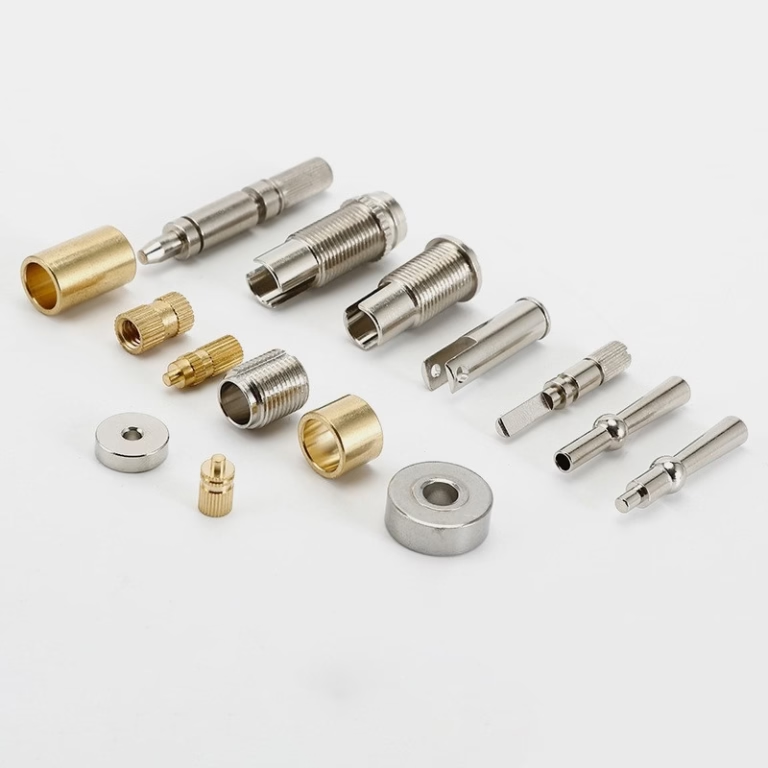
The process suits parts that are longer than they are wide, or at least not much wider. Pins, spacers, bushings, threaded studs, connector bodies, sensor housings, and small shafts are the classic work. A part with a 6:1 length-to-diameter ratio and a few turned features is close to ideal. The bar does the work; the tool only removes what the feature needs.
Parts with a single dominant diameter and light secondary features are cheap. Parts with deep cross-holes, milled flats, or off-axis slots need live tooling or a second operation. That is not a dealbreaker, but it changes the machine and the price. On a mill-turn center, one setup can finish a part that would otherwise need two fixtures.
Titanium, 17-4PH, and Inconel turn fine on a bar feeder, but tool life and cycle time move. On Ti-6Al-4V, expect lower surface speed and more attention to coolant through the tool. On 303 stainless, the material is free-cutting and the process is nearly transparent. Material choice is a cost lever, and it is fair to ask whether a 304 part can be quoted in 303 for a prototype.
Where the process loses is small quantities of very large parts, or parts that need heavy milling. A 4,000 mm travel machine can handle long work, but feeding a 4,000 mm bar is a different problem. For those jobs, the supplier should say so and route the work to a 3-axis or 5-axis mill instead of quoting a coil feed line that will not run it well.
- 1Good fitPins, spacers, bushings, studs, connector bodies, small shafts.
- 2Needs live toolingCross-holes, flats, and off-axis slots on a mill-turn center.
- 3Poor fitShort stout parts, large heads on thin shanks, heavy milling.
Judging a supplier: five things that change the price
Bar capacity is the first number to check. A shop that tops out at Ø20 mm cannot quote your Ø35 mm part no matter how good the price looks. Here the bar range runs from Ø2 mm to Ø42 mm, and the guide bushing and collet set change with it. Ask for the diameter range in writing, not a verbal yes.
Tolerance is the second. A ±0.005 mm claim is only meaningful when it is tied to a feature and a length. On a short, stiff part, it is routine. On a 200 mm slender shaft, thermal drift and tool push-off make it hard. A good supplier will tell you which dimensions hold and which need a second op, rather than promising the whole drawing.
Certification is the third. If your end customer is in automotive, IATF 16949:2016 is usually mandatory. Medical work often needs ISO 13485:2016. Aerospace and defense buyers ask about ISO 9001:2015 and traceability. ISO 27001:2022 matters when you send CAD files across borders. A supplier without the right certificate cannot be qualified, whatever the price.
Lead time and MOQ are the fourth and fifth. A shop that quotes 12 hours for a quote and free DFM feedback, starts production in 24 hours, and ships in 3–5 days is set up for fast turns. No minimum order quantity matters for prototypes. But confirm what happens on a 10,000-part run: the same shop needs the bar in stock, which is a scheduling question, not a promise.
- 1Bar rangeØ2–Ø42 mm here. Get it in writing before you send drawings.
- 2Tolerance by featureTie ±0.005 mm to a specific dimension and length.
- 3CertificatesIATF 16949, ISO 13485, ISO 9001, ISO 27001 — match to your industry.
- 4Lead time and MOQ12-hour quote, 24-hour start, 3–5 day ship, no MOQ.
Where coil feed quotes go wrong
The most common mistake is quoting only the cycle time. Bar remnant, guide bushings, first-article inspection, and deburr all add cost, and they are invisible until the invoice. Ask for a line-item quote that separates material, machining, finishing, and inspection. A single lump sum hides the levers you can pull.
The second trap is assuming the second operation is free. A part that needs a milled flat or a cross-hole leaves the lathe for a second setup, and that setup has its own fixture, its own inspection, and its own queue time. If your drawing has a feature that cannot be turned, expect a second line on the quote.
The third trap is surface finish. As-machined turning sits around Ra 1.6–3.2 μm, which is fine for most functional parts. A sealing face or a bearing seat may need Ra 0.8–1.6 μm, and a polished or lapped surface may need Ra 0.2–0.8 μm. Each step adds a pass, and passing a part back through the machine for a finish is more expensive than hitting it in the first cycle.
The fourth trap is material substitution without a note. A shop that quotes 303 instead of 304 to save money is making a decision that belongs to you. It may be a good decision for a prototype. It is not a good decision if the part sees chlorides in service. Insist that any substitution is flagged in writing and approved before the bar is cut.
- 1Ask for line itemsMaterial, machining, finishing, inspection — separately.
- 2Count the second opMilled flats and cross-holes add a setup, a fixture, and queue time.
- 3Finish is a passRa 1.6–3.2 μm as-machined; finer finishes cost extra passes.
What to check before you release the run
Ask how parts are inspected. A supplier that inspects 100% before shipment and can produce raw material certificates, in-process records, and a final inspection report is easier to qualify than one that ships on trust. Reports on request should mean a real document, not a verbal confirmation.
Ask for the first-article process. On a new part, a first article with a full dimensional report catches a setup error before it becomes 5,000 scrap parts. If the supplier skips the first article on a tight-tolerance feature, that is a warning sign, not a shortcut.
Ask about the material certificate. For medical, aerospace, and automotive work, the heat lot number connects the finished part to the mill certificate. Without that link, a quality escape is hard to contain. If the supplier cannot trace the bar back to a lot, the certification on the wall does not help you.
Finally, ask about confidentiality. Uploads should be secure, and a non-disclosure agreement should be available on request. If your drawings carry export-controlled geometry or a customer's unreleased design, the paperwork has to exist before the files move.
- 1100% inspectionRaw material, in-process, and final reports on request.
- 2First articleA full dimensional report before the run starts.
- 3Lot traceabilityHeat lot number linked to the mill certificate.
- 4NDA on requestSecure uploads; paperwork before files move.
How to qualify a coil feed supplier in 6 steps
Run these in order. Each step disqualifies some shops before you spend time on samples.
- 11. Match bar capacity to your partSend the largest and smallest turned diameter. Confirm the shop covers both. A Ø2–Ø42 mm range covers most small turned work; if your part is outside it, stop here.
- 22. Confirm the tolerance by featureMark the tight dimensions on the drawing and ask which ones hold at ±0.005 mm. Expect a feature-by-feature answer. A blanket yes is a red flag on long slender parts.
- 33. Check certificates against your industryAutomotive: IATF 16949:2016. Medical: ISO 13485:2016. General quality: ISO 9001:2015. Data handling: ISO 27001:2022. Ask for the certificate number and scope.
- 44. Ask for a line-item quoteMaterial, machining, finishing, inspection, and remnant handling as separate lines. Compare two suppliers on the same lines, not on the bottom number.
- 55. Order a first article before the runOne part, full dimensional report, before the bar is cut for production. Budget 3–5 days. Fix the setup now, not after 5,000 parts.
- 66. Set the finish and deburr spec in writingState Ra in μm and name the edges that must be broken. As-machined is Ra 1.6–3.2 μm; a sealing face may need Ra 0.8–1.6 μm.
Questions buyers ask before the first run
Is a coil feed machine the same as a bar feeder?
Not quite. A bar feeder pushes rigid bar stock; a coil feed system pulls from a coil of wire or coiled bar through a straightener. Coil feeding suits smaller diameters and longer uninterrupted runs, because a coil holds far more material than a 3 m bar.
On a CNC lathe the practical difference is run time between reloads and how much the material straightens before it reaches the collet. For Ø2–Ø42 mm turned parts, both setups are common.
What is the minimum order quantity?
There is no minimum order quantity here, so a single prototype and a 10,000-part run both get quoted. That does not mean a one-off is cheap per part — setup and first article are spread over fewer pieces.
If you are prototyping, ask for the first-article cost separately so you can see what disappears at volume.
How tight a tolerance can a coil feed line hold?
±0.005 mm is achievable on stable features with short overhangs and consistent bar. Length tolerance depends on the feed stop and bar straightness, and diameter tolerance depends on tool wear and thermal drift.
On long slender parts, expect to negotiate which dimensions carry the tight tolerance rather than assuming the whole drawing does.
Which materials run well on this process?
Free-cutting stainless such as 303, aluminium 6061 and 2024, brass C36000, and 1018 or 1045 steel all run cleanly. Titanium TA2 and TC4, 17-4PH, and Inconel are also machined here, with lower surface speeds and more tool wear.
If a part is specified in 304 and does not see chlorides, 303 is often a cheaper prototype substitute — but that change has to be approved in writing.
What lead time should I expect?
Quotation and free DFM analysis come back within 12 hours. Production can start within 24 hours after approval, and parts ship in 3–5 days. The historical late-delivery rate is below 2%.
These are shop figures, not a delivery guarantee. Complex parts, special bar, or a multi-step finish will take longer, and a good supplier will say so at quote time.
Can you handle secondary operations and finishing?
Yes. Milling, cross-drilling, threading, and assembly are handled in-house, along with anodizing, plating, powder coating, black oxide, bead blasting, polishing, and laser marking with a minimum character height of 1.5 mm.
Keeping post-processing in-house shortens the queue and keeps one inspection record for the finished part.
Send drawings, get a coil feed quote in 12 hours
Upload your CAD and we return a line-item quote with free DFM feedback. No minimum order quantity, 100% inspection before shipment.
12-hour quoteNo MOQ100% inspection
More from the shop floor
We publish setup notes, tooling trials and inspection data from the factory floor.











