
Copper CNC Machining Services
This guide is for engineers and buyers sourcing copper and copper alloy parts. It covers alloy selection, achievable tolerance, tool wear, inspection limits and the questions to ask before you place a purchase order.
In this article
- 1
- 2
- 3
- 4
- 5
- 6
- 7
- 8
Key takeaways
What to check before you send a copper RFQ
Read each row as a question you want answered in writing
| Check | Weak answer | Strong answer |
|---|---|---|
| Alloy grade | "Copper" only | C101, C110 or C36000 named with temper |
| Tolerance | "precision" | ±0.005 mm stated per feature |
| Thin-wall plan | Not mentioned | Support plan and stress-relief step given |
| Tool wear | Not mentioned | Tool change interval and coated grades listed |
| Inspection | Visual only | 100% inspection with reports on request |
| Lead time | Open-ended | Quote in 12 hours, parts in 3–5 days |
| Minimum order | 5,000 pieces | No minimum order quantity |
Pick the copper alloy before you talk about machining
Most RFQs start with a drawing and a vague material callout. That is where copper jobs go wrong first. Copper is not one material. C101 and C110 are oxygen-free and tough-pitch grades with high conductivity, and they machine with long, stringy chips that wrap around the tool. C36000 free-cutting brass breaks chips into short pieces and holds tight tolerance with far less fuss. The alloy decides your feed rate, your surface finish and your scrap rate.
Tell the shop what the part actually does. A busbar cares about conductivity and cross-section, not about Ra 0.2 μm. A waveguide or a vacuum chamber part cares about surface finish and internal geometry, and the alloy choice follows that. A connector pin cares about plating adhesion and dimensional repeatability across thousands of pieces.
If you only need the shape and not the conductivity, say so. Shops can often propose C36000 or a leaded grade that machines faster and costs less, and you keep the function you need. If conductivity is a hard requirement, lock the grade and accept the slower cutting parameters that come with it.
One more note on grades. Beryllium copper machines well but the dust is a health matter, so the shop needs the right handling and the lead time reflects it. Tell the shop early if beryllium copper is in the mix.
Tolerance, heat and tool wear in copper CNC machining services
Copper conducts heat about eight times better than steel. That sounds helpful, and in one way it is: heat leaves the cutting zone through the chip and the workpiece instead of sitting in the tool edge. The downside is that the workpiece itself changes size as it warms and cools. A part measured hot can be out of tolerance when it reaches room temperature. Shops that run copper all day measure after the part has settled, not straight off the machine.
Copper is also soft and gummy. It galls, which means material welds onto the cutting edge and tears the surface on the next pass. The fix is not one setting. It is a combination of sharp uncoated or diamond-coated tooling, high positive rake, generous coolant and a feed rate high enough to keep the edge biting instead of rubbing.
Thin walls are the second trap. A 0.5 mm wall in C110 will deflect under normal clamping pressure and spring back after the vise opens. Rough the part, let it rest, then finish with light passes and low clamping force. On thin discs and rings, a sacrificial support or a soft jaw set pays for itself.
Tool wear shows up as a slow drift in size, not a sudden failure. On a 10,000 piece run, the shop should track the first-off, the mid-run part and the last part. If the size drifts more than a third of the tolerance band, the tool needs changing before the next batch. Ask how they track it. A shop with no answer is a shop that will ship you a mixed lot.
How to inspect copper parts without guessing
Copper is reflective and soft. Optical comparators and vision systems can struggle with a bright surface, and a touch probe can leave a small mark on a polished face. Neither problem is fatal, but the inspection plan has to match the part.
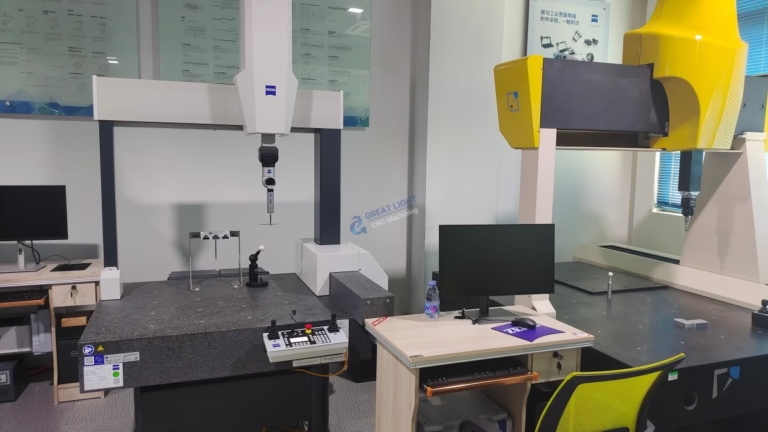
For most parts, a calibrated micrometer and a CMM with a light touch program are enough. For high-conductivity grades, eddy current or four-point probe checks confirm the material property, not just the shape. For plated parts, measure before plating as well as after, because plating adds thickness on every surface.
Ask for the inspection report with the first article, not after a problem. A first article report that lists the drawing dimensions, the measured values and the gauge used tells you more about a supplier than any brochure. GreatLight runs raw material checks, in-process monitoring and a final inspection before shipment, with reports on request.
If a feature cannot be measured with the equipment on hand, say so at quote stage. The shop can often propose a functional gauge or a change to the drawing that makes the feature checkable. Finding this out after the parts ship is expensive for both sides.
Machine capacity and part size limits
Copper parts range from a 2 mm connector pin to a 4,000 mm busbar. Not every shop can cover both ends, and the machine list tells you which end a shop really works in.
GreatLight runs 127 high-precision CNC machines across three wholly-owned plants, with 16 simultaneous 5-axis machining centers, 12 four-axis mills, 27 three-axis machines and 16 mill-turn centers. Maximum processing size reaches 4,000 mm, with a Ø400 mm rotary table for round work. That range covers long busbars, heat sinks and manifolds as well as small connector bodies.
The plant area is 7,600 m² and the team is 150 technicians. For copper specifically, the useful question is how many machines are set up for gummy, high-conductivity material at any given time. Ask it. A shop that runs copper once a month will fight the same tool wear problems you would.
Location matters for logistics. GreatLight operates from Dongguan, China and a Singapore factory at No.3 Joo Koon Circle, Singapore 629032. If your assembly line is in Southeast Asia, the Singapore site can shorten the shipping leg.
Lead time, MOQ and what the quote should include
Copper stock is not always on the shelf. C101 and C110 plate and bar are common, but a specific temper or a beryllium copper grade may need to be ordered in. That is a material lead time, not a machining lead time, and it should be listed separately in the quote.
On the machining side, GreatLight issues a quotation and free DFM analysis within 12 hours, production can start within 24 hours, and parts ship in 3–5 days. Historical late-delivery probability is below 2%. Those numbers apply to the shop schedule, not to material that has to be milled to order.
MOQ is the other term that separates shops. There is no minimum order quantity here, so one prototype and a 10,000+ part run both go through the same process. For a copper prototype, that means you can check fit and conductivity before committing to a production run.
Confidentiality is part of the commercial package. Uploads are secure and confidential, and an NDA is available on request. If your copper part sits inside a product that has not launched, put the NDA in place before you send the model.
Step by step: how a copper part moves through the shop
- 11. Review the drawing and the functionSend the 3D model, the 2D drawing and a one-line note on what the part does. Flag conductivity, plating and any cosmetic surface. Expect DFM feedback within 12 hours.
- 22. Lock the alloy and temperName the grade, for example C101, C110 or C36000, plus temper. If you are unsure, ask for a recommendation and state which properties are fixed and which can move.
- 33. Set the tolerance per featureDo not put ±0.005 mm on every dimension. Apply tight tolerance only where it matters. This alone cuts cycle time and scrap on copper.
- 44. Plan the thin-wall strategyFor walls under 1 mm, expect roughing, a rest period, then light finishing passes with reduced clamping force and a support or soft jaws.
- 55. Choose tooling and coolantSharp high-rake cutters, uncoated or diamond-coated, with high-pressure coolant. Keep feed per tooth high enough to avoid rubbing and built-up edge.
- 66. Inspect at first article and mid-runMeasure the first part, a mid-run part and the last part. Check size drift against one third of the tolerance band and change tools before it is exceeded.
- 77. Finish and documentConfirm the finish callout (Ra 1.6–3.2 μm as machined, Ra 0.8–1.6 μm on request) and the plating spec. Ask for the inspection report with shipment.
Questions buyers ask about copper machining
Can you hold ±0.005 mm on copper parts?
Yes, on features that support it. Rigid geometry, stable alloy grade and a finishing pass after the part has cooled can all hold ±0.005 mm (±0.0002 in).
Long slender parts, very thin walls and parts with no natural datums are harder. For those, expect a wider band or a design change that adds stiffness. Tell us which dimensions are critical and we will quote to that, not to a blanket tolerance.
Which copper grades do you machine most?
C101, C103, C110 and beryllium copper, plus the brass grades C27400, C28000 and C36000. The free-cutting brasses run fastest and hold the tightest size over long runs.
If conductivity is the main requirement, C101 or C110 is usually the right call. If you need machinability and corrosion resistance more than conductivity, C36000 is often the better economic choice.
How does copper tool wear compare with aluminum?
Copper is softer than aluminum but gummier. Built-up edge and galling appear faster, especially on C110, so tool life is usually shorter than on 6061 aluminum at the same feed.
Coated or diamond-coated tooling and high-pressure coolant extend the interval. On long runs we track size drift and change tools before it reaches one third of the tolerance band.
Do you offer copper surface finishes?
Yes. Options include electroless nickel, silver and gold plating, bead blasting, tumbling, brushing and polishing, plus laser marking with a minimum character height of 1.5 mm.
For parts that carry current, conductive anodizing is not applicable to copper, so plating or a bare machined surface is the usual route. Confirm the contact resistance requirement before choosing a finish.
What is the minimum order quantity for copper parts?
There is no minimum order quantity. One prototype and a 10,000+ part run both fit the same workflow.
For a first article, send the model and drawing with a note on the function. We return a quotation and free DFM analysis within 12 hours, and production can start within 24 hours.
How do you keep copper designs confidential?
Uploads are secure and confidential, and an NDA is available on request. We can sign your document or provide ours.
Certification coverage includes ISO 9001:2015, IATF 16949:2016, ISO 13485:2016 and ISO 27001:2022, which covers information security as well as quality.
Send your copper part for a 12-hour quote
Upload the model and drawing, tell us which dimensions are critical, and we will return a quotation with free DFM analysis.
12-hour quote100% inspectionNo minimum order quantity
More from GreatLight
We publish setup notes, tooling trials and inspection data from the factory floor.











