
Direct CNC Machining Services: A Complete Buyer Guide
This guide is written for engineers and procurement staff choosing a direct CNC machining supplier. It covers the checks that decide whether a shop can hold your tolerance, handle your part size, and ship on schedule.
In this article
- 1
- 2
- 3
- 4
- 5
- 6
- 7
- 8
- 9
- 10
What matters before you send a PO
Which machining route fits your part
Match the part geometry and volume to the machine class before you ask for price.
| Part situation | Best machine class | Why it fits | Watch out for |
|---|---|---|---|
| 6 faces, tight true position | Simultaneous 5-axis | One setup holds all faces | Fixture access can limit reach |
| Shaft with flats and holes | Mill-turn | Turning and milling in one cycle | Long shafts need a steady rest |
| Flat plate, loose tolerance | 3-axis | Lowest cost per hour | Second setup adds stack error |
| Pocketed housing, 4 sides | 4-axis with rotary table | Indexing beats refixturing | Deep pockets need long reach tools |
| Part over 750 mm long | Large-travel 5-axis | Travel up to 4,000 mm | Few shops have this capacity |
| One prototype, tight deadline | Direct shop, no MOQ | No tooling, no minimum | Ask for the DFM note first |
| 10,000+ identical parts | CNC + finishing in house | Cycle time and finish control | Outsourced anodizing adds days |
The short version
If your part needs one setup across six faces, a tight true position, or a run that starts at one piece, a direct shop with 5-axis capacity and no MOQ is the safer route. If the tolerance is loose and the geometry is flat, a 3-axis quote will cost less.
Tolerance: what ±0.005 mm actually requires
A tolerance callout is not a wish. It is a statement about the machine, the material, and the setup. ±0.005 mm (±0.0002 in) is achievable on aluminum and brass with a light finish pass and a stable fixture. On titanium or Inconel the same number becomes a thermal problem: the tool heats, the part grows, and the last 0.01 mm drifts.
Ask which machine class will run your part. A simultaneous 5-axis center holds position across faces in one setup. A 3-axis machine can hit the same tolerance on a single face, but every refixture adds stack error. If your drawing has a true position callout across two faces, the setup plan matters more than the spindle.
Surface finish and tolerance are linked. A Ra 0.2–0.8 μm finish usually follows a finishing pass with a small stepover, which costs cycle time. If your print says Ra 0.8–1.6 μm, say so early. Shops that quote a generic finish and then chase it after inspection are the ones that miss dates.
- 1Material changes the numberAluminum and brass hold ±0.005 mm more easily than titanium or stainless.
- 2Setup count is a tolerance costEach refixture adds error. One 5-axis setup beats three 3-axis setups.
- 3Finish is not freeRa 0.2–0.8 μm adds pass time; Ra 1.6–3.2 μm is the as-machined default.
Part size and machine travel
Most quotes fail at the size check. A shop with 500 × 500 × 450 mm travel cannot run a 900 mm housing no matter how good the drawing looks. Ask for the travel envelope before you send the file. It saves a week of back and forth.
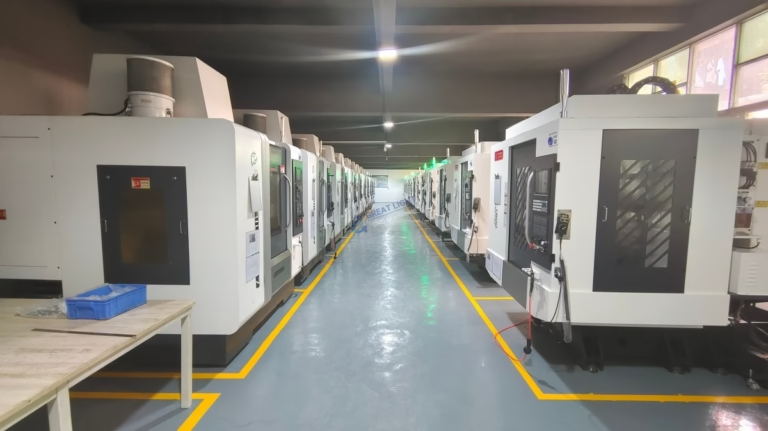
GreatLight runs travel envelopes from 500 × 310 × 200 mm up to 4,000 × 400 × 150 mm, plus a Ø400 mm rotary table for round parts. That range covers small medical housings and long structural rails on the same floor. The point is not the number of machines. The point is whether your part fits one of them without a special fixture.
Long parts need support. A 3,000 mm rail will sag under its own weight if it is clamped at two points. The shop has to plan support blocks or a steady rest. Ask how they will support the part, not just whether the machine is big enough.
- 1Get the envelope in writingTravel limits decide feasibility before price does.
- 2Round parts need a rotary tableØ400 mm covers most valve bodies and flanges.
- 3Ask about supportLong thin parts deflect. Fixturing is part of the quote.
MOQ, prototype runs, and what direct means
A broker adds a margin and a handoff. A direct shop runs the machine. That difference shows up in two places: the minimum order quantity and the speed of a design change. GreatLight quotes from one prototype to 10,000+ part runs with no minimum order quantity.
For a hardware startup, the first run is usually 5 to 20 parts for fit and function. A shop with no MOQ will run those on the same machines that later handle production. The setup knowledge carries over, so the second run is cheaper and closer to the drawing.
Watch for the hidden minimum. Some suppliers accept a one-piece order but price it with a tooling or programming charge that only makes sense at volume. Ask for the breakdown: material, machining time, finishing, inspection. If the programming line is large, ask whether it repeats on the next order.
- 1No MOQ, no toolingCNC cuts from stock. There is no mold to amortize.
- 2Ask if the setup repeatsA direct shop keeps the program and fixture for the next run.
- 3Get the cost breakdownMaterial, machining, finishing, inspection. Four lines, not one.
Lead time: quote, start, and ship
Lead time has three parts, and suppliers often quote only the last one. The quote and DFM analysis should come back within 12 hours. Production can start within 24 hours of drawing release. Parts ship in 3–5 days for typical runs.
The trap is finishing. Anodizing, plating, or heat treatment can add days if it is outsourced. A shop with in-house finishing controls that queue. Ask where finishing happens. If the answer is a third party, add a buffer to your schedule.
A historical late-delivery probability below 2% is a useful number, but it is a shop-level average. Your part may sit in a harder category. Ask how the shop tracks jobs in process and whether you get a status update at inspection. That is a better predictor than a headline percentage.
- 1Quote in 12 hoursIncludes a free DFM analysis of your drawing.
- 2Start in 24 hoursOnce material and drawing are confirmed.
- 3Ship in 3–5 daysFinishing is the variable. Ask who does it.
Certifications and inspection paperwork
Certifications are a filter, not a score. ISO 9001:2015 covers general quality systems. IATF 16949:2016 is what automotive and EV programs expect. ISO 13485:2016 applies to medical devices. ISO 27001:2022 matters when your files are sensitive and you want the data handling audited.
Match the certificate to your industry. A shop with ISO 9001 and IATF 16949 can support automotive brackets and EV housings. If you are building a surgical instrument, the medical quality system is the one to check. Ask for the certificate scope, not just the logo on a web page.
Inspection is the other half. 100% inspection before shipment covers raw material check, in-process monitoring, and final inspection. Reports are available on request. If your drawing has a critical dimension, name it in the PO so it appears on the report.
- 1Ask for the scopeA certificate covers specific processes and sites.
- 2Name critical dimensionsThey go on the inspection report only if you ask.
- 3Check data handlingISO 27001 covers file security, not just part quality.
Material and finishing availability
Material availability decides whether a quote is real. A shop that stocks 6061, 7075, 304, 316L, 17-4PH, and Ti-6Al-4V can start in days. A shop that orders every grade per job adds a week before the spindle turns. Ask what is on the shelf.
Finishing is where schedules slip. Anodizing in clear, color, hardcoat, and conductive types covers most aluminum parts. Electroless nickel, zinc, silver, and gold plating handle wear and conductivity. Powder coating and black oxide are the low-cost options for steel.
Secondary operations like laser marking need a minimum character height of 1.5 mm to stay legible after coating. Bead blasting, tumbling, brushing, and polishing change the surface without changing the dimension if the shop controls stock removal. Say which finish you want before the part is cut, not after.
- 1Stocked grades start fasterAluminum, stainless, steel, copper, titanium, and engineering plastics.
- 2In-house finishing saves daysNo shipping to a third party and back.
- 3Marking needs 1.5 mmSmaller text fills in after anodizing or powder coating.
Confidentiality and file handling
Your CAD file is your product. Ask how it is stored, who can open it, and whether it is deleted after the run. Uploads should be secure and confidential. An NDA should be available on request, not treated as a special favor.
A shop with ISO 27001:2022 has an audited information security system. That covers access control, storage, and incident handling. For defense-adjacent or medical work, this is often a procurement requirement, not a preference.
Practical checks: is the quote portal encrypted, does the shop reuse your file for marketing, and can they confirm deletion. Get the answer in writing before you release the model. It takes one email and prevents a long conversation later.
- 1NDA on requestAvailable before you send files, not after.
- 2Secure uploadsEncrypted transfer, restricted access.
- 3Ask about deletionConfirm the file policy in writing.
Step by step: from drawing to first article
Seven steps that turn a quote into a verified part.
- 1Send the 3D model and a 2D printInclude material, finish, and the critical dimensions. A STEP file alone hides tolerance intent. Note the units: mm or inch.
- 2Read the DFM note, not just the priceA useful quote lists thin walls, deep pockets, and tool reach limits. If there is no DFM note, ask for one before you compare prices.
- 3Confirm the machine class and travelAsk which machine will run the part and whether the envelope covers it. For 5-axis work, confirm simultaneous, not 3+2 indexing.
- 4Check the tolerance against the material±0.005 mm is reasonable in aluminum. In titanium, expect a wider band unless the shop has thermal control.
- 5Lock the finish and marking spec earlyName the finish type and Ra range. For laser marking, keep character height at 1.5 mm or more.
- 6Agree the inspection report formatList the critical dimensions and the report type. 100% inspection before shipment is the baseline.
- 7Run a first article before the full runCheck the first part against the print. Fix the process, not the part, before the rest of the order is cut.
Questions buyers ask before the first order
How tight a tolerance can direct CNC machining services hold?
±0.005 mm (±0.0002 in) is the working limit for aluminum and brass on a stable setup. Surface finish in the Ra 0.2–0.8 μm range is available when the print calls for it.
On titanium, Inconel, and thin-wall parts, expect a wider band or a longer cycle. The machine is rarely the limit. Heat, tool deflection, and fixturing are.
Is there a minimum order quantity?
No minimum order quantity. Runs go from one prototype to 10,000+ parts. There is no mold or tooling to amortize, so the per-piece price falls with volume but the first part is still economical.
Ask whether the program and fixture are kept for repeat orders. That is where the second run gets cheaper.
What lead time should I plan for?
Quotation and DFM analysis come back within 12 hours. Production can start within 24 hours. Typical parts ship in 3–5 days.
Add time for outsourced finishing. If anodizing or heat treatment leaves the building, the schedule depends on a third party. In-house finishing removes that dependency.
Which certifications matter for my industry?
ISO 9001:2015 is the baseline. IATF 16949:2016 fits automotive and EV work. ISO 13485:2016 applies to medical devices. ISO 27001:2022 covers information security.
Ask for the certificate scope. A certificate applies to specific sites and processes, not to every job a company quotes.
Can you machine large parts as well as small ones?
Travel ranges from 500 × 310 × 200 mm up to 4,000 × 400 × 150 mm, with a Ø400 mm rotary table for round parts.
For long parts, ask how the shop will support the workpiece. Sag and chatter will show up in the tolerance long before the machine runs out of travel.
How are my files protected?
Uploads are secure and confidential, and an NDA is available on request. ISO 27001:2022 adds an audited information security system on top of the quality certifications.
Ask about file deletion after the run and whether your model is ever used in marketing. Get both answers in writing.
Send your drawing, get a quote in 12 hours
Upload your model and print. We return price, lead time, and a DFM note within 12 hours.
12-hour quoteNo MOQ100% inspection
More from the shop floor
We publish setup notes, tooling trials and inspection data from the factory floor.











