
Electronic CNC Machining Services
This guide is for engineers and sourcing teams choosing a supplier for electronic CNC machining: housings, heat sinks, RF shields, connector bodies, chassis and fixtures. Read it and you can judge a shop on tolerance, material, finish, lead time and paperwork instead of a price list.
In this article
- 1
- 2
- 3
- 4
- 5
- 6
- 7
- 8
Key takeaways
What to compare before you send an RFQ
Use this as a scoring sheet. Weight the rows by what actually breaks your product.
| Criterion | Weak signal | Strong signal | Why it matters |
|---|---|---|---|
| Tolerance claim | ±0.01 mm on all features | ±0.005 mm named on critical features | Blanket claims hide the features that matter |
| Inspection | Certificate of conformance only | 100% inspection, reports on request | You need numbers, not a signature |
| Material traceability | Grade named on invoice | Mill cert tied to the heat number | Mixed 6061 and 6063 ruins anodize color |
| Finish control | Anodize quoted as a line item | Bath type, thickness range, masking plan | EMI and cosmetic parts fail at the finish |
| Lead time | Vague '2 to 4 weeks' | Parts ship in 3–5 days after release | Prototype loops live or die on this |
| Order size | Tooling fee at low volume | No minimum order quantity | Pilot lots de-risk the design |
| Data handling | Email attachments, no policy | ISO 27001:2022, NDA on request | Gerber and STEP files leak easily |
| Quote turnaround | 3 to 5 business days | Quotation and DFM analysis within 12 hours | Slow quotes stall the whole build |
The practical verdict
If your part is complex, low to mid volume, and needs tight tolerance with a controlled finish, CNC is the right call. Qualify the supplier on tolerance map, inspection plan, material traceability and certificates, then run a pilot lot before the volume order. That order of checks catches more problems than any price comparison.
Tolerance, thin walls and the features that actually cost money
Most electronic parts are not hard because of one tight hole. They are hard because of many small features packed into a thin envelope. A radio housing might carry a 0.5 mm wall, a recessed gasket groove, four M1.6 threaded bosses and a connector cutout, all inside 90 mm. Each feature is easy. Holding them together is the job.
Ask for a tolerance map before you approve the design. General tolerance on a drawing is usually loose, and only a handful of features carry ±0.005 mm. Those are the ones that mate with a PCB, a connector or a shield can. If the shop cannot tell you which features need the tight band, the quote is guesswork.
Thin walls are the usual cost driver. Below about 1.0 mm in aluminium, chatter and deflection climb quickly. You can still machine 0.5 mm walls, but expect slower passes, extra fixtures and a higher scrap rate. If the wall is not structural, consider thickening it or moving that face to a sheet metal part.
- 1Threaded bossesM1.6 and M2 threads below 4 mm depth need a thread mill or a tapping head with torque control.
- 2Deep pocketsKeep depth-to-width under 4:1 for standard end mills, or plan for a long-reach tool.
- 3FlatnessSealing faces and PCB seats often need 0.05 mm over the full face, not just local tolerance.
- 4DatumsName the datum that touches the PCB. Everything else should reference it.
Picking material and finish for electronic hardware
Aluminium covers most electronics work, and 6061-T6 is the default for housings and brackets. It machines cleanly, welds, and takes a uniform anodized color. 5052 is a better choice when the part will be formed or needs corrosion resistance near salt air. 7075 gives higher strength for RF chassis and heat-sink clamps, but it anodizes darker and less evenly, so color matching across lots is harder.
Copper and brass show up where conductivity matters: busbars, RF cavities, waveguide sections and contact blocks. C101 and C110 machine well but are gummy at high feed, so surface finish suffers if the shop pushes too hard. Beryllium copper is used for spring contacts; it requires controlled chips and cleaning because the dust is a health hazard. Ask how the shop handles it.
For heat management, the material is only half the story. A heat sink with a rough base does not transfer heat, no matter how many fins it has. Specify the base flatness and finish, usually Ra 0.8–1.6 μm with 0.05 mm flatness across the contact area. On the finish side, anodize is standard for appearance and wear, but it is an insulator. If the part needs a ground path, use masked pockets, conductive anodize or a plated finish instead.
- 1Enclosure housings6061-T6, anodized clear or black, bead blasted before anodize for a matte look.
- 2EMI shields5052 or 6061 with conductive anodize, or electroless nickel on the mating flange.
- 3Heat sinks6063 or 6061, machined base, Ra 0.8–1.6 μm, no anodize on the contact face.
- 4RF and waveguideCopper or brass, silver or gold plating, tight corner radii for signal integrity.
When CNC is the wrong process
CNC wins on prototypes, low volume and parts with real geometry. It loses on simple flat covers and brackets at volume. If you need 50,000 plain aluminum lids with two bends, sheet metal or die casting will beat machining on unit cost every time. The crossover usually sits somewhere between a few hundred and a few thousand parts, and it depends on how much machining the casting still needs.
A practical route is to prototype on CNC, then move to casting or sheet metal once the design is frozen. GreatLight runs 3 wholly-owned plants and offers CNC machining, sheet metal fabrication, die casting, vacuum casting and 3D printing under one roof, so the same drawing can move between processes without a new supplier qualification. That saves weeks on a program transition.
One more boundary: very small features. Micro-holes under 0.3 mm, sharp internal corners, and optical surfaces are often better served by EDM, laser cutting or a specialist process. A machine shop that says yes to everything is not filtering for you. A good partner tells you when to go elsewhere.
- 1Choose CNCPrototypes, under a few thousand parts, tight tolerance, complex 3D geometry.
- 2Choose castingVolume housings where wall thickness is above 1.5 mm and tolerances are moderate.
- 3Choose sheet metalFlat panels, brackets and chassis with bends and few machined features.
- 4Choose EDM or laserMicro-features, hardened tool steel, sharp internal corners.
How to qualify an electronic CNC machining supplier
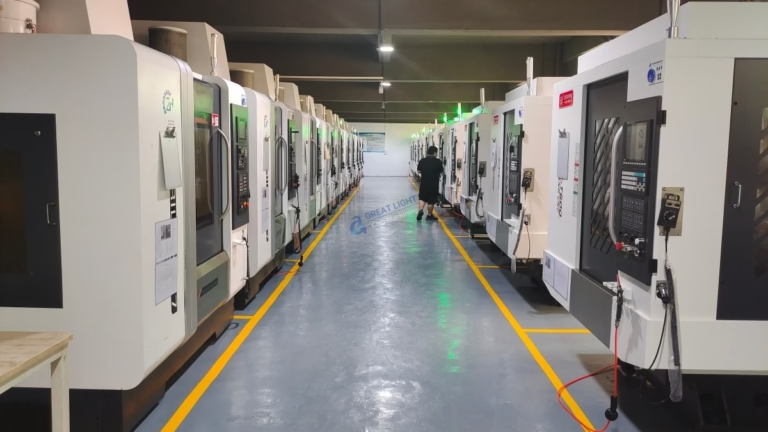
Start with the machines, not the brochure. Simultaneous 5-axis centers handle angled connector faces and undercut pockets in one setup, which removes stack-up error. Mill-turn centers cut a turned body and milled flats without re-chucking. Ask how many of each the shop owns and which one your part will run on. GreatLight runs 127 high-precision CNC machines, including 16 simultaneous 5-axis centers and 16 mill-turn centers, with a maximum processing size of 4,000 mm.
Then ask about inspection. A shop that measures only the first article is not controlling a production run. You want raw material check, in-process monitoring and final inspection, with reports on request and 100% inspection before shipment. The tolerance figure is ±0.005 mm, and fine finishes run Ra 0.2–0.8 μm when the drawing calls for it.
Paperwork decides whether the parts are usable in your market. ISO 9001:2015 covers general quality systems. IATF 16949:2016 matters if the part goes into a vehicle. ISO 13485:2016 matters for medical hardware. ISO 27001:2022 covers how your CAD files and Gerbers are stored and shared. If you send confidential designs, ask for an NDA before the first upload.
Finally, test the quote process. A supplier that returns a price with no manufacturability comments is a job shop. A supplier that flags a 0.4 mm wall, suggests a different alloy, or points out a missing datum is doing DFM work you would otherwise pay for.
- 1Machine listAsk for the specific machine and setup count, not a general capability page.
- 2Inspection planRequest the measurement method for your tightest feature.
- 3CertificatesMatch the certificate to your industry, not to the marketing page.
- 4DFM feedbackA quote without comments is a red flag on complex parts.
Reading a quote: what drives price and schedule
Price on an electronic enclosure is mostly setup and fixturing at low volume, and cycle time at high volume. A part with six setups costs more to start than one with two, even if the cycle time is similar. That is why a design review that removes one setup often cuts the first-order price more than a material swap.
Lead time has two halves: quote and production. Ask for both in writing. GreatLight returns a quotation and free DFM analysis within 12 hours, can start production within 24 hours of release, and ships parts in 3–5 days. Historical late-delivery probability is below 2%. Those numbers only hold if the drawing and material are fixed at release.
Watch for hidden cost lines. Deburring and edge break on small electronics parts is real labor. Anodize masking for ground contacts adds a step. Laser marking has a minimum character height of 1.5 mm, so tiny logos need a different method. None of these are traps, but they should appear in the quote rather than on the invoice.
- 1Setup countEach extra setup adds fixturing cost and stack-up error.
- 2Material availabilityExotic alloys and thick plate can add days before the spindle even starts.
- 3Finish stepsMasking, blasting and plating are separate operations with their own queues.
- 4Inspection levelFull dimensional reports cost more than a conformance certificate.
Step by step: from drawing to shipped electronics parts
This is the sequence we run. Timings assume the design is frozen.
- 11. Send the 3D model and 2D drawingSTEP or IGES for geometry, PDF for tolerances, datums and finish callouts. Name the critical features. Missing GD&T is the most common cause of a wrong first article.
- 22. Get DFM feedback and a quoteWithin 12 hours you get a price plus notes on thin walls, deep pockets, tool reach and tolerance stack. Reply with a decision on each note before tooling starts.
- 33. Confirm material and finishLock the alloy grade and the finish spec, including color, thickness range and masking zones. For anodize, send a physical sample or a defined color standard.
- 44. Approve the first articleProduction can start within 24 hours of release. The first part is measured against the drawing; you review the report and sign off before the run continues.
- 55. Run production with in-process checksOperators check features at defined intervals. Tight features at ±0.005 mm are monitored with the same instrument and fixture used for the first article.
- 66. Final inspection and documentation100% inspection before shipment, with reports on request. Parts ship in 3–5 days, packed to protect finished surfaces.
Questions buyers ask before ordering
Can you machine parts that touch a PCB without damaging the board?
Yes, but the interface has to be defined. We machine PCB seats to a flatness callout rather than a general tolerance, and we keep burrs off the seating face.
If the part clamps the board, tell us the board thickness and the compression you allow. That sets the pocket depth and the boss height.
What is the smallest feature you can hold at ±0.005 mm?
It depends on the feature, not the shop. A bored hole or a milled face at that tolerance is routine. A 0.5 mm wide slot 10 mm deep is not, because tool deflection dominates.
Send the drawing and we will mark which features can hold the tight band and which need a relaxed callout.
Do you offer conductive finishes for EMI shielding?
Yes. Conductive anodize, masked anodize pockets and electroless nickel are the usual options for a ground path.
The choice depends on whether you need corrosion resistance, solderability or just low contact resistance. Tell us the requirement and we will pick the process.
Is there a minimum order quantity?
No. We run from one prototype to 10,000+ part runs. There is no minimum order quantity, so a pilot lot is a normal way to start.
For volume, the same process can scale, or we can move the part to casting or sheet metal if that lowers unit cost.
How do you protect our design files?
Uploads are secure and confidential, and we hold ISO 27001:2022 for information security. An NDA is available on request.
Files are shared only with the engineers and operators who need them for your job.
What do you need to quote an electronics housing?
A 3D model, a 2D drawing with tolerances and finish, the alloy, the quantity and the target date. Photos of a similar part help too.
With those, you get a quotation and free DFM analysis within 12 hours.
Send your drawing and get a real answer
Upload your STEP file and get a quotation with DFM notes within 12 hours. No minimum order quantity, and your files stay confidential.
12-hour quoteNo MOQ100% inspectionNDA on request
More from GreatLight
We publish setup notes, tooling trials and inspection data from the factory floor.











