
Evaluating CNC Machining Service: 7 Checks That Decide the Build
This guide is for engineers and procurement staff picking a machining supplier. It lists the checks that actually predict part quality: tolerance capability, inspection records, lead time, MOQ, and certification fit. Read it and you can score a quote sheet before you send a PO.
In this article
- 1
- 2
- 3
- 4
- 5
- 6
- 7
Key takeaways
Seven checks and what separates a strong answer from a weak one
Use this as a first-pass filter. Weak answers do not always disqualify a shop, but they push the conversation toward a trial part rather than a full run.
| Check | Weak signal | Strong signal | Why it matters |
|---|---|---|---|
| Tolerance | One number for every feature | Capability tied to the feature | Flat claims hide setup limits |
| Inspection | Certificate only | Measured values on request | You need numbers, not a stamp |
| Lead time | Vague weeks | 3–5 days for machined parts | Short cycles protect your schedule |
| MOQ | Fixed batch minimum | One part to 10,000+ | Prototype budget stays small |
| Certification | Generic quality claim | ISO 9001 / IATF 16949 / ISO 13485 | Sector audits ask for specifics |
| DFM feedback | Silence until quote | Analysis within 12 hours | Early feedback cuts scrap |
| Confidentiality | No document offered | NDA available on request | Your drawings stay yours |
The verdict
If your part carries a tight tolerance, a sector certificate or a confidentiality requirement, judge the supplier on inspection records and DFM depth, not on the lowest quote. If the part is a simple bracket, price and lead time are enough.
Tolerance and inspection: the two numbers that decide the part
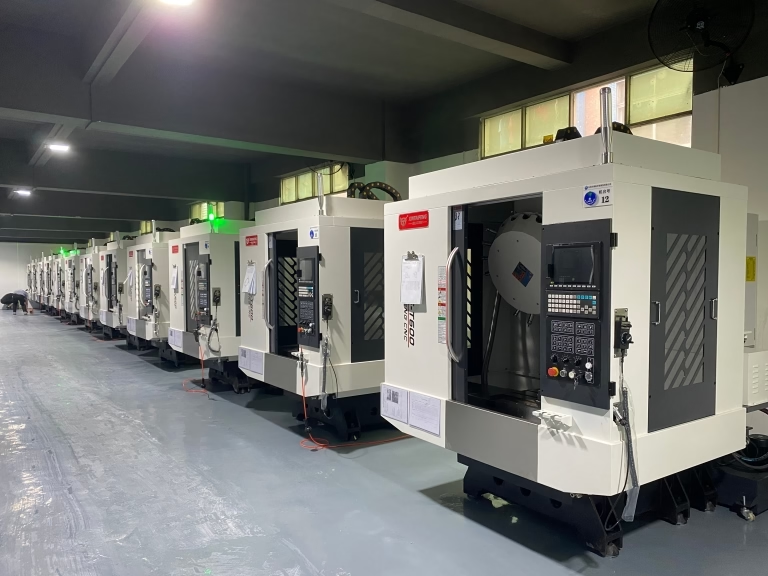
Start with tolerance because it drives machine choice, fixturing and cost. A shop running 16 simultaneous 5-axis machining centers, 12 four-axis mills and 27 three-axis machines can hold ±0.005 mm (±0.0002 in) on the right geometry, but that number is a floor, not a promise on every feature. Ask how the tolerance applies to your thin wall, deep pocket or long bore. The answer tells you whether the shop read your drawing or just your file name.
Inspection is where quotes quietly differ. GreatLight runs raw material checks, in-process monitoring and a final inspection, with 100% inspection before shipment and reports on request. That matters for a bracket that holds a sensor, less for a decorative cover. If your part is safety-related, ask which dimensions are measured, on what equipment, and whether the report ships with the parts or only when requested.
Surface finish sits beside tolerance. Ra 0.2–0.8 μm is a fine finish, Ra 0.8–1.6 μm is typical for mating surfaces, and Ra 1.6–3.2 μm is as-machined. A supplier that cannot separate these three bands will either over-machine your part or under-deliver on a sealing face. Both cost you a rework cycle.
- 1Tie tolerance to featuresA blanket ±0.005 mm claim on a 400 mm part deserves a follow-up question.
- 2Ask for measured valuesA report with numbers, not a signed form.
- 3Name the finish bandFine, high or as-machined, per surface.
Lead time and MOQ: the filters that shape your program
Lead time is not a single date. Break it into quote, production start and shipment. GreatLight returns a quotation and free DFM analysis within 12 hours, can start production within 24 hours, and ships machined parts in 3–5 days. Historical late-delivery probability is below 2%. Use those as separate checkpoints. A shop that quotes fast but starts slowly is still a bottleneck when your prototype review is on Friday.
MOQ is the other filter. No minimum order quantity means a single prototype and a 10,000+ part run sit on the same PO template, which keeps early-stage programs affordable. If a supplier forces a batch minimum, you pay for parts you have not validated. For hardware startups and R&D teams, that difference decides whether a design iteration happens this month or next quarter.
Read lead time and MOQ together. A shop with no MOQ but a two-week start is fine for a production ramp and wrong for a design sprint. A shop with a 24-hour start and a high MOQ suits a released design. Match the pair to your stage, not to the headline number.
- 1Split the timelineQuote, start and ship are three different promises.
- 2No MOQ protects iterationOne prototype to 10,000+ parts on the same terms.
- 3Match the pair to your stageDesign sprint and production ramp need different suppliers.
Certification fit and machine capability for your part
Certifications are sector-specific, not a generic badge. ISO 9001:2015 covers a quality management baseline. IATF 16949:2016 applies to automotive and EV work. ISO 13485:2016 covers medical device manufacturing. ISO 27001:2022 covers information security, which matters when your drawings are the asset. GreatLight holds all four. If a supplier lists one and your program needs another, ask how the gap is closed before you send files.
Machine capability decides what your geometry can do. A 4,000 mm maximum processing size handles long extrusions and rails, with travels of 4,000 × 400 × 150 mm on the large platform. Medium work fits 750 × 1,150 × 550 mm or 600 × 600 × 600 mm. Compact parts run on 500 × 500 × 450 mm and 500 × 310 × 200 mm platforms. A Ø400 mm rotary table supports 4-axis work on round and angled features.
Material range is part of capability. Aluminum 6061-T6 and 7075, stainless 303, 304 and 17-4PH, steels like 4140 and 4340, titanium TC4 (Ti-6Al-4V), Inconel, magnesium AZ31B, plus plastics such as POM, PEEK and PC all behave differently at the spindle. Ask what the shop runs weekly, not what its brochure lists.
Finishing and secondary operations close the loop. Anodizing in clear, color, hardcoat or conductive, electroless nickel, zinc, silver and gold plating, powder coating, black oxide, bead blasting, tumbling, brushing and polishing are all in scope, along with laser marking at a minimum character height of 1.5 mm. A supplier that outsources every finish adds a handoff and a delay.
- 1Match the certificate to the sectorIATF 16949 for automotive, ISO 13485 for medical.
- 2Check travels against your envelopeLong parts need the 4,000 mm platform.
- 3Ask what runs weeklyMaterial experience shows up in chip control and tool life.
Quote quality and confidentiality: reading the paperwork
A good quote is a small engineering document. It should name the process (3-axis, 4-axis, 5-axis, mill-turn), the material grade, the finish band, and any DFM note that changes the design. A quote that lists only a price and a part count gives you nothing to compare. When two suppliers differ by 30%, the DFM notes usually explain why.
Confidentiality belongs in the same review. Uploads are secure and confidential, and an NDA is available on request. For a supplier managing customer drawings across four certification schemes, that is a process, not a courtesy. Ask who inside the shop sees your files and how long they are retained.
One more habit: compare quotes on the same drawing revision. A supplier working from an old revision will look cheaper because it skipped a feature. Lock the revision number in the PO and ask the shop to confirm it back.
- 1Demand a process lineAxis count, material grade, finish band.
- 2Put the NDA on the table earlyBefore files move, not after.
- 3Lock the drawing revisionA cheap quote on the wrong revision is not cheaper.
Step by step: scoring a CNC machining supplier
Run these steps in order. Steps 1 to 3 filter the list; steps 4 to 6 confirm the winner on a real part.
- 1Send one drawing with a hard featurePick a part with a thin wall, a deep pocket or a true position callout. Ask for tolerance applied to that feature, not a generic number.
- 2Time the DFM responseStart a clock when you send the file. A free DFM analysis inside 12 hours shows the shop has an engineering review step, not just a sales inbox.
- 3Ask for the inspection planRequest which dimensions are measured, on what equipment, and whether reports ship with parts. 100% inspection before shipment should come with values on request.
- 4Order one prototype, no minimumUse the no-MOQ route to validate fit and finish. Check finish against the band you named: Ra 0.2–0.8 μm, Ra 0.8–1.6 μm or Ra 1.6–3.2 μm.
- 5Measure the delivered partVerify the critical features against the drawing. If a dimension sits at the edge of ±0.005 mm, ask how the process will center it for the production run.
- 6Scale to a 10,000+ part runOnce the prototype passes, confirm the same process, material lot control and inspection plan carry into volume. Production can start within 24 hours and parts ship in 3–5 days.
Questions engineers ask before awarding a machining order
What tolerance can a CNC machining service actually hold?
On well-fixtured features, ±0.005 mm (±0.0002 in) is achievable, and GreatLight works to that band. The limit is geometry, not the machine list.
Thin walls, deep pockets and long unsupported bores move under cutting force. Ask the shop to name the features it can hold and the ones that need a second setup or a different process.
How do I compare lead times between suppliers?
Split the promise into three dates: quote, production start and shipment. GreatLight returns a quotation and free DFM analysis within 12 hours, starts production within 24 hours, and ships parts in 3–5 days.
A supplier quoting a single total is hiding which stage is slow. That stage is where your schedule will slip.
Is no minimum order quantity a real advantage?
Yes, during development. No MOQ means a single prototype and a 10,000+ part run use the same process and paperwork, so you validate the supplier before committing volume.
It also lowers the cost of a design change. You re-cut one part instead of scrapping a batch.
Which certifications should I ask for?
Start from your industry. ISO 9001:2015 is the baseline. IATF 16949:2016 fits automotive and EV programs. ISO 13485:2016 fits medical devices. ISO 27001:2022 covers information security for your drawings.
GreatLight holds all four. List the certificate number and scope in the supplier file, not just the logo.
How do I know the quote reflects my drawing?
Check that the quote names the process, the material grade and the finish band, and that it carries a DFM note. If two quotes differ sharply, compare those lines first.
Then confirm the drawing revision number in writing. Most quote disputes trace back to an old revision, not to machining cost.
What keeps my files confidential?
Uploads are secure and confidential, and an NDA is available on request. Ask who inside the shop can open your files and how long they are kept.
For programs with export or IP sensitivity, ISO 27001:2022 gives you a documented information security process to point at during an audit.
Send a drawing and see the review for yourself
Upload your file and get a quotation with free DFM analysis within 12 hours. One prototype or 10,000+ parts, the same engineering review.
12-hour quote100% inspection before shipmentNDA on requestNo MOQ
More from the shop floor
We publish setup notes, tooling trials and inspection data from the factory floor.











