
Flexible CNC Machining Services: How to Choose a Supplier
This guide is for engineers and sourcing managers comparing flexible CNC machining services. It covers the capability checks, tolerance questions and commercial terms that decide whether a supplier fits your part. Read it before you send the first drawing.
In this article
- 1
- 2
- 3
- 4
- 5
- 6
- 7
- 8
- 9
Key takeaways
Which supplier type fits your program
Read across the row that matches your part, then check the fit notes before shortlisting.
| Program type | Best-fit setup | Lead time shape | Watch out for |
|---|---|---|---|
| Single prototype, tight tolerance | 5-axis mill-turn, one setup | Quote in 12 hours, ship in 3–5 days | No first-article report offered |
| Bridge run, 50–500 parts | 3-axis plus fixture plate | Steady weekly releases | Fixture cost folded into unit price |
| Long part over 2,000 mm | Gantry mill, 4,000 mm travel | Longer setup, short cycle | Quoted on a smaller machine |
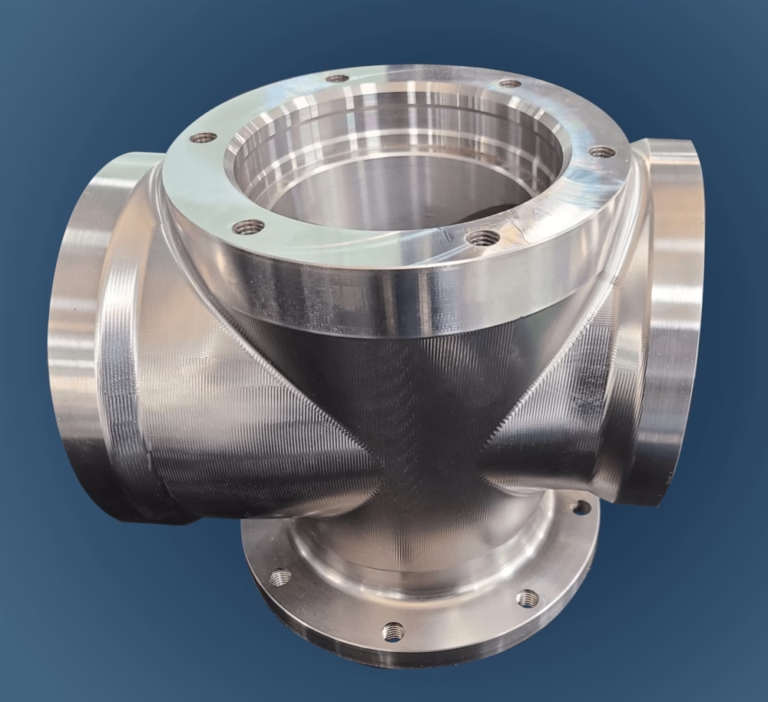
| Turned housing with cross holes | Mill-turn center, Ø400 mm table | One-op cycle, fast repeat | Second op re-chucking error |
| Regulated medical or auto part | ISO 13485 or IATF 16949 line | Audit and PPAP add weeks | Cert claimed, not scoped |
| Prototype to production handoff | Same plant, same CAM files | No re-qualification gap | Design transferred to a new shop |
The short version
Fit the machine to the part, keep the tight tolerance band for the features that need it, and confirm the certification scope and inspection report before the first cut. A supplier that quotes one prototype and a 10,000-part run without changing the process is the one worth shortlisting.
What flexible CNC machining services should actually cover
Flexibility is not a slogan on a website. It means the shop can move a part between machine types without re-quoting the geometry. A supplier with 16 simultaneous 5-axis centers, 12 four-axis mills, 27 three-axis machines and 16 mill-turn centers can pick the setup that suits the feature, not the one that suits the shop schedule.
Ask how the shop handles a change mid-program. If a prototype comes back from test with a moved boss or a thicker wall, the same CAM file should be editable and re-cut without a new fixture. That is the practical test of flexibility. A shop that only runs one machine class will send your revision to the back of the queue.
Size range matters too. Maximum processing size at GreatLight is 4,000 mm, with travel of 4,000 × 400 × 150 mm on the gantry class, 750 × 1,150 × 550 mm and 600 × 600 × 600 mm on the mid class, and 500 × 500 × 450 mm or 500 × 310 × 200 mm on the compact class. Send the envelope with the RFQ. Every supplier will price the part against a machine it can actually load.
- 1Machine mix5-axis, 4-axis, 3-axis and mill-turn under one roof
- 2Size envelopeUp to 4,000 mm, with Ø400 mm rotary table for round work
- 3Revision handlingCAM file stays with the part through prototype and production
Tolerance, surface finish and where money goes
Tolerance drives cost more than material does. GreatLight works to ±0.005 mm (±0.0002 in) where the drawing needs it. The same shop holds Ra 0.2–0.8 μm on a fine finish, Ra 0.8–1.6 μm on a high finish, and Ra 1.6–3.2 μm as machined. A bearing bore and a bracket face should not carry the same callout.
Engineers often copy a tight tolerance block onto every dimension. That forces the machinist to slow the finishing pass, add a semi-finish cut, and inspect more points. If a face only locates a cover plate, ±0.1 mm is enough. Reserve the tight band for fits, seal faces and datum features that control the stack-up.
Surface finish follows the same logic. A Ra 0.4 μm seal face may need a separate finishing operation after the main cut. Bead blasting, tumbling or brushing can hit cosmetic targets at lower cost than a full fine-finish pass. State the function of the surface in the RFQ, not just the Ra number.
- 1Tight band±0.005 mm for fits, bores and datum features
- 2Working band±0.05 mm covers most brackets, plates and housings
- 3Finish bandsRa 0.2–0.8 μm fine, Ra 0.8–1.6 μm high, Ra 1.6–3.2 μm as machined
Material selection and the limits of each grade
Available stock covers aluminium 6061, 6061-T6, 2024, 5052, 5083, 6063, 6082, 7075 and ADC12; stainless 303, 304, 316, 316L, 420, 430, 431, 440C and 17-4PH; steel 1018, 1045, 4130, 4140, 4340, A36 and tool steel; copper and brass C101, C103, C110, beryllium copper, C27400, C28000 and C36000; titanium TA1, TA2, TC4, Inconel and magnesium AZ31B or AZ91D; plus ABS, PC, PMMA, POM, PA, PEEK, PP, HDPE and carbon fibre.
Grade choice changes the cut, not just the price. 7075 aluminium machines cleanly but is more prone to stress movement after heavy stock removal. 316L work-hardens, so a light feed will rub the surface instead of cutting it. 17-4PH in the H900 condition needs a different insert and a slower finishing pass than the annealed bar.
Thin-wall plastic parts behave the opposite way. POM and PEEK deflect under clamping pressure, so the shop should use soft jaws and light passes. If the part is a cover with no load, sheet metal or vacuum casting may be cheaper than a machined block. Say what the part does, and the shop can tell you when machining is the wrong process.
- 1Aluminium6061-T6 for general work, 7075 when strength matters
- 2Stainless303 for free cutting, 316L where corrosion resistance rules
- 3PlasticsPOM and PEEK need soft jaws and light radial cuts
MOQ, lead time and how to read a quote
A flexible shop should quote one piece and 10,000 pieces. GreatLight runs no minimum order quantity, from a single prototype to a 10,000+ part run. That matters at the prototype stage, when a fixture cost spread over one part would double the price. Ask whether the fixture is charged once or built into the unit rate.
Timing is the other half of the decision. A quotation and free DFM analysis come back within 12 hours, production can start within 24 hours, and parts ship in 3–5 days. Historical late-delivery probability is below 2%. Treat those as process claims, not guarantees, and ask which step in the flow is the constraint for your part.
Read a quote line by line. Material, machining, finishing, inspection and freight should each appear. A single blended number hides where the cost sits and makes a fair comparison impossible. If the quote does not list the inspection step, ask what is checked and whether a report is included.
- 1Quote detailMaterial, machining, finish, inspection and freight as separate lines
- 2DFM feedbackFree analysis with the quote, within 12 hours
- 3ConfidentialityUploads kept secure; NDA available on request
Certifications and what each one tells you
Certifications are a filter, not a ranking. ISO 9001:2015 covers the quality management system and applies to any buyer. IATF 16949:2016 is the automotive standard and brings PPAP, traceability and change control with it. ISO 13485:2016 is the medical device standard and adds process validation and record retention. ISO 27001:2022 covers information security, which matters when drawings and CAD files leave your network.
Check the scope on the certificate, not just the logo. A site certificate covers the plant named on it. If the supplier intends to run your part at a second site, ask whether that site is in scope. A group certificate and a site certificate are different documents.
Inspection is the part of the system you can verify on the first order. GreatLight runs 100% inspection before shipment, with raw material check, in-process monitoring and a final inspection, and reports on request. Ask for the report with the first shipment. If it arrives without measured values, the inspection step is paperwork.
- 1ISO 9001:2015Baseline quality system for general industrial parts
- 2IATF 16949:2016Automotive programs with PPAP and change control
- 3ISO 13485:2016Medical devices with validation and record retention
- 4ISO 27001:2022Information security for shared drawings and files
When CNC is the right process, and when it is not
CNC machining wins on geometry that cannot be formed. Undercuts, deep pockets, cross-drilled ports and true-position hole patterns belong on a mill. The same features on a casting would need a tool that cannot reach them, or a second op that reintroduces tolerance stack-up.
It loses on thin cosmetic shells and high-volume simple parts. A 0.8 mm wall over a 200 mm panel will chatter, and a die-cast or vacuum-cast version may be closer to net shape. Sheet metal handles flat brackets with bends faster and cheaper. If a part has no critical machined feature, ask whether another process in the same shop can make it.
The useful question is not which process is best. It is which features must be machined and which can be formed. A hybrid part, a machined insert in a cast housing, often beats a fully machined block on cost without giving up the critical fit. Bring that split to the RFQ and the shop can quote both halves.
- 1Machined by defaultSeals, bores, threads, datum faces, tight hole patterns
- 2Consider castingLarge thin shells, ribbed housings, cosmetic covers
- 3Consider sheet metalFlat brackets, enclosures, parts with simple bends
Step by step: qualifying a flexible CNC supplier
Run these in order. Each step removes suppliers that cannot carry the part past the prototype.
- 1Send the full envelope with the RFQInclude the 3D model, 2D drawing, material grade, quantity and any cosmetic requirement. State the maximum outer dimension so the shop can confirm the machine class before quoting. A 4,000 mm part and a Ø30 mm fitting go to different machines.
- 2Mark function on the drawingTag the fits, seal faces and datum features that need ±0.005 mm. Leave non-critical faces at ±0.1 mm or looser. This single change often moves the quote more than a material swap.
- 3Ask for DFM feedback in writingRequest the free DFM analysis with the quote. It should name specific features: a wall too thin to hold, a pocket too deep for the chosen tool, a tolerance that needs a second op.
- 4Confirm the machine and setup planAsk which machine class will run the part and how many setups are needed. A one-setup 5-axis plan removes re-chucking error on parts with features on five faces.
- 5Check the certification scopeMatch the certificate to the requirement: ISO 9001:2015 for general work, IATF 16949:2016 for automotive, ISO 13485:2016 for medical, ISO 27001:2022 for file security. Confirm the site named on the certificate is the site running the job.
- 6Agree the inspection and report formatSet out what is measured, at which stage, and whether a report ships with the parts. Raw material check, in-process monitoring and final inspection are the three points to confirm.
- 7Fix the commercial terms before the first cutConfirm MOQ, fixture ownership, revision policy and lead time. No minimum order quantity should apply from one prototype to a 10,000+ run. Ask what happens to the price if quantity doubles.
- 8Run a first-article checkMeasure the critical features against the drawing before releasing the full quantity. If a dimension is out, the CAM file and fixture are already in place, so the correction is fast.
Questions buyers ask before awarding a contract
What tolerance can flexible CNC machining services hold on a normal production part?
GreatLight works to ±0.005 mm (±0.0002 in) where the drawing requires it. On most brackets, plates and housings, ±0.05 mm is enough and costs less.
The tighter band should be reserved for fits, bores and datum features. Putting ±0.005 mm on every dimension adds finishing passes and inspection points without improving the assembly.
Is there a minimum order quantity for prototypes?
No minimum order quantity applies. The same shop quotes one prototype and a 10,000+ part run.
At the prototype stage, ask whether the fixture is charged separately or built into the unit price. On a one-piece order, a separate fixture line is usually the honest answer.
How fast can a quote and a first shipment arrive?
A quotation with free DFM analysis comes back within 12 hours. Production can start within 24 hours, and parts ship in 3–5 days.
Treat those figures as process claims. Ask which step constrains your part, since a large gantry job or a new finishing step can extend the flow.
Which certifications matter for an automotive or medical part?
IATF 16949:2016 is the automotive standard and brings PPAP and change control. ISO 13485:2016 is the medical device standard and adds process validation and record retention.
Check that the certificate names the site running your part. A group certificate does not automatically cover a second plant.
Can I keep the design confidential during quoting?
Uploads are kept secure and confidential, and an NDA is available on request. ISO 27001:2022 covers the information security side.
Send only the files needed for the quote. If the NDA must be signed before any drawing leaves your network, say so in the first message.
When should I use another process instead of CNC?
Large thin cosmetic shells, simple flat brackets and ribbed housings are often cheaper as castings or sheet metal parts.
A hybrid part with a machined insert in a cast housing can beat a fully machined block on cost while keeping the critical fit. Ask the shop to quote both.
Send your drawing and get a quote with DFM feedback
Upload the model and drawing, and we return a quotation with free DFM analysis within 12 hours. No minimum order quantity, from one prototype to a 10,000+ part run.
12-hour quoteNo MOQ100% inspectionNDA on request
More from GreatLight
We publish setup notes, tooling trials and inspection data from the factory floor.











