
01
Whine at running speed
Tooth flanks that touch on one side only. The pair was never lapped together, so contact stays partial and the noise follows the mesh frequency.
Teeth finished after heat treatment, where cutting stops working. We control profile, lead and backlash on hardened gears, then ship lapped pairs as a matched set.

Most gear complaints trace to one of four places. Check whether any of these sound familiar.
Tooth flanks that touch on one side only. The pair was never lapped together, so contact stays partial and the noise follows the mesh frequency.
Once teeth pass 350 HB (38 HRC), hobs and shapers stop removing metal. Shops keep running the same cutter and burn the flank instead of grinding it.
Quenching moves tooth form. A gear that measured good in the green state can sit outside its profile tolerance once it comes out of the furnace.
Both members were matched to each other on the machine. Replace one gear on its own and the contact pattern has to be broken in again from zero.
Lapping and grinding are not interchangeable. Pick by hardness, by tolerance, and by how the pair runs in service.
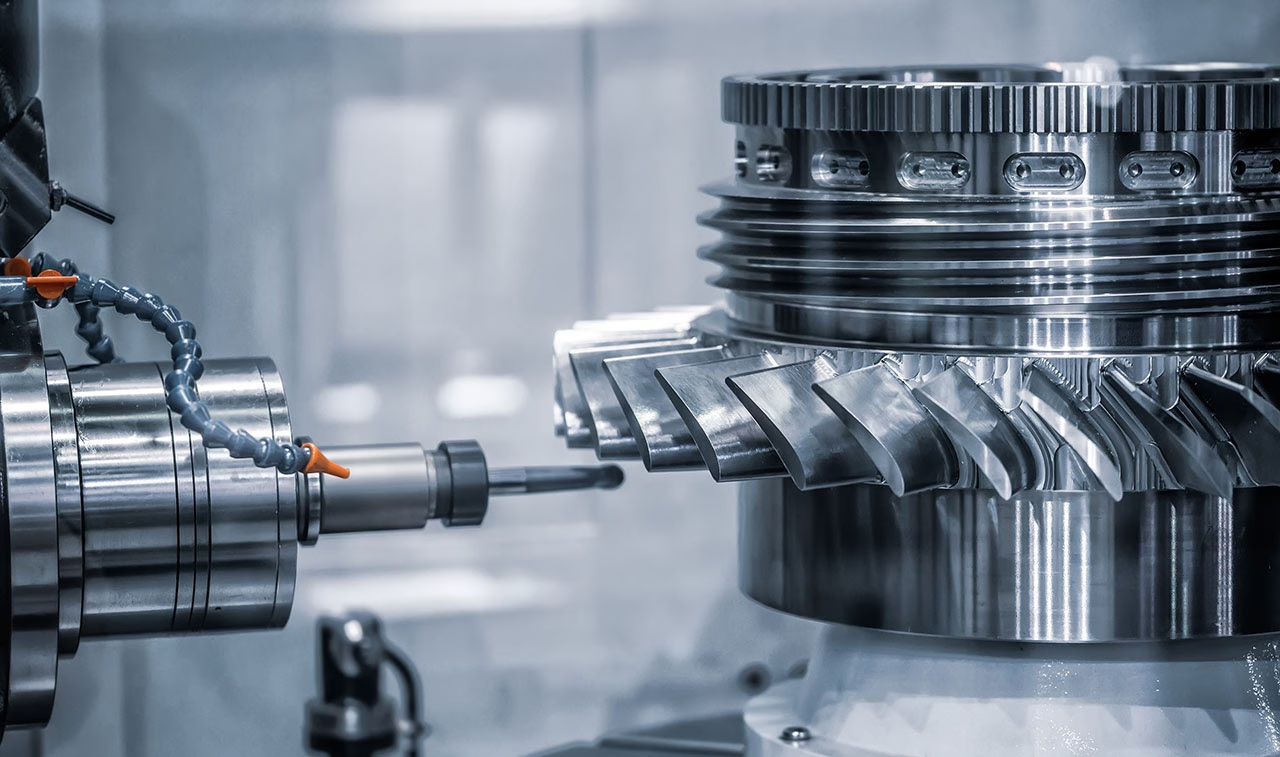
Above 350 HB (38 HRC) a hob or shaper no longer cuts cleanly. Grinding removes the hardened stock in small increments and puts the involute back where the drawing says it should be.
We run both families. Form grinding dresses the involute into a disc wheel and grinds both flanks of one tooth space at once, which suits fine pitch and tight batches. Generation grinding uses a straight-sided wheel and rolls the work against it, so the wheel stays simple and the tooth form comes from the machine motion.
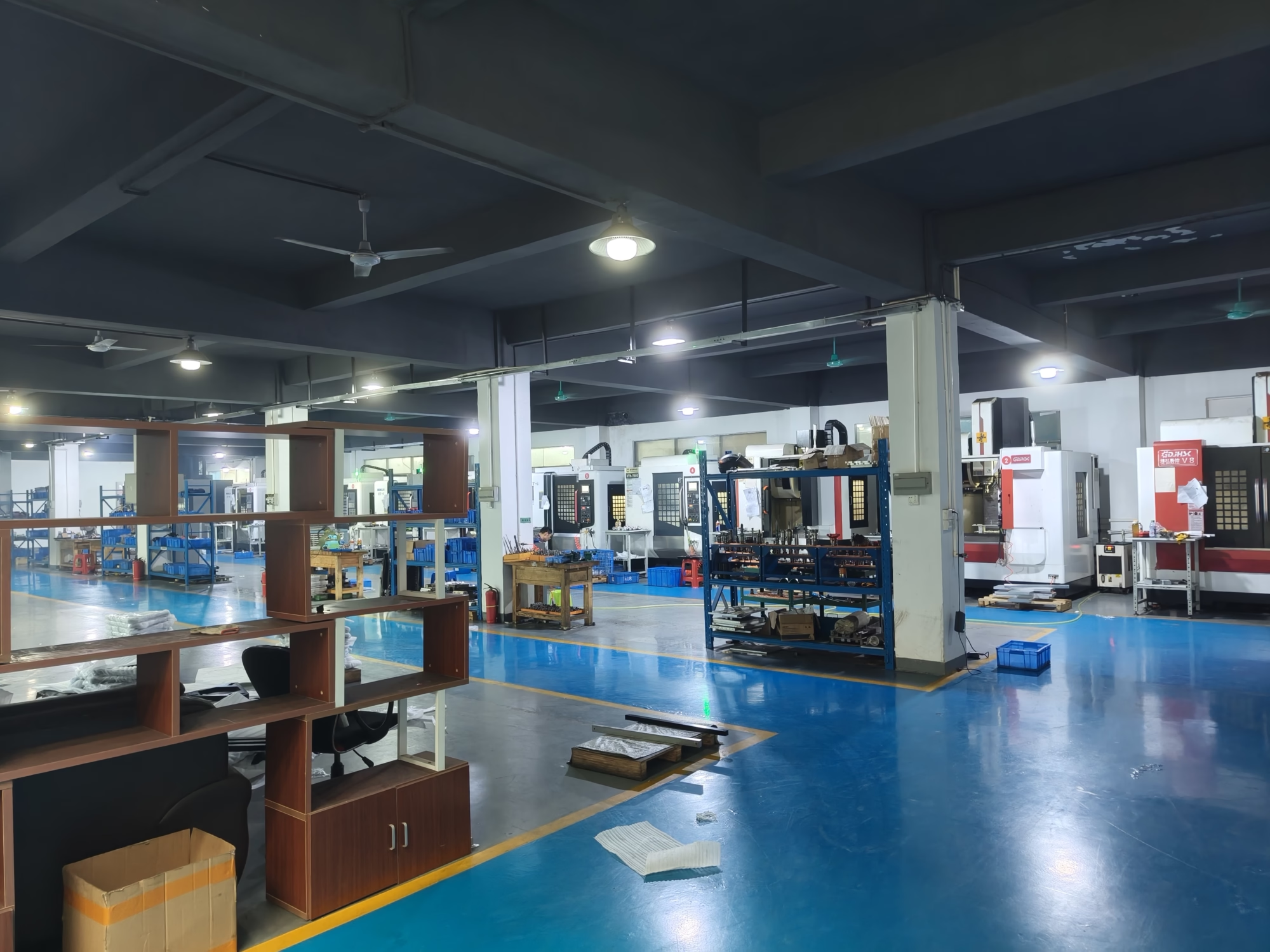
Lapping is a mating process, not a one-part process. The two gears run together in mesh while a fine abrasive compound is fed under pressure into the contact. A few micrometres come off the flanks where they actually touch.
That is why lapped gears must stay a set. Ship them as a pair, install them as a pair, and replace them as a pair. Split the set and the contact pattern you paid for is gone.
We use it where the requirement is quiet running, not where the requirement is a number on a drawing.
Read down the column that matches your gear, not the column that sounds better.
| Condition | Grinding | Lapping |
|---|---|---|
| Hardness above 350 HB (38 HRC) | Yes, this is the normal route | Only after grinding |
| Soft teeth, under 38 HRC | Possible but rarely economical | Not recommended |
| Fine pitch, small module | Form grinding works well | Feasible on small pairs |
| Profile and lead correction | Corrects both | Does not correct form |
| Noise is the main complaint | Improves it | The reason to choose it |
| Spare parts replaced singly | Fine, each gear stands alone | Poor fit, set must stay together |
| Inspection load | MPI and macroetch often requested | Contact pattern check |
| Cost per part | Higher, small increments | Lower stock removal |
Gear teeth are one feature. Most parts also need a bore, a face, a keyway or a housing that has to line up with them.
Bores, hubs and journals turned in the same setup family as the teeth, so the bore-to-pitch-circle runout stays under control.
16 simultaneous 5-axis centers handle gear housings, covers and brackets that carry the shaft centers.
Keyways, splines, flats and oil grooves cut after heat treatment where the drawing allows it.
Bead blasting, black oxide, plating and polishing on the non-tooth surfaces.
100% inspection before shipment. Raw material check, in-process monitoring, final inspection. Reports on request.
No minimum order quantity. One prototype pair or a 10,000+ part run, same process route.
Numbers below are what we work to on gear and shaft parts, not a general catalog claim.
| Item | Capability |
|---|---|
| Positional tolerance | ±0.005 mm (±0.0002 in) |
| Lapped flank finish | Ra 0.2–0.8 μm |
| Ground flank finish | Ra 0.8–1.6 μm |
| Maximum part size | 4,000 mm |
| Large travel | 4,000 × 400 × 150 mm |
| Rotary table | Ø400 mm |
| Materials | 1018, 1045, 4140, 4340, 17-4PH, 420, 440C, tool steel |
| Batch size | 1 pc to 10,000+ pcs |
| Lead time | Parts ship in 3–5 days |
| Inspection | 100% before shipment |
Founded in 2011. Three wholly-owned plants, 7,600 m² of floor, 150 technicians. Gear and shaft work has been part of that the whole time.
16 simultaneous 5-axis centers, 12 four-axis mills, 27 three-axis machines and 16 mill-turn centers. Turning and tooth work stay in the same plant.
Stated in millimetres, not as a range. If your drawing needs more, say so early and we will tell you before the quote.
Drawings and 3D files reviewed within 12 hours. We flag an unrealistic profile callout before you commit to tooling.
Once the process route is agreed, production can start within 24 hours. No waiting on a batch to fill.
Measured across shipped orders. 100% inspection before shipment, with reports on request.
Gear whine shows up at highway speed. Lapped pairs and ground flanks cut mesh noise on hardened transmission and drive parts.
Reducers and index drives run for years. We hold profile and lead so the contact pattern stays across the face width.
Harmonic and planetary stages need low backlash. Ground teeth plus turned bores keep the runout inside the assembly budget.
Choose lapping when the pair has to run quietly and the teeth are already at final hardness. It removes a few micrometres from the contact area and improves how the two gears sit together.
Choose grinding when the tooth form itself is out of tolerance, or when the part has never been finished after heat treatment. Lapping will not correct profile or lead.
No. Lapping matches two specific gears to each other, so the contact pattern belongs to that pair. Replace one member alone and the new gear has to break in against a flank shaped for its old partner.
We mark both gears with the same set number before packing. Order them as a pair and install them as a pair.
Above 350 HB, which is about 38 HRC, cutting tools stop removing material cleanly. The hob or shaper starts to rub and burn instead of cut.
That is the point where grinding becomes the normal route. Below that hardness you can often cut to final size and skip the grinding step.
Form grinding uses a disc wheel with the involute dressed into its side, and grinds both flanks of a tooth space at once. It suits fine pitch gears and small batches.
Generation grinding uses a straight-sided wheel. The tooth form comes from the rolling motion between wheel and work, so the wheel stays simple and stays true longer.
Yes. Grinding removes material in small increments, so it takes more machine time per part than cutting. Ground gears also attract more inspection, often magnetic particle inspection and macroetching.
The trade is that you get a hardened tooth at final form. If the part does not need that, cutting is the cheaper route.
Send the drawing or 3D file with module, tooth count, pressure angle, helix angle, material and hardness callout. If you have a mating gear, send that too.
We return a quotation and a free DFM analysis within 12 hours. Any profile or lead callout we cannot hold gets flagged at that stage.
Uploads are secure and confidential. We can sign an NDA before you send drawings, and our quality system is certified to ISO 27001:2022.
If your program needs it, ask for the NDA first and send files after it is signed.
There is no minimum order quantity. One prototype pair and a 10,000+ part run go through the same process route.
For prototypes we may recommend a different finishing step, but the tolerance and inspection standard do not change.
Tell us the module, hardness and whether the pair runs together. We will come back with a process route and a quote.
12-hour quote100% inspectionNo minimum order quantityNDA on request
Trusted by engineers and manufacturers worldwide










Upload your 3D model or 2D drawing and get a quotation with a free DFM analysis. Maximum processing size 4,000 mm.
CNC Metals 13 grades
CNC Plastics 10 grades
Machines & processes 12 options
Surface & post-processing 10 options
Material: not selected Machine: not selected Post-process: not selected
Fill in this short form and we'll open WhatsApp with your message ready to send. We only use these details to reply to you.
Nothing is sent until you press send inside WhatsApp.