
How Many Type of CNC Machine? A Practical Guide
This page is for engineers and buyers who need to pick a machine type before quoting a part. It walks through the seven machine categories we run, the axis count behind each one, and the geometric features that decide which type of CNC machine a job actually needs.
In this article
- 1
- 2
- 3
- 4
- 5
- 6
- 7
- 8
Key takeaways
How many type of CNC machine are actually used in production
Ask five shops how many type of CNC machine exist and you will get five answers, because the counting rule changes. Trade schools count by control platform. Job shops count by spindle orientation. For quoting work, the useful count is seven: 3-axis vertical mills, 4-axis mills, 5-axis simultaneous centers, turning lathes, mill-turn centers, wire EDM, and abrasive waterjet.
Each one removes material in a different way, and that changes what geometry is cheap and what geometry is expensive. A pocket with a fillet at the bottom is simple on a 3-axis mill with a ball nose tool. The same pocket with a 20° undercut wall needs either a 5-axis tool path or a custom angled fixture. Same drawing, different machine, different cost.
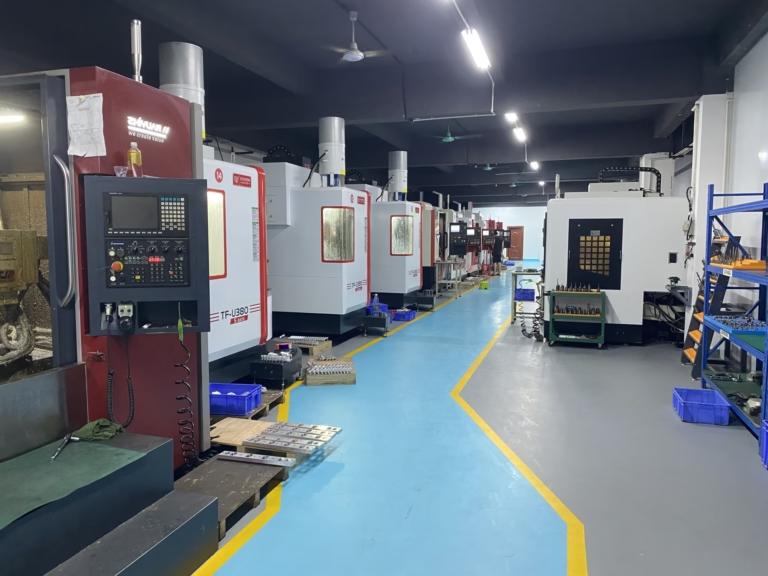
We run 127 high-precision CNC machines across three plants in Dongguan and Singapore. That mix is not random. It reflects which categories carry the load in prototype and low-volume production: 27 three-axis machines, 12 four-axis mills, 16 simultaneous 5-axis centers, and 16 mill-turn centers, with the balance covering turning and finishing equipment.
- 1Count by motionSpindle orientation plus number of controlled axes is the only count that maps to part geometry.
- 2Count by envelopeTwo machines with the same axis count can differ by 3,000 mm of travel.
3-axis, 4-axis and 5-axis mills: what each one can reach
A 3-axis mill moves X, Y and Z while the tool spins. The part stays fixed. This is still the most common type of CNC machine in the world, and for good reason: it is rigid, fast to set up, and simple to program. Prismatic parts with features on one face, or on faces you can reach by flipping the part in a vise, belong here. Plate work, brackets, housings, heat sinks and fixture plates are typical.
Add a fourth axis and the part rotates around X or Y, usually on a rotary table. Now you can cut four faces in one setup without re-clamping. That matters when the datum matters. Re-clamping a part three times stacks three position errors. A single 4-axis setup keeps one datum for the whole job. Cross-holes, keyways, and slots on multiple faces of a shaft are classic 4-axis work.
A 5-axis machine adds two rotary axes on top of the three linear ones. In a simultaneous 5-axis center, all five move at once, so the tool tip can follow a curved surface at a constant angle. Impellers, turbine blades, deep cavities with undercuts, and contoured medical implants are the parts that justify it. If your geometry can be reached by a 3-axis tool pointing straight down, 5-axis adds cost without adding value.
- 13-axis envelopeUp to 4,000 × 400 × 150 mm on our large travel machines.
- 25-axis envelope500 × 500 × 450 mm and 600 × 600 × 600 mm with a Ø400 mm rotary table.
- 3Setup countEach extra clamp is a new chance for a 0.01 mm datum shift.
Lathes and mill-turn centers for round parts
On a lathe the workpiece spins and the tool stays still. That single change makes round parts dramatically faster to produce than on any mill. A Ø30 mm shaft with a shoulder, a thread and a groove takes minutes on a lathe and much longer on a mill that has to orbit around the part. Anything that is rotationally symmetric is lathe work by default: pins, bushings, spacers, valve bodies, connectors.
A mill-turn center combines both motions. It has a turning spindle and live tooling, so rotating tools can cut flats, cross-holes, axial slots and keyways while the part is still gripped. Some of our mill-turn centers carry a secondary spindle, which means the back of the part can be machined without a second operation. This done-in-one approach is where turned parts with milled features get their accuracy.
The trade-off is programming time and setup time. A mill-turn job with a complex tool path takes longer to prove out than a two-operation job on separate machines. For a one-off part with a single cross-hole, splitting the work is often faster. For a 500-piece run of a hydraulic fitting with six cross-ports, keeping it in one spindle wins on both cost and concentricity.
- 1ConcentricityOne-spindle machining removes the second-op runout error.
- 2Bar stockLathes and mill-turn centers work well from bar; mills need pre-cut blanks.
EDM and waterjet: the two types that do not cut with a tool edge
Wire EDM erodes metal with a spark between a thin wire and the part, submerged in deionized water. Because there is no cutting force, it can machine hardened tool steel at 60 HRC after heat treatment, which avoids the distortion that milling a hardened part would cause. It also cuts sharp internal corners that no end mill can produce, since the wire has no radius to leave behind. Square inside corners are a wire EDM signature.
The limits are real. Wire EDM is slow compared to milling, it cuts through the part thickness only in the Z direction unless you tilt the head, and it needs a conductive material. It is also a through-cut process, so it cannot make a blind pocket. Use it for punch dies, extrusion dies, gears, and fine slots in hardened stock.
Abrasive waterjet cuts with a high-pressure stream of water and garnet abrasive. It handles almost any material including titanium, Inconel, glass and composites, and it does not create a heat-affected zone, which matters for aerospace alloys. The cut edge has a slight taper and a rougher finish than milling, so waterjet is usually a blanking step followed by a finish pass on a mill or lathe. It is the fastest way to get a 4,000 mm plate down to near-net shape.
- 1Wire EDMHardened steel, sharp internal corners, no cutting force.
- 2WaterjetNo heat-affected zone, any hardness, taper on thick sections.
Where engineers pick the wrong machine type
The most frequent error is specifying 5-axis for a part that has no undercut. If every feature can be reached from one direction, a 3-axis mill will do the job with a simpler setup and a lower hourly rate. Axis count is a capability, not a badge. We see this on brackets and housings where the only reason for 5-axis was a vague assumption about complexity.
The second error runs the other way: forcing a 5-axis part onto a 3-axis machine with a custom angle plate. That works once, then the fixture wears, the operator re-shims it, and the third batch drifts out of tolerance. If the geometry needs two rotary axes, it needs them in the machine, not in a fixture.
A third mistake is ignoring wall thickness. A 0.8 mm aluminium wall will deflect under cutting force no matter how many axes the machine has. In that case the fix is not a different machine type, it is a different strategy: lighter depth of cut, more finishing passes, and a support material or fixture on the back side. Sometimes the answer is a redesign to 1.5 mm.
- 1Over-specifying axesAdds cost with no geometry benefit.
- 2Under-specifying axesPushes error into fixtures that wear over time.
Step by step: how to choose the right type of CNC machine for a part
- 1Step 1 — List the features and their directionsWrite down every machined feature and the direction its tool must approach from. Holes on +X, +Y and +Z faces are three directions. A slot on the underside is a fourth. This list decides your minimum axis count before you look at tolerance.
- 2Step 2 — Check rotational symmetryIf the part is mainly a body of revolution, start with a lathe or mill-turn center. A shaft with a 0.02 mm concentricity callout between two diameters is lathe work. Moving it to a mill adds fixture error for no gain.
- 3Step 3 — Measure the bounding boxCompare the part size to machine travel. Our large mills cover 4,000 × 400 × 150 mm; compact cells cover 500 × 310 × 200 mm. A part that fits a small envelope costs less per hour, so do not book a big machine for a 200 mm bracket.
- 4Step 4 — Match tolerance to process capabilityWe hold ±0.005 mm on critical features, with surface finish from Ra 0.2–0.8 μm on fine work and Ra 1.6–3.2 μm as-machined. Do not put a ±0.005 mm callout on a feature that only needs clearance. It raises inspection time and scrap risk.
- 5Step 5 — Count the setupsEvery re-clamp can shift the datum by 0.005–0.02 mm. If the print has tight relationships between features on different faces, move to 4-axis or 5-axis to keep one datum. If not, multiple 3-axis setups are cheaper.
- 6Step 6 — Decide on heat treatment timingIf the part is hardened after machining, plan the sequence. Rough mill with 0.3–0.5 mm stock, heat treat, then finish by grinding or wire EDM. Finishing a hardened part on a mill is slow and wears tools.
- 7Step 7 — Confirm with a DFM reviewSend the model and we return a quotation plus a free DFM analysis within 12 hours. We flag features that force a machine change, and production can start within 24 hours of approval.
Comparison of CNC machine types by part geometry
Use this to shortlist a process before quoting.
| Machine type | Best for | Typical limit | Watch out for |
|---|---|---|---|
| 3-axis mill | Prismatic parts, one-face features | ±0.02 mm on rigid setups | Multiple re-clamps shift datums |
| 4-axis mill | Shafts, multi-face slots, cross-holes | One rotary axis only | Rotary table runout adds error |
| 5-axis center | Undercuts, impellers, contoured surfaces | ±0.005 mm on critical features | Thin walls flex under point contact |
| CNC lathe | Round parts, threads, grooves | Bar diameter and length limits | Milled flats need a second op |
| Mill-turn center | Turned parts with milled features | Done in one spindle | Longer prove-out on complex paths |
| Wire EDM | Hardened steel, sharp inside corners | Through-cuts only | Slow material removal rate |
| Waterjet | Plate blanking, any hardness | Slight edge taper | Rough edge needs a finish pass |
Pick the machine from the geometry, not from the spec sheet
If every feature is reachable from one direction, a 3-axis mill is the right answer. If the part has undercuts or free-form surfaces, 5-axis earns its cost. For round parts with milled features, mill-turn keeps one datum and removes a second operation.
Questions engineers ask about machine types
Does a 5-axis machine always hold tighter tolerance than a 3-axis machine?
No. Tolerance comes from stiffness, thermal stability, tool condition and setup, not from axis count. A well-set 3-axis mill can hold ±0.005 mm on a flat, rigid plate.
A 5-axis machine cutting a thin-wall part with a long reach tool can do worse, because the rotary axes add stack-up and the tool deflects. Match the process to the geometry, then check the tolerance claim.
Which machine type should I choose for a part under 50 mm with tight features?
Small parts usually run best on compact 3-axis or 4-axis cells with high spindle speeds. Our compact envelopes cover 500 × 310 × 200 mm, which is plenty for a 50 mm part.
The exception is a small part with an undercut or a curved surface. Then a 5-axis center with a Ø400 mm rotary table gives better tool access.
Can a mill-turn center replace both a lathe and a mill?
For many parts, yes. If the part is turned and needs flats, cross-holes or keyways, a mill-turn center with live tooling completes it in one spindle.
For a simple shaft with no milled features, a plain lathe is faster and cheaper per part. For a complex milled pocket on a rectangular block, a mill is better. Mill-turn sits in the middle.
When is wire EDM worth the slower cycle time?
When the material is already hardened, when internal corners must be sharp, or when the part is too thin for cutting force. Punch dies and extrusion dies are the textbook cases.
If the part is soft and has no sharp internal corners, milling is faster and cheaper. Wire EDM is a targeted tool, not a general one.
How do I know if my part fits your machine envelope?
Send the STEP file and the bounding box. We check travel, fixture space and tool access, then confirm the machine type in the quotation.
Remember that the part must fit with the fixture, not just on its own. A 4,000 mm part needs clearance for clamping at both ends.
Do you handle hard materials like Inconel and titanium?
Yes. We machine TA1, TA2, TC4 (Ti-6Al-4V), Inconel and magnesium alloys, along with 6061, 7075, 17-4PH and hardened tool steels.
Hard alloys run at lower cutting speeds and need more tool changes, so expect a higher hourly rate than aluminium. The DFM review will call this out before you commit.
Send the model and get a machine recommendation
Upload a STEP file and we return a quotation with a free DFM analysis within 12 hours, including the machine type we would run and why.
12-hour quote100% inspectionNo MOQNDA on request
More machining notes
We publish setup notes, tooling trials and inspection data from the factory floor.











